





Hardgainers, Genetic Monsters and You - Part 2
 Author: Šárka Randáčková
 There are 7 basic somatotypes. A hardgainer is someone who genetically doesn't build muscle easily. A genetic monster is the opposite. Such a person builds muscle with seemingly minimal effort.
Hardgainers definitely exist, but the term is overused. Everyone has a different genetic disposition for building muscle, but a true hardgainer is more of a rarity. The reality is that lack of improvement is usually due to factors other than genetic predisposition.
Let's take a look at those factors. But first, let's define a true hardgainer and see how many really exist.
Last episode was dedicated to the seven basic somatotypes, and we looked at the first three growth-limiting factors.

4. Not training hard enough
Everyone likes to think they train hard, but supposed hardgainers might not quite have it that way. Most of them compensate for their lack of intensity by training too much.
I'm not saying you have to go beyond failure in every set, but you do need to train hard. This may mean more reps with the same weight, more weight for the same number of reps, or the same pattern of sets and reps but shorter breaks.
You want to be better each time you go to the gym than you were the week before. Not more work, BE BETTER! Sometimes you may not make it, but you should always try.

You don't always have to go all the way to failure to train hard. It's a good tool, but it can also shake you out if you use it too often or on the wrong exercises.
When to train to failure?
- Using a medium to high repetition count on the last set of isolation exercises.
- For lower repetitions (5 or less) on basic exercises, failure will not give you better results than stopping 1-2 reps before it. Without failure, you will improve without burnout.

5. Too much training
This is the deadly sin of most people who think they are hardgainers. If the muscles aren't coming up fast enough, the natural reflex is to add work.
Volume of work does affect growth, but it's not as crucial as other variables like mechanical load, working hard in sets, and improving. Moreover, more volume of work usually leads to lower intensity sets.
It also flushes out more cortisol and fatigues the nervous system. The former directly limits muscle formation, the latter reduces muscle fiber engagement.
If you train hard and try to improve in every workout, it will be very hard not to gain weight.
Another form of excess? Too frequent workouts. Yes, I've written programs where you train 6 times a week, but those have minimal work volume, 3-5 work sets per workout.
The magic number is 4 workouts a week. More rest will give you more recovery and time to grow. Plus, you'll be able to give it your best every workout.

6. Too much stress
Any stress will raise your cortisol and adrenaline levels. Cortisol, and especially its chronically high levels, will damage your capacity to build muscle by:
- Increased muscle breakdown.
- Potential reduction in testosterone levels. Both cortisol and testosterone are made by pregnenolone. If cortisol occupies it, there is no testosterone left to make.
- Increased myostatin secretion. The latter limits how much muscle your body will allow you to build.
- Reduced glycogen recovery in the muscles.
If adrenaline levels are elevated constantly, it can lead to burnout by numbing beta-andrenergic receptors and depleting noradrenaline and dopamine.

Do you have unrealistic expectations?
If you expect 10 pounds of muscle in 3 months, and you only gain 2 (which is excellent), you probably see that as a failure and 7 pounds you didn't gain.
How much can the average person gain?
- Intermediate: 0.5 - 1.0% for men and 0.25 - 0.5% for women.
- A beginner can gain (it's a % of body weight) per month: 1.0 - 1.5% for men and 0.5 - 0.75% for women.
- Advanced: 0.25 - 0.5% for men and 0.12 - 0.25% for women.
- The very advanced will gain muscle incredibly slowly. Unless they are gaining muscle that they have lost in the past.
The exact percentages can vary a bit, but the upper limit is a lot lower than what people usually think.
I don't want to disillusion you. I'm just trying to set realistic expectations. Your program and diet may be working great, but if you were expecting three times faster results, you may be looking at your program too critically or making poor decisions.
Recommended
Czech Virus Melatonin

Czech Virus Magnesium Bisglycinate

Nebbia Slim fit legíny s kapsami SLEEK 482
Amix ThermoCore 2.0
6 Things that will help you grow
The good news is that being a true hardgainer is very hard. You probably just have unrealistic expectations, or you're hurting yourself in some way.
Make sure you...
- You have a caloric surplus. The less genetically gifted you are, the higher it must be, especially from carbs (if you have enough protein).
- Aim for 2 grams of protein per kilo of body weight. This will ensure you have enough for optimal muscle building. Larger amounts will not give you faster growth. Instead, add on carbohydrates instead.
- Aim for 8 hours of quality sleep each night. You can survive the occasional seven, but eight is optimal. More sugars at the end of the day can help with sleep by lowering cortisol and adrenaline levels.
- You should constantly strive for improvement in your training. Think higher weight on at least some of the exercises. Or it could be more reps with the same weight, shorter breaks or better technique.
- Don't overdo the volume of work. When in doubt, opt for less work but harder, not more work.
- Don't train more than 4 hard workouts per week. This will keep your cortisol and adrenaline levels in check. You will also be fresher and more capable of working harder on training days.
So what if I really am a hardgainer?
It's unlikely, but possible. You can still hope for some muscle (only 1% of the population doesn't respond). But I'm not going to lie. Without steroids, you won't become a fitness model, even if you've been working out all your life. However, there are still things you can do to maximize your chances.
First, you need more rest than most people. So you should exercise 2-3 times a week:
- Monday: lower body
- Wednesday: upper body
- Friday: full body
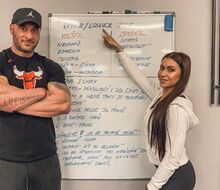
You should choose a lower volume of work, 3-4 exercises in one workout and 1-3 work sets depending on how you recover.
Two styles of training will be effective. Ironically, they are the opposite.
- Heavy training. Hardgainers build strength faster than mass. Therefore, heavy training keeps them motivated and muscle tone. Both of these are heavily dependent on the activation and efficiency of the nervous system.
- Lactate training. This is about fatigue accumulation. It is necessary to make the series last 40-70 seconds. Methods such as blood flow restriction can also be interesting.
Do lactate training on Mondays and Wednesdays and leave the heavy training for Fridays (2-5 reps and 3-4 exercises in one workout).
Source: www.t-nation.com - The 7 Types of Muscle Gainers
Author.
Author: Šárka Randáčková No posts have been made yet.








