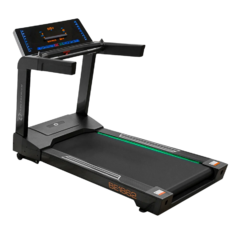
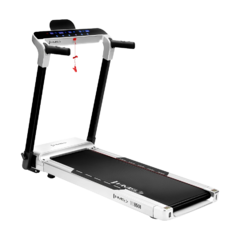
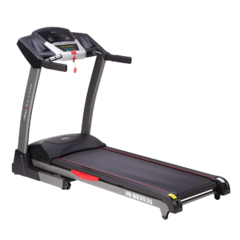
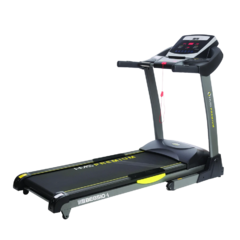
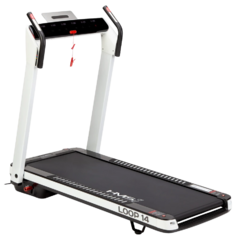
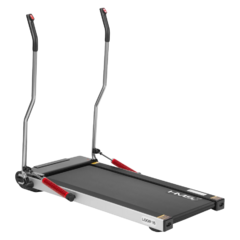
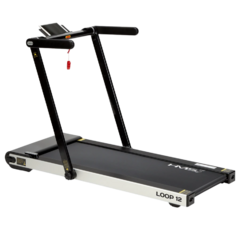
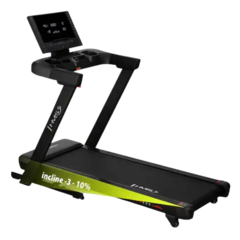
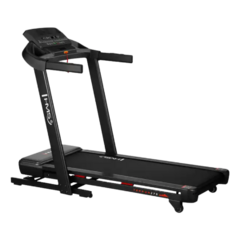
Choosing the right treadmill is important for achieving your training goals and having a comfortable workout. Here's a guide to help you choose the best treadmill for your needs:
Available space: measure the area where you intend to place the treadmill. Consider the length, width and height to ensure there is enough space for a comfortable and safe workout.
Type of treadmill: There are two main types of treadmills:
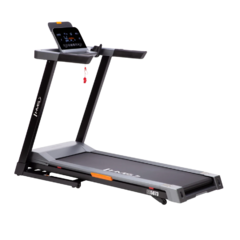
Folding: ideal for limited spaces, they can be folded after a workout.
Non-folding: They tend to be more stable and usually offer a larger running surface.
Treadmill area: Choose a treadmill with a large enough running surface. Ideal dimensions are around 140 cm in length and 50 cm in width. A larger area will provide a more comfortable space for running.
Motor power: Motor power will affect the smoothness and strength of the treadmill. For home use, a motor with around 1.5 - 2.5 horsepower will be sufficient.
Maximum speed: Check the maximum speed the treadmill can reach. For most users, a speed between 10 and 16 km/h will be sufficient.
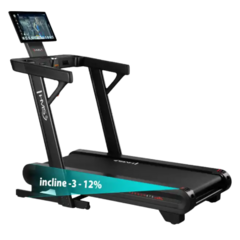
Incline and terrain simulation: Some treadmills allow you to adjust the incline, which can make your workout more challenging. If you are interested in simulating inclines, choose a treadmill with this feature.
Shock absorption and cushioning: Quality treadmills have shock absorption systems that save joints and reduce the risk of injury.
Features and Options:
Pulsometer: Integrated sensor or compatibility with a chest belt to monitor heart rate.
Preset Programs.
Display and connectivity.
Reviews and Brand: Read user reviews of the treadmill before purchasing to see how a particular brand is known for quality and reliability.
Budget. Quality treadmills can be an investment, but it's not always necessary to buy the most expensive model. The important thing is to strike a balance between quality and price.
Warranty and service: Make sure the treadmill has a sufficient warranty and that service is readily available if repairs are needed.
Testing: If possible, test the treadmill in person at a store or fitness center to see how it performs when you run.
Remember that choosing a treadmill depends on your individual needs, goals and preferences. Thorough research and comparison will help you find the ideal model for your training requirements.
Frequently Asked Questions
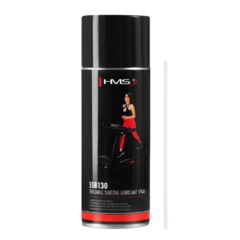
The absolute baseline of treadmill maintenance is regularly lubricating the running belt. You must periodically (depending on how often you run) apply a special silicone lubricant between the moving belt and the solid deck underneath. If the belt runs dry, it creates immense friction that overloads the motor and the control board, which can lead to irreversible damage.
Yes, the vast majority of modern home treadmills feature a foldable running deck. Using a hydraulic assist shock (which helps bear the weight), you simply lift the running deck into a vertical position. The treadmill then takes up about a third of its original footprint, and thanks to integrated transport wheels, you can easily move it around the room.
Motor power (measured in HP – horsepower) is absolutely crucial. If you plan to use the treadmill strictly for walking, a 1.5 to 2 HP motor is sufficient. However, for regular and fast running, or for users with a higher body weight (over 90 kg), you must absolutely choose a stronger motor with a continuous duty rating of at least 3 HP. Otherwise, a weak motor will struggle, overheat, and fail prematurely.
Quite the opposite! High-quality home treadmills feature an integrated cushioning system (often based on rubber elastomers or air shock absorbers) that reliably absorbs a massive portion of the impact energy. Running on a good treadmill is therefore significantly gentler on your joints, back, and ligaments compared to the hard impact of running on outdoor asphalt or concrete.
For home training and standard running, we definitively recommend a motorized treadmill. Manual (magnetic) treadmills are better suited for walking, as you have to propel the belt with your own leg power, which is very uncomfortable for a smooth run. The only exceptions are the highly expensive, professional curved manual treadmills used for CrossFit and HIIT workouts.