





What is the best split of the workout? Push-ups, pull-ups and leg curls!
 Author: Šárka Randáčková
 There are too many variables in life to say unequivocally that any program is good or bad for anyone. However, if you're talking to advanced athletes, one principle persists.
It's the thing you can turn to when all else fails. It may be a hackneyed phrase, but we're going to talk about getting back to your roots, a program broken down into pushes, pulls and legs.
This is centering training for me. It's boring, yet functional.
A few details:
- In one workout of the week, you train the pressing muscles: chest, shoulders, and triceps.
- In the second workout, you work the pulling muscles: back and biceps.
- In the third, you work the lower body.
- You repeat the whole thing as often as you see fit.
3 Reasons why we divide our workouts like this
1 - It minimizes overlap between exercises.
For example, in regular splits you train the triceps much more often than the other muscles because you engage them when you train your chest, shoulders and arms. Here, you'll do everything in one workout.
You can argue that working the same muscles in several workouts a week is good. And it can be, if you know how to work with volume.
But with this split, allow your pressing muscles a little stretch under load when you do deadlifts, for example, which can be good for their recovery.
If you want to stimulate the pressure muscles again in a given week, add another pressure workout.
Plus, for example, chest training works as a warm-up for your shoulders. The front shoulders get a lot of work when you work the chest. Then you can work the rest of your shoulders a little more locally and in isolation.
Since we're not limited by the overlap between exercises, it's easier to work with local and systemic recovery. We simply work at a higher training frequency and one unit will be with a higherweight while the other will be with a lower weight.
For example, you can train your legs with a heavier workout focused on mechanical tension and one lighter workout focused on metabolic load. The latter is also excellent if you want to train for vomiting.
2 - You can prioritize muscle groups and weak areas.
With minimal overlap, this split is ideal for prioritizing weaker areas. Let's say you want to improve your shoulders. In a pressure workout, you can put one exercise on your chest and then crazy volume on your shoulders. This is what it would look like:
Chest
- Single arm presses: 2 working sets of 8-10 reps, no failure
Shoulders
- Overhead presses: Use the 350 method (aim for a total of 50 reps in 3 working sets with the same weight).
- Use the pyramid. Practice 25 reps with light single-arm dumbbells, then get heavier ones and do 15 reps, then 10 with even heavier ones. After 3 minutes of rest, pick up the medium one-handers again and do 15 reps. Finish with 20 reps with the lightest one-handers.
- Rear Delt Prone Dumbbell Swing: 4 sets of 25 reps
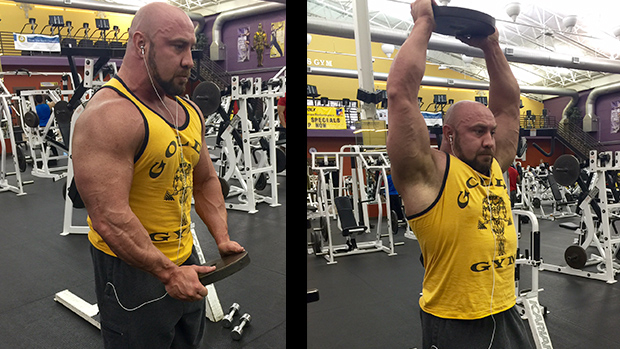
- Discus Front Squat: 100 reps without a break
Triceps
- Pulley Press: 2 sets of 25 reps
So you only do 2 sets on the chest, then something crazy on the shoulders, and then 2 sets on the triceps again. You'd do something similar again in the same week, but with different exercises.
Remember, two things are important for a lagging group. Build the neuromuscular connection and exercise the muscles at different levels of shortening!
3 - You can set training goals.
Let's say you want to strengthen your legs and sculpt. For this, it's good to alternate between heavy leg training and training with a higher metabolic load. The first workout will be lower volume and higher intensity, the second will be medium volume, low intensity, but the effort will be very high.
It would be roughly the equivalent of a nightmare:
Legs 1
| Exercise | Series | Repetition | |
|---|---|---|---|
|
A |
Burying |
4 |
10-12 |
|
B |
Squats 85% |
3 |
6 |
|
C |
Deadlift with legs extended from deficit (1 heavy three/easier 12 reps) |
1/1 |
3/12 |
Legs 2
| Exercise | Series | Repetition | |
|---|---|---|---|
|
A1 |
Pre-kicking |
3 |
20 |
|
A2 |
Leg press |
3 |
20 |
|
B1 |
Stumbling (5 seconds of lowering) |
3 |
10 |
|
B2 |
Good morning (5 seconds of triggering) |
3 |
10 |
|
C |
Lunge walk |
1 |
500/each leg |
Then try not to cry. You're probably not gonna make it.

Frequency factor - this is a workout for every goal
The examples above are not set in stone. Modify your workout according to your goals and schedule.
Let's look at frequency so you can pick what works for you.
Frequency: 3 workouts per week
- Monday: chest, shoulders, triceps
- Wednesday: back, biceps
- Friday: legs
This was my base when I did the triathlon. I did bench and supplementsone day, squats and deadlifts the next, then their supplements the third workout.
I had a little bit of leg work in my back and biceps workout (usually front kick and stumble), but my back and biceps were the main focus. I didn't make it complicated. And you shouldn't either.
My basic exercises were pulldown pulleys, dips, and pull-ups. That's what it usually looked like. It's just a sketch. I varied the workout depending on what I wanted to focus on.

Monday
| Exercise | Series | Repetition | |
|---|---|---|---|
|
A |
Bench press |
1/*/1 |
|
|
Periodized work, one lower than maximum, several lighter sets of 6-8 reps and maximum reps in one set |
|||
|
B |
One-arm bench press on positive bench |
2 |
8-10 |
|
C |
Overhead presses (1 heavy five and 1 set for max reps) |
1/1 |
5/MAX |
|
D |
Triceps exercise (Different in each workout) |
||
Wednesday
| Exercise | Series | Repetition | |
|---|---|---|---|
|
A |
Squats (Periodized work) |
||
|
B |
Squats with break |
2 |
5 |
|
C |
Deadlifts (Periodized work) |
||
|
D |
Deadlift with legs outstretched from deficit |
2 |
3-5 |
Friday
| Exercise | Series | Repetition | |
|---|---|---|---|
|
A1 |
Pre-kicking |
2-3 |
10-12 |
|
A2 |
Burying |
2-3 |
10-12 |
|
B |
Pulling down the upper pulley |
2-3 |
10-12 |
|
C |
Pull-ups with chest support (to spare the lower back) |
2-3 |
10-12 |
|
D |
Stumbling variations (or 100 reps without a break) |
2-3 |
20+ |
Benefits
- Great for strength athletes.
- Virtually impossible to overtrain.
- Ideal for people who can't get to the gym 4-6 times a week.
Disadvantages
- If you're all about volume, you have to do a lot of work in each workout because the frequency is not optimal.
- Does not allow for specialization in terms of frequency.
- No room for error and bad workouts. You have one attempt at one workout each week.
Recommended
Czech Virus Day Starter
Czech Virus SuperVita PRO 2.0
Nebbia Dámské tvarující push-up legíny INTENSE Heart-Shaped 843

Czech Virus Vitamin D3
Frequency: 4 training sessions per week
The ideal workout here is 2 days training, 1 day off, 2 days training, 2 days off. Ideally Monday, Tuesday, Thursday and Friday. You will rotate the split back in one week, so one part will be trained twice, the others once.
- Monday: chest, shoulders, triceps
- Tuesday: back, biceps
- Wednesday: rest
- Thursday: legs
- Friday: chest, shoulders, triceps (starting over)
- Saturday: rest
- Sunday: rest
I have a much lower volume of work in this workout, so I extend my sets with breaks, weight drops, or giant combinations.
I also liketo alternate between two different workouts so I don't repeat the same day over and over. For example:
Week 1
- Monday: chest, shoulders, triceps (workout 1)
- Tuesday: back, biceps (workout 1)
- Wednesday: rest
- Thursday: legs (workout 1)
- Friday: chest, shoulders, triceps (workout 2)
- Saturday: rest
- Sunday: off
Week 2
- Monday: back, biceps (workout 2)
- Tuesday: legs (workout 2)
- Wednesday: off
- Thursday: chest, shoulders, triceps (workout 1)
- Friday: back, biceps (workout 1)
- Saturday: rest
- Sunday: rest
Benefits
- Increased frequency exercises each area more frequently.
- Increased frequency allows for specialization and focus on weaknesses.
- Great for alternating exercises, which prevents stagnation.
Disadvantages
- Exercises need to be chosen wisely, as leg and back workouts can come out on consecutive days. Definitely don't practice deadlifts before a leg workout.

Frequency: 5-6 workouts per week
I use this split for quick improvements in physique (weight loss and muscle holding). You simply burn more calories than if you work out 4 times a week.
With this frequency , always pay attention to the volume of work and intensity. It's relative and individual, of course, but you need to ease up on both. If you enjoy training at maximum effort, choose a very low volume of work. If you are more comfortable with more work, cut back on the loaded weights
Example - 6 workouts per week
- Monday: back, biceps
- Tuesday: chest, shoulders, triceps
- Wednesday: legs
- Thursday: back, biceps
- Friday: chest, shoulders, triceps
- Saturday: legs
- Sunday: rest
If you want to work out 5 times a week, pick the next day for a day offand continue in the same order after that.
Benefits
- Better weight loss due to frequency.
- Allows for variation and frequent practice of the same exercises.
- Great for people who like to be in the gym often.
Disadvantages
- High frequency limits work volume and intensity.
- Not good for those who want to practice primarily complex exercises.
- For the same amount of work, it won't give you much more muscle growth than training 4 times a week.
- It's not ideal for busy individuals.
Exercise according to your goals
- For strength, training 3 times a week works best.
- For building mass, 4x a week.
- For those who want to improve physique quickly, I recommend training 5-6x per week.
Source: www.t-nation.com - Push-Pull-Legs: The Ultimate Split
By Paul Carter
Author: Šárka Randáčková No posts have been made yet.








