





Optimal frequency and intensity of training
 Author:
 Great question, and like most things in the world of strength and conditioning training, hotly debated. This article attempts to look at it from a slightly more systematic point of view.
Frequency versus intensity
Training programs have two basic variables, frequency and intensity. Frequency determines how often you do something, either the total amount of workouts or a specific movement like the bench press, and is usually given in weekly cycles. The first mentioned will be referred to in this article as the overall frequency, the second mentioned will be referred to as the Frequency of training each area.
Intensity determines the level of difficulty of the workout. For cardio, we use heart rate to measure intensity, but since we're dealing with weight training, we'll use percentage of one repetition maximum (%1RM). While this may sound accurate, it still has some minor cracks. If your max is 365 pounds and you're benching 315, that's 86%1RM, which is commonly considered moderate to high intensity.
But isn't there still something missing that would really determine the intensity of a given set? We need to know how many reps were performed with a given weight. If you put 365 and you get an A with 315, that's a relatively easy series. A three would be harder, but still doable; that sounds like medium intensity to me.
A six with 315 sounds like a hell of an intense series that should be almost as hard as a one with 365.
Because of the aforementioned, I suggest the term total intensity, which combines the percentage of max for a single rep and the number of reps performed with that weight. You would have to know the owl conversion chart to get it perfect. I'll give you one quick conversion chart here to save you some time.
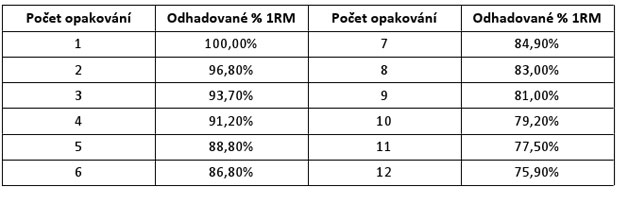
This chart assumes how many reps you should be able to perform with a certain percentage of your max for one rep. It also allows you to calculate your total intensity. Simply take the %1RM you are lifting and calculate how many extra reps you can handle in each set.
You have to lift something once for it to count. So the extra reps is simply the number of complete reps, after you've completed the first one. Once you've counted how many extra reps you've done, go up the appropriate number of levels in the chart (each rep is one level).
Here are some examples.
1RM: 365 pounds
Finished set: 315 x 3 reps
Extra reps: 3 - 1 = 2 extra reps
315/365 = 86% intensity (6RM estimated maximum)
Total intensity (two levels above) = 91.2% intensity
1RM: 365 pounds
Finished set: 315 x 1 repetition
Extra reps: 1 - 1 = 0 extra reps
315/365 = 86% intensity (6RM estimated maximum)
Total intensity (zero levels above) = 86% intensity
1RM: 365 pounds
Finished set: 315 x 6 reps
Extra reps: 6 - 1 = 5 extra reps
315/365 = 86% intensity (6RM estimated maximum)
Total intensity (five levels above) = 100% intensity
Confusion? Post your 1RM and the number of reps you're coming away with in the discussion and we'll help you out.
And why should we even care?
Maybe you're not clear on how all of this affects your training. Let me clarify it for you. We have to balance frequency and intensity. If the frequency is too low, the stimulus won't be enough and the effect of the workout won't be the same. Too low an intensity is simply a waste of time. If the frequency is too high, we increase the risk of chronic injury. It's the same with high intensity, you just have to throw in acute injuries.
In the beginning, everything is simple. Just train 2 - 3 times a week at moderate intensity. You're not used to anything, so you'll respond well to pretty much anything. Usually it's with greater strength that people find that their recovery isn't running fast enough anymore.
They need more volume and intensity to keep their muscles growing, and that added intensity increases the time it takes to recover, forcing the training frequency of each area to drop. But the story doesn't end there, nor should it.
Optimal frequency and intensity
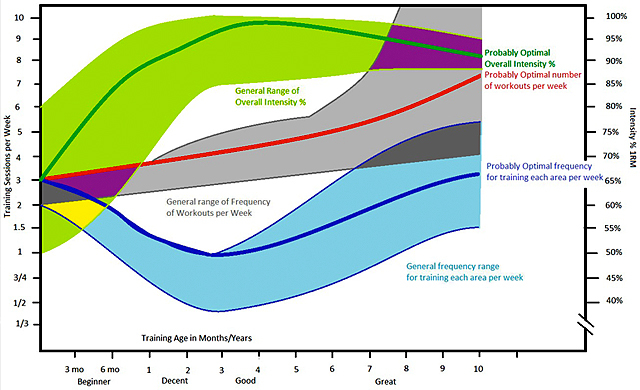
A picture is worth a thousand words. Below you have a chart that shows the optimal overall frequency, training frequency of each area, and overall training intensity over the course of a strength athlete's career. The key points are then broken down.
Key points
- The red line, with the grey shadow, indicates the suggested frequency of workouts that a strength athlete should perform during the week. Note that the curve has an upward slope during the athlete's career.
- The dark blue line, with a light blue shadow, marks the suggested frequency of training each area or movement during the week. Note that the curve declines for the first few years, and then rises later in the career.
- The dark green line, with a light green shadow, marks the suggested total intensity the athlete should achieve in each training unit. Note that it increases steadily for a few years, and then gradually decreases, but remains relatively high throughout the career.
Note: Don't take the timeline as completely binding. The purpose of the chart is to paint a general picture of how things evolve over the training career of a typical strength athlete.
What did the chart teach us?
- When starting a training program, an athlete should train 2-3 times per week, training each muscle area 2-3 times per week (i.e., training the whole body in every workout). The overall intensity should be light (
- After a year or two, hopefully the athlete has reached some of that strength. His or her overall training frequency should stay the same or increase, the frequency of training each area should decrease, and the overall training intensity should continue to increase.
- After a few years and/or reaching decent strength, the overall training frequency should increase to 4-5 training units per week. The training frequency of each area should remain the same or increase, and the overall training intensity should peak.
- When an athlete has been training for many years and/or has reached high strength, the overall training frequency will likely increase (if improvement is still the goal), the training frequency of individual areas should increase, and the overall training intensity will decrease slightly to make way for the higher frequency.
Let's start with the intermediate strength athlete. The chart says he/she should train intensely 3-5 training units per week and it should be a split. It's safe to say that training like this for at least a chunk of your career is a good idea, as such training will improve hypertrophy and teach the athlete to engage type II B muscle fibers.
There is also value in leaving it all out there and performing super-intense sets that will wreck you for days because it improves neuromuscular coordination, fully fatigues and stimulates your muscles, and strengthens your mental and physical side. Such training programs allow you to allocate more time to assisting exercises and generally focus on improving your weaknesses.
However, once an athlete becomes noticeably better (most of you aren't there yet, but hopefully will be), such training ceases to be optimal - at least not on a regular basis - especially if strength is the goal.
As you get better, it becomes easier and easier to outpace your recovery capabilities with training. Such an athlete will probably get better results if he or she takes the intensity down slightly and increases the frequency noticeably to compensate.
The increased frequency will allow the athlete to further improve technique while leaving more room for specific assistance exercises. At this time, general assistance exercises go by the wayside and are only used for balance and injury prevention rather than as a means of improvement.
An athlete in our scenario, for example, may be able to push 315liberos for six reps once a week, but it will be extremely challenging for him and take him out of training for the next few days.It might be better for him to only do it 3-4 times, but repeat that set two, three, even four times a week.
Unfortunately, this won't be the case for a weaker athlete who can do a six with 200, but will instead do it multiple times a week with twos or threes. Such an athlete is probably leaving most of his muscles untouched and needs to intensify his sets.

Arguments in conclusion
Not every strength athlete is the same. Nor are all strength disciplines the same. That's why you'll rarely come across an experienced athlete suggesting that beginners train the same way he does, or that the bench press and deadlift should be done with the same frequency.
With this sorted out, it is very useful to know where the athlete is today and where they want to be tomorrow. Skipping any of the crucial steps presented in this article may result in the athlete not fulfilling their full training potential for nothing.
Written by Tim Henriques, translated by Jaromír Uhlíř
No posts have been made yet.








