





Lose fat and gain muscle at the same time!
 Author: Šárka Randáčková
 Is it possible to lose fat and gain muscle at the same time?
Is such a body transformation even feasible? The short answer is yes, but it is usually quite difficult. Most who attempt it fail. In fact, they achieve neither.
Before I give you advice on how to succeed, let's look at the main reasons why people usually fail. If you can avoid these problems, your chances of success will greatly increase.
1. Excessive tightening of calorie intake
Our first mistake tends to be trying to lose weight too quickly. By doing this, we make it impossible for us to gain muscle, or even actively lose it. So you shouldn't primarily focus on losing fat as if you were on a strict diet. That's a recipe for disaster.
The greater your caloric deficit, the more cortisol you'll make and your mTOR and insulin levels will decrease, which together is the worst physiological profile imaginable for building muscle.
The amount of calories needed will be different for everyone, but we're going to aim to lose about a pound a week. Any greater losses will mean that you will find it very difficult to gain muscle.
2. Calorie deficit 7 days a week
A state of chronic calorie deficit will lead to an adaptation of your metabolism that will make it very difficult to lose fat and gain muscle at the same time. You will have to tighten your calories more and more, which will increase cortisol levels, which will inhibit muscle gain.
The key is to be in a calorie deficit, which will ensure that you lose about half a kilo a week, but not spend the whole seven days in it. You can be in a bigger deficit five days a week, and have a slight calorie surplus the other two days.

3. Carbohydrate deficiency
Diets based on tightening carbohydrates (low carb) are great for weight loss. There is no need to debate this. Whether restricting carbs is better than simply following a balanced diet is up for debate. Low carb, however, is much easier to plan for. Enough people are extra motivated by extreme diets.
However, for our changing physique, a low carb diet brings enough complications. Even at a caloric surplus, it is hard to build muscle. Just like caloric deficiency, carbohydrate deficiency leads to decreased mTOR, IGF-1 and insulin levels. (And also to higher cortisol levels, since its function is to work with glucagon to raise low blood sugar.)
Diet alone induces this condition, but combining it with a low carb approach will only make the situation worse.
4. Too much work in the gym
People who desire to rebuild their bodies instinctively add to their work volume. Their reasoning dictates that more work in the gym must yield more muscle, plus burn more calories. This approach can work for two to three weeks... before it goes wrong.
Again, this will lead to a higher cortisol response (which is already elevated by a caloric deficit), which will limit your chances of building muscle, and it may even contribute to negative metabolic adaptations - too much cortisol can lower T3 levels, which will lower metabolism.
You can also cause muscle damage that you won't have the capacity to repair.
5. Insufficient number of days off
As you can see, the common denominator of most of these mistakes is excess. It's the same with time off, or lack thereof.
This is probably due to the short-sightedness of people who assume that when they're not in the gym, their physiques don't improve. Emotionally, you just want to hurry things along. But the result can be quite the opposite.
On your days off, your cortisol and adrenaline levels drop, glycogen stores are restored, and energy is devoted to repairing and building muscle instead of fueling your workout. It grows on days off.

6. Insufficient training frequency for muscles and muscle groups
Whenever you train a muscle, you are activating mTOR, increasing its level of protein synthesis and increasing its sensitivity to insulin. This all contributes to the anabolic response of the muscle. If the anabolic response is higher than the catabolic factors (such as cortisol), you will build muscle.
If you only train a muscle once a week, anabolic factors only affect it for about 36 hours a week. The other 132 hours will be under the influence of catabolism of the entire system. Under such conditions, it will be difficult to just hold muscle, let alone build it.
If you exercise a muscle twice a week (even indirectly), you increase the anabolic advantage to 72 hours per week. If you exercise three times a week, that's already 96 hours of anabolism. Proportionally, the chances that you will build muscle also increase.

7. Not including cardio
Cardio has a bad reputation with many exercisers. I too have written articles against it in the past. However, I now think it can be useful. That is, provided you don't overdo it, thereby raising your cortisol levels unnecessarily.
First, cardio allows you to eat a little more. And that's a major advantage in rebuilding your body. Let's say you do the equivalent of 200 calories of cardio, 4 times a week. This will allow you to eat 150-200 extra calories on those days and get the same result as if you ate less and didn't do cardio.
If we're talking about rebuilding your body, 200 calories of food (say 50g of carbs or something like 20g of protein and 30g of carbs) will do more good than any potential damage that cardio can do.

A plan to rebuild your body
Here are the specifics needed to build muscle and lose fat at the same time.
1. Adjust your food intake so that you lose about half a kilo a week.
Faster weight loss will reduce the likelihood that you will gain some muscle. Remember, however, that you can easily lose 1.5 pounds in the first week. Hold off for two weeks before adjusting your plan.
2. Don't be in a calorie deficit every day of the week.
Have two days in a row where you will not be holding calories slightly above maintenance levels. This will reduce the likelihood of negative metabolic adaptations, and you'll be able to build muscle a little more easily. On those days, train the hardest/longest workouts.
If you need to cut calories because you're not losing weight, cut on days when your caloric intake is low. Don't lose weight on the heartier days.
I'm not saying you should gorge yourself on chocolate on the days with more calories. Eat the rational food needed for your goal. Just a little more of it.
Recommended
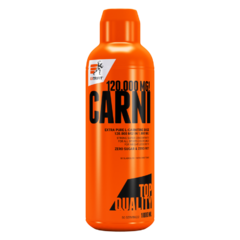
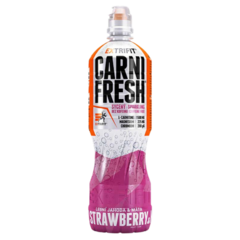
Extrifit Carni Liquid 120000mg
3.Eat enough protein and carbohydrates.
Aim for 2.5g of protein per kilo of body weight (2g will be enough for most people). Get about 70% of your remaining calories from carbohydrates, which you should spread strategically around your workout and in the evening.
I prefer my carbs in liquid form before and during my workout, while after and in the evening I tend to take my carbs in solid form. However, if you lead a stressful life or have a physically demanding job, I recommend spreading your carbs evenly throughout the day.
Let's say you have 100 kilos. I would base the following nutrient plan on that (remember - 70% of your non-protein calories will be from carbohydrates).
- Protein: 250 g/day
- Calories on low days: 2400 kcal
- Calories on high days: 2800 kcal
- Calories from protein: 1000 kcal
- Calories left over for fat/carbohydrate on low days: 1400 kcal
- Calories left for fat/carbohydrates on high days: 1800 kcal
Carbohydrates on a low day (in our example)
70% of 1400 kcal = 980 kcal from carbohydrates. There are roughly 4 calories in one g of carbohydrate, so that equals 245 g of carbohydrate.
Fat on a low day
1400 kcal - 980 kcal (calories from carbohydrates) = 420 kcal. There are roughly 9 calories in one g of fat, which equals 47 g of fat.
Carbohydrates on a high day
70% of 1800 kcal = 1260 kcal, which is 315 g of carbohydrate.
Fats on a high day
1800 kcal - 1260 kcal = 540 kcal, which equals 60 g of fat.
4.Exercise 4 days per week and each muscle 2-3 times per week.
Do 3 full-body workouts based on basic exercises and one lighter workout with mainly isolated exercises for lagging areas. I'm able to add a fifth workout, but in that I only work small areas like abs, calves and forearms and add some rubber band work. Most of the time though, it should be 4 workouts a week.
Three appropriate splits:
| Day of the week | Type of workout |
| Monday | Full body |
| Tuesday | - |
| Wednesday | Whole body |
| Thursday | - |
| Friday | Whole body |
| Saturday | - |
| Sunday | Light training (isolated exercises for neglected or lagging body parts) |
| Day of the week | Type of workout |
| Monday | Lower body |
| Tuesday | - |
| Wednesday | Upper body |
| Thursday | - |
| Friday | Lower body |
| Saturday | Upper body |
| Sunday | - |
| Day of the week | Type of workout |
| Monday | Quadriceps + push-ups |
| Tuesday | - |
| Wednesday | Hamstrings + Deadlifts |
| Thursday | - |
| Friday | Quadriceps + push-ups |
| Saturday | Hamstrings + Deadlifts |
| Sunday | - |

5. Avoid excessive volume of work.
I recommend 4-6 exercises in one workout and about 3 work sets per exercise. If you choose to do 6 exercises, do 3-4 complex exercises and 2-3 isolation exercises. If I have to choose between increasing work volume and intensity, I always choose intensity.
6. Variety must be a pillar of your program.
Change your workout every 3rd week. The more the workouts vary from each other, the better. You don't want to do the same workouts even within the same week.
For example, when I do a full body workout in each workout, I use a slow start on the first day, use a combination of static and dynamic elements (pause and explosive movement) in the second workout, and in the third workout I either do the normal or just the positive parts of the exercises (from the stops).
7. Include undemanding cardio.
It can be an easy walk or 20 minutes on the treadmill. Just don't make it an endurance discipline.
The wrong kind or too much cardio can cause problems, and even reduce the chance that you'll gain muscle and lose fat at the same time. That's why I recommend low-intensity cardio like walking.
It's best to do cardio in the morning because that's when you naturally have elevated levels of cortisol and adrenaline, which will help you mobilize fat more easily as fuel.
Important: For rebuilding the body, I really like carrying weights. However, I don't count it as cardio, but as weight training. For example, if I have 5 exercises planned in my workout and I do a farmer's walk, I treat it as one comprehensive exercise, and I only have 4 left in that workout.
Lessons learned at the end
Physical remodeling is definitely possible if you can overcome your urges and fears. Basically, every mistake you make will stem from excess in eating or training. Or it will be simple impatience. You must learn to keep these habits at bay.
Body rebuilding is a slow process. Fat loss is slower than on a normal diet, and muscle gain is also slower than on a normal volume diet. For these reasons, such a strategy is better suited for individuals who are already quite muscular and lanky, or for those of you who abound with infinite patience.
Source: www.t-nation.com - Losing Fat While Gaining Muscle - A Guide
Author.
Author: Šárka Randáčková No posts have been made yet.








