





How to set up a diet and adjust calorie intake - Part 3
 Author:
 In the previous chapters we have shown the calculation of basal metabolic rate and then calculated the energy expenditure of physical activity. Now we know the value of the total daily energy expenditure (TDEE). In the next step we will look at our sporting goal, i.e. whether we are going to lose fat, maintain the muscle mass gained so far or gain muscle mass. In doing so, we will also take into account our somatotype.
For the sake of clarity and to refresh your memory, here are the steps of the calculation leading up to our goal, i.e. the creation of a skeleton diet.
- 1.calculating basal metabolic rate
- 2.calculating physical activity
- 3.matching caloric intake to sports goal and somatotype
- 4.distribution of caloric intake into nutritional values
- 5.creating a skeleton diet
Chapter 3
In the next step we need to match our calculated TDEE (total daily energy expenditure), to our sport goals. In the following table, select one of the values.
|
Sports goal |
Coefficient |
|
Fat loss |
0,85 |
|
Maintaining muscle mass |
1,00 |
|
Gaining muscle mass |
1,10 |
Continuing the example
Suppose your goal is to gain muscle mass. So we take the TDEE value from the previous step of the calculation and multiply it by the coefficient corresponding to our goal.
- 3235 * 1.10 = 3558 kcal
The difference is 323 kcal. In order to achieve our muscle mass growth we need to add 323 kcal to our total energy expenditure TDEE. The excess of 323 kcal means a total of 9690 kcal in 30 days. With this excess energy, at an average consumption of 5 kcal to create 1g of mass, we gain a total of 1938g of mass. So we are planning for a gain of approximately 2kg per month, which also means a reasonable balance between muscle and fat gain.
Some nutrition experts recommend simply adding or subtracting 500 kcal. I think the percentages better reflect the differences in the initial TDEE of an individual's metabolism. For example, if we had a TDEE of only 2500 kcal, adding 500kcal would make a 100% difference relative to the recommended 250 kcal! However, everything is relative and nothing that involves a machine as complex as the body can be expressed in formulas. In the future, you will certainly fine tune your caloric intake according to the speed at which you want to achieve your goal without too much degradation of muscle mass or, conversely, growth of adipose tissue.
In a quick recap, we will summarize the steps we have taken so far. First we calculated our BM, basal metabolic rate, then we added an activity factor (AF) to find TDEE, total energy expenditure. In the last step we performed, we adjusted the TDEE according to our sports goal.
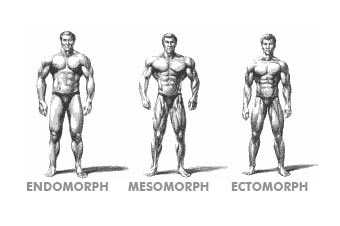
However, our calculation is not over yet. Now we have to decide which somatotype you belong to. The three basic types are
Ectomorph
The predominant traits of frailty. Weak bones, very weak musculature. Shoulders are slumped. Torso relatively short, limbs relatively long, stature not always tall. The abdomen tends to be flat. The lumbar lordosis, unlike the mesomorph, is slight and high, the thoracic kyphosis is greater. The thorax is relatively long compared to the abdomen. It is flat and narrow. The rounded shoulders are held forward, wing-like protruding scapulae are common. Very weak thighs and weak arms. Fingers fragile and long. Neck is long, defective posture of head and neck common. The facial part of the head is relatively small compared to the cranial part. The skin tends to be weak and dry.
Mesomorph
Massive musculature and skeleton predominate, angularity of body. Sharp muscular relief. The trunk is heavy, muscular. Limbs muscular, massive, length varies. Forearm, wrist, hand also strong. Chest girth far exceeds abdominal girth. Chest and shoulders broad, trunk usually erect, m. trapezius and deltoideus massive and clearly defined. The length of the trunk and the length of the limbs is not a constant character in mesomorphs. The pelvis is massive (Sheldon states that the narrow pelvis often found in muscular athletes reveals the presence of a third component, the ectomorphic component, in addition to the mesomorphic component). The arms and lower limbs are relatively equal in length. Head size varies. Shoulders broad, strong, clavicles prominent. Posture is good, lumbar lordosis is sometimes slightly increased. The abdominal wall is firm, not protruding. The chest is prominent.
Endomorph
Predominantly rounded shapes and soft to the touch musculature with excess fat. The abdomen protrudes in front of the thorax. Waist circumference is greater than chest circumference. The upper limbs stand out above the lower limbs. Short neck. Shoulder contours rounded. Large head. Muscle relief absent. Short limbs, weak, relatively small hands and feet. The trunk is relatively short. Skin is soft.
Of course, you could be somewhere in between. For example, an ecto-mesomorph or an endo-mesomorph. That's common. Few people can fit neatly into one of these three groups.
Here are the coefficients for each of the types
|
Somatotype |
Coefficient |
|
Ectomorph |
1,10 |
|
Ecto-mesomorph |
1,05 |
|
Mesomorph |
1,00 |
|
Endo-mesomorph |
0,95 |
|
Endomorph |
0,90 |
Let's go back to our example. Our exerciser is an ecto-mesomorph and his goal is to gain muscle mass.
- 3558 * 1.05 = 3735 kcal
This is the final number we will work with! And this number will change as your TBM - total weight, BF% - percentage of adipose tissue, and age change.
Therefore, keep this in mind at all times and recalculate your caloric intake.
In the following section, we will convert your caloric intake to the nutritional values of the individual components of your diet. We will look at the amounts of protein, carbohydrates and fat.
No posts have been made yet.








