





We bring you the four best training splits according to Christian Thibaudeau!
 Author: Šárka Randáčková
 Which split is best?
A bad split means insufficient recovery time, less growth and poor performance. It can under-stimulate some muscles and be too demanding for others.
Let's take a look at how to design the perfect training split, and the four best options.
First, answer these 4 questions
Choose a split that has all of these items checked "yes":
1. Does it provide sufficient weekly frequency for each muscle group?
New research tells us how often to train muscles to maximize their growth. Training a muscle twice a week is better than once, even if the total volume is the same. For some, even three times a week may be marginally more effective. So your split should allow you to significantly stimulate each muscle 2-3 times per week.
2. Is there minimal negative impact between workouts?
If you train your arms hard on Monday and hit your chest and back on Tuesday, your performance will be negatively affected in this second workout. Your arms are still recovering, and you may be weaker during the big lift sets for chest and back.
3. Is the ratio of work to rest days optimal for recovery?
Sometimes a very high training frequency can work. For example, the book The Best Workout Plan for Natural Lifters uses six workouts per week. This is only feasible if you use a training model that revolves around a very low volume of work (training load) during each workout.
Most exercisers should train four days a week. And three workouts a week is better than five. Six and seven are unthinkable unless you are using a low volume model.
Days off are important for maximizing recovery and muscle growth and preventing the risk of training burnout and training immunity.

4. Can you get enough practice in at least twice a week in four weekly workouts?
In many exercises, more than one muscle is stimulated. The bench press is a chest exercise, but the triceps and anterior delts are equally worked. The hunch builds the chest muscles, but the biceps are also heavily involved. And while the squat is focused on building the quadriceps, it also stimulates the hamstrings, glutes, and lower back.
If you use compound exercises, you don't have to use direct isolated work for each muscle twice a week. You can still exercise each muscle group sufficiently to achieve significant growth.
4 Best Splits
The four options below are not ranked in order of effectiveness. They all work equally well, although some may be better for strength and others for size. But honestly, you can choose any of them and get great results for any goal.
The best split for YOU will be a matter of individual preference. Choose the one that motivates you. Motivation is the most important thing for maximum and long lasting results.
1. Full Body Training + Break Training
I use this approach most often with athletes and strength-oriented clients.
Full body training is the oldest type of split. It was the dominant method of training until the 1960s when single body part splits became more popular. Some even correlate the beginning of the "steroid era" with the popularization of single body part splits.
In earlier times, the typical approach was to train the entire body three days a week: Monday, Wednesday and Friday. This approach is optimal for people who simply want to get bigger, stronger, more powerful and better conditioned.
While there are several ways to train the whole body, I use a minimalist approach where I rely almost exclusively on big, complex exercises. Some take a very detailed approach and incorporate one (or more) exercises for each muscle group. This means 8-10 exercises per workout, which is too many for most.
I usually use 4-5 exercises per workout:
- Squat
- Deadlift
- Deadlift
- Hip flexion
By using these exercises, you will exercise everything to some degree. Sure, you don't have any exercises for the biceps, triceps or deltoids, but these muscles are involved in great exercises.
The benefits of a full body workout are as follows:
- Exercising each muscle and key movement pattern three times a week, which, while providing better overall strength gains, can also provide the benefit of muscle growth.
- Allows you to use several different training methods, intensity zones and contraction types for each muscle.
For example, I like to use eccentric focus (slow-trigger or eccentric overload) on Mondays and stato-dynamic (including isometric holds during sets or reps) on Wednesdays, then do normal weight training on Fridays.
But you can also use something like heavy/light/medium or heavy/very dense/voluminous to reap gains from different angles. It's more effective to include one form of training for each unit, rather than trying to include several crammed into one workout. - It's very effective.
- Whole body training reduces myostatin more than upper and lower body training. Myostatin is a protein released by muscles that limits growth. The less of it you produce, the more growth you will achieve.

Pause training
If you're a bodybuilder who wants to maximize the development of several body parts, full-body training may not be a good option for you. To overcome this limitation, I added a fourth weekly workout. Training into the break will satisfy your need for more isolated work with and pumping up.
This is a less stressful workout where you perform exclusively "easier" exercises: isolation, machine work, or pulley work. The exercises you perform are chosen to fill in the developmental gaps left by full-body workouts.
Typically, you will perform exercises that exercise the biceps, triceps, hamstrings and rear delts. However, you can use this workout to exercise any muscle that needs strengthening. This allows you to reap the benefits of a full-body workout while achieving more typical bodybuilding results.
Sample weekly split
- Monday: Whole Body 1
- Tuesday: Free
- Wednesday: Full Body 2
- Thursday: Free
- Friday: Full Body 3
- Saturday: training until break
- Sunday: Free
Disadvantages of a full body workout? All those complex exercises can be exhausting. The workout can also take longer because of the longer warm-up and rest periods.
However, two of my experienced athletes have gained 20kg and significantly increased their strength in a year using this approach.

2. Split top/bottom
This allows you to work out hard twice a week all over. There is minimal negative carryover from each workout. It allows you to incorporate more volume and targeted work for individual muscles than a full body split. There are fewer complex exercises than a full body workout, making it more manageable for many.
The only downside? The upper and lower body split can be mentally demotivating for some. A lot of men don't like to train their legs. Having half of a workout dedicated solely to legs can kill motivation for those who hate lower body workouts. Something may be physiologically optimal, but if it kills your desire to train hard, it won't work.
But if you like to train your lower body, this is one of the best workouts you can use. It is the most versatile method. You can use it for any training goal: strength, size, athletic performance, fat loss, or health.
Ways to use this split
- You can use the typical approach of working out your entire upper body twice a week and your entire lower body twice. This is the best option for muscle growth.
- You can use exercise-specific splits. For example, using Wendler's 5/3/1 split, you would have a squat day, a bench day, a deadlift day, and a military press day. Train the big exercise and then add 3-5 assistance exercises for the muscles involved in the main exercise of the day. This is a good way to strength train because you can easily correct weak links in the big exercises.
- You can use a movement plane or split based on movement patterns. Do an upper body workout with vertical pull and push and a second workout with horizontal pull and push. One day you would train the front chain for the lower body and the next day the back chain. This is great for balanced development and minimizing injury.
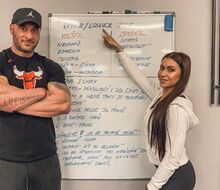
Sample weekly split
Here is what a weekly split might look like:
- Monday: lower body one
- Tuesday: Free
- Wednesday: Upper body one
- Thursday: Free
- Friday: Lower body two
- Saturday: Upper body two
- Sunday: Free
- Push-ups/Pull-ups

3. Push/Pull (Modified Hatfield Split)
I first learned about this split when I was 18 years old and doing Fred Hatfield's 80-day powerlifting cycle. In this program - specifically designed to peak at Lithuanian competitions - you trained squat, bench and assist in one workout and deadlift and assist in the other. That's a total of four workouts a week.
It's highly motivational and a good way for those who don't like leg training to get more into it. While you have two lower body exercises per workout, you also have four upper body exercises.
Here's what it looks like:
Workout A
- Squats
- Comprehensive Press Exercise
- Quadriceps dominance exercise
- Chest exercise
- Triceps exercise
- Delta exercise
Workout B
- Hip flexion or sled push
- Hamstring exercise
- Vertical pull
- Horizontal pull
- Exercise for biceps
- Back delts, rhomboids or traps
- Exercise for lower back
Recommended
Nebbia Dvouvrstvá sportovní podprsenka FLEX 241

Nebbia Dlouhá everyday HERO mikina s kapucí 580
Nebbia Dámský sportovní overal INTENSE Focus 823
Czech Virus Algastin Natural Astaxanthin
Sample weekly split
Option 1 (4 workouts per week)
- Monday: Workout A
- Tuesday: Workout A: Free
- Wednesday: Workout B
- Thursday: Free
- Friday: Training A
- Saturday: Training B (no full hip flexion, only sled pushes or pulls from the rack)
- Sunday: Training: free
In this variation, we'll skip the hip flexor exercise on Saturday because we did squats the day before. We want to minimize damage to the quadriceps because the squats will return on Monday.
The second option (training every other day)
Here you train every other day. Some weeks you'll have three workouts, some weeks you'll have four. This option is best, but can be frustrating for those who prefer to stick to a fixed schedule.
It would look something like this:
- Monday: Workout A
- Tuesday: off
- Wednesday: Training B
- Thursday: Free
- Friday: Training A
- Saturday: free time
- Sunday: Training B
Then...
- Monday: Free time:
- Tuesday: training
- Friday: Training A
- Saturday: free time
- Sunday: Training B
Then...
- Monday: Free time:
- Tuesday: training A
- Wednesday: Free
- Thursday: Training B
- Friday: Free time
- Saturday: training A
- Sunday: Free
You may leave the hip flexor exercise in all B workouts.
I consider this split to be just as good as the top/bottom when it comes to being able to use it for any training goal.

4. Modified split pressures/pulls/legs
The original push/pull/leg split is very popular. It is efficient but does not meet all requirements.
You may have minimal negative carryover from workout to workout, but it's hard to train every muscle twice in 7-8 days unless you do up to 5-6 workouts per week, which will be too much for most people.
Making the pushes/pulls/legs an optimal split means adding a fourth workout: a full-body day.
Sample weekly split
- Monday: Whole Body
- Tuesday: Free
- Wednesday: Legs
- Thursday: Free
- Friday: Pressures
- Saturday: Deadlifts
- Sunday: Free
You can use the full-body workout to work on strength, and focus the other days more on maximizing growth or eliminating weak links in big exercises.
For example, on Monday you would perform squat, deadlift, deadlift, and press. Nothing else. Then on Wednesday, Friday, and Saturday you would train the muscles to maximize growth with an emphasis on the muscles lagging in the big exercises:
- Wednesday: Squat assistance exercises to build squat strength
- Friday: Bench press assistance exercises
- Saturday: assistance exercises for deadlifts and pull-ups (or dips).
This is a motivational breakdown. Each workout has a very specific purpose and you have two different "feelings" during the week. You can also use the full-body day for something other than weight training, such as conditioning work or athletic training.

Source: www.t-nation.com - The Very Best Workout Split For YOUR Goals
Author: Christian Thibaudeau
Translated by Jaromír Uhlíř
Author: Šárka Randáčková No posts have been made yet.








