





Six lies that hold you back from progress!
 Author: Šárka Randáčková
 Bodybuilding: beyond improving the beginner
As a beginner, you probably put on muscle pretty quickly. After all, you've gone from not lifting to lifting. Back then, almost anything worked. After the novice stage, you had to get smarter. This is where bodybuilding (a general term) gets a little more complicated.
You may even have to "unthink" some things that seemed to work at first. So what cripples the progress of most exercisers? Here are the six most common lies about building muscle.
Lie 1 - You must practice classic squats
Only triathletes need to squat with a barbell on their back. A properly executed squat is an excellent bodybuilding exercise - one of the best. However, the emphasis is on "properly performed".
No matter what they do, many exercisers will never squat well with a barbell on their back because of their physical configuration, which is not suitable for squatting, or because of back or knee problems.
A minority of bodybuilders are well suited to squatting with a barbell. Another minority of bodybuilders are very unsuitable for barbell squats (including very tall exercisers). Most, however, are somewhere in the middle.
Many of those "in between" can become decent (but not exceptional) at classic squats through excellent training. But a coach who can come up with such training is hard to find.
Even some individuals who have an excellent physical configuration for squatting and healthy knees and backs will never realize the enormous potential of the classic squat. Why? Because they will never learn excellent technique.
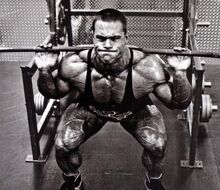
If you can squat well with your axis back (which includes the ability to keep your back straight just below parallel while wearing no more than three-quarter inch heels) and maintain excellent technique even when squatting intensely, keep squatting.
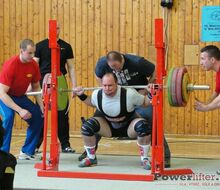
If not, try a safety axis squat , deadlift with trap axis shown below, with a generous knee bend (using low grips if you can do it safely), a good squat machine or a belt squat. If none of these options suit you, try leg-press.
Lie 2 - You should not practice deadlifts
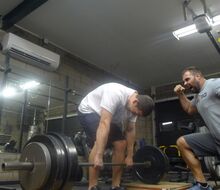
Even bodybuilders can benefit greatly from this basic element of powerlifting. A properly executed deadlift is one of the best exercises for building strength and muscle mass. And it's often an exercise suitable even for those who are not comfortable with the classic squat and bench press.
Interestingly, bodybuilders who are physically well suited for the barbell squat and bench press often have trouble with the classic deadlift.
The only problem? If you have terrible technique, you'll find it dangerous, just like the squat. That's why these two exercises often have such a bad reputation. So make sure you use proper technique, or don't practice the exercise at all.
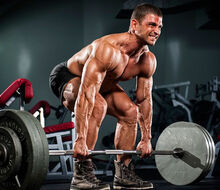
If you can't safely perform the classic deadlift, perform the simpler Romanian deadlift, which involves little knee flexion but lots of bending that targets the posterior chain.
To simplify your preparation for the Romanian deadlift, perform it in a squat rack with the axle on the stops 5 cm below the kneecaps. Even if you can safely perform a regular deadlift, you may prefer to perform a partial Romanian deadlift.
Lie 3 - You have to bench
A bench press with a large axis can both increase strength and improve volume. However, if you're stuck at a dead stop and your technique doesn't need improvement, why stick with this exercise? Other exercises will be more productive and satisfying for you.
Try push-ups on the bars (classic style or on a good machine) and push-ups with a slight positive and negative incline on good machines to find the best exercise or two.
However, you must set up your machines to suit you and use faultless technology. When doing push-ups on the bars, don't descend lower than a position where your triceps are parallel to the floor, perform reps smoothly, and keep a full chest of air with each lowering and raising.
Straight bench presses and slightly incline presses can be excellent alternatives to bench presses. With single-arm presses, you can find the position of your hands and elbows that gives you the best pressing technique.
You just need to master getting the one-handers into position for the push, find the best path of movement and avoid going too deep.
Recommended

Czech Virus ColonClean Ultra

Nebbia Dámský crop top s dlouhým rukávem INTENSE Perform 839
Nebbia Crop top s dlouhým rukávem ELEVATED 468

Intense Šortky GOLD Nebbia print 828
Lie 4 - You need to exercise more than 3 times a week
Bodybuilding training only builds muscle if it stimulates growth and is followed by enough time for recovery, sleep and sufficient nutrient intake to allow the body to recover.
Train too often and you may not stimulate any growth because you won't be able to train hard enough. And even if you do stimulate growth, you won't have enough recovery time between workouts to reap the full benefits.
If you're young, have a free lifestyle, and good genetics for bodybuilding, you can make moderate progress initially with four or more workouts a week. But why not optimize your recovery ability, make more progress, and as a bonus, spend less time in the gym?
It's easy for a natural bodybuilder with normal genetics to overtrain. But someone with superior genetics for bodybuilding can thrive with more frequent training. Such a person can effectively benefit from even more frequent training if they take anabolics.
For the typical exerciser, it is best to train no more than three times a week; for most, only twice a week is better. Never mind that many anabolically super-performing bodybuilding champions have achieved their best results with six workouts per week. Some of them even engaged in training twice a day six days a week for a short time.
Such a high frequency is training suicide for typical bodybuilders. Most splits are problematic for the average exerciser. The physiological system is so intertwined, and many exercises overlap in the muscles and other tissues they affect.
In addition, training hard for only a limited area of the body still creates systemic demands from which you need to recover. If you train too often, you will never recover from systemic fatigue and make little or no progress. Have more recovery days than training days!
Lie 5 - More work is more efficient
Practice a maximum of 3 work sets. Sometimes it is even better to do only one or two work sets per exercise.
Recommendations of high work volume commonly come from anabolic users, including those who claim to be "naturals". Some of the best, legitimately natural bodybuilders also recommend high volume training. However, they have the monstrous genetics needed for it, and thus a huge advantage over typical non-anabolic bodybuilders.
Much of the information in support of high volume training is based on the results of poorly understood and/or biased studies or pseudoscience.
Too much training is just as counterproductive as training too often. However, most typical bodybuilders train too often and perform too many sets per workout. Volume of work obviously plays an important role in the muscle building process, but intensity comes first. If you're not training with enough intensity, you're not stimulating any growth, no matter what volume you train at.
Low-volume training is highly effective provided you use a selection of exercises best suited to you, apply excellent technique, train hard, don't train too often, eat well, sleep generously and try to make progress. However, most unsuccessful bodybuilders fail in all of these areas.
Lie 6 - Advanced bodybuilders are a good source of information
The pros have great advice for other bodybuilders with stellar genetics and anabolics support. But for genetically normal exercisers without anabolics, a different approach is needed. No top bodybuilder can empathize with the genetically typical natural exerciser.
Someone who struggled for years without building much muscle - but then learned to train effectively and packed on 12 kg of muscle without anabolics - knows more about training genetically normal bodybuilders without anabolics than a genetic stud on drugs who built 100 kg of muscle.
Source: www.t-nation.com - 6 Bodybuilding Lies Crippling Your Progress
Author: Stuart McRobert
Translated by Jaromír Uhlíř
Author: Šárka Randáčková No posts have been made yet.








