





Improve your bench press!
 Author: Šárka Randáčková
 Below we offer you a guide on how to add pounds to your bench, and take it to the next level!
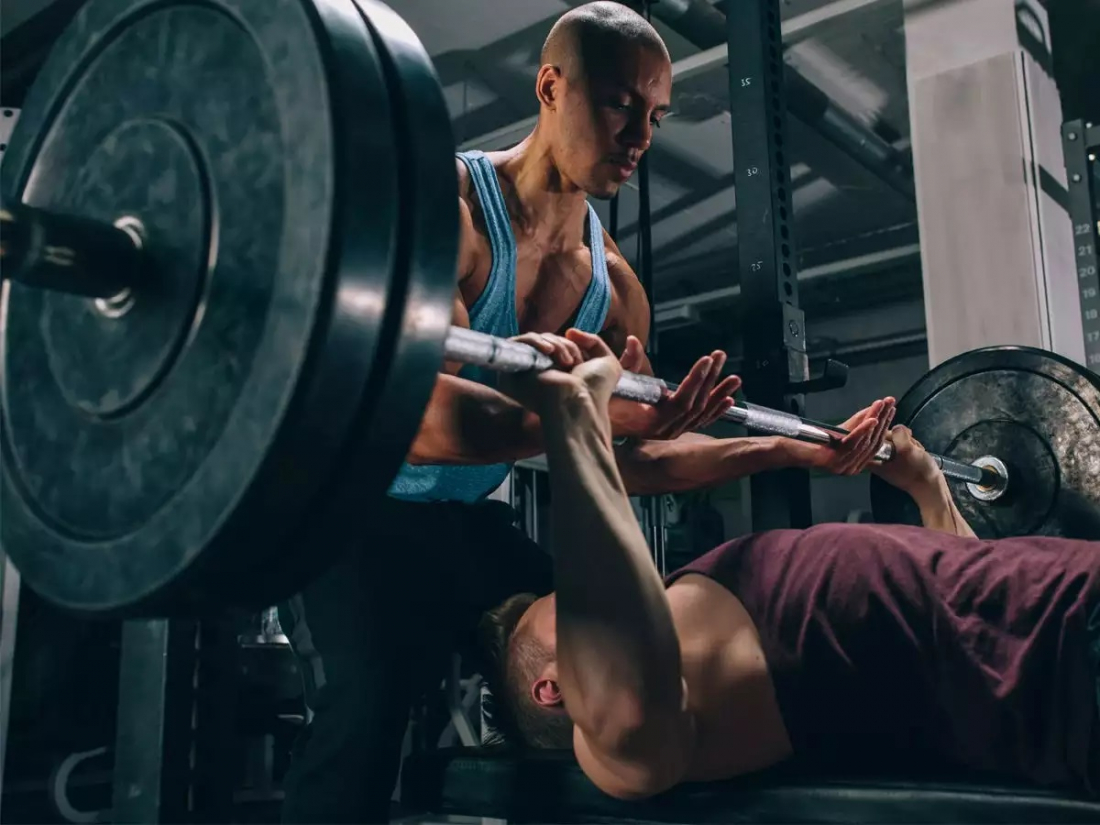
1. Bench press from the bottom
This exercise will help you push the barbell strongly away from your chest. The main benefit? It eliminates the stretch reflex that makes it easier for you to bench normally.
As the eccentric phase of the exercise transitions into the concentric phase, the body is aided by stored elastic energy. This creates a stretch reflex that provides a sort of auxiliary spring.
It's not necessarily bad, but you must also learn to create energy from a complete stop. Such an ability will improve your weight control, muscle engagement, and overall performance in benching.
This variation will also force you to have a clenched upper back. Unless you clench them and retract your shoulder blades, pushing any decent weight out of this position will be essentially impossible.
- Set the stops so that the axis is either lightly touching your chest or just above it.
2. Pressed bench (lockout)
This exercise will help you train the upper half of the benches and triceps. It is often used by triathletes who compete in the jersey. But a few pounds on the bench can add anyone.
The jersey helps triathletes from the bottom. Its effect diminishes as the axle gets further away from the chest, where strong triceps are needed to push.
This exercise allows you to overload a limited range of motion. The majority of your workout should train the full range of motion, but strategically you can include these shortened exercises with more weight. Such training also builds connective tissue strength, especially around the hands and forearms, which will aid in stabilization with higher weights.
Although you will be able to load more weight with this variation, start lightly. Dramatically increasing the weight right from the start might make your elbows a little sore. Add gradually, and allow your body to adjust.
- Set the stops somewhere between half and three-quarters of full arm extension.
3. Biceps Overhead Lifts with Thick Axis
If you can't stabilize the axis, it's very difficult to complete the bench successfully. This exercise will strengthen your forearms and hands, allowing you to grip the axis more tightly and better control the loaded weight.
Grip strength is also strongly linked to an efficient nervous system. A strong grip allows you to engage more muscles. This will result in a more efficient transfer of force when pushing the axle away from your chest.
- If you don't have a thick axle, you can use extensions to increase the width of the large axle or one-handed grippers.
Source: www.t-nation-com - Tip: 3 Exercises for a Guaranteed Bigger Bench
Author: TJ Custer
Translated by Jaromir Uhlir
Author: Šárka Randáčková No posts have been made yet.








