Chicory syrup - a really healthy alternative to sugar
 Author:
 Sugar consumption is rising every year and is accompanied by an increase in the number of people suffering from obesity, diabetes or insulin resistance. Therefore, in recent years it has become quite trendy to look for various alternatives to regular sugar. However, not all alternative sweeteners are actually better than regular sugar. This is not the case with chicory syrup, which is instead one of the most suitable alternatives ever, and we will take a closer look at chicory syrup today.
Article content:
- Theoretical window - what is chicory syrup?
- Health benefits of chicory syrup
- What to take away from the article?
Theoretical window - what is chicory syrup?
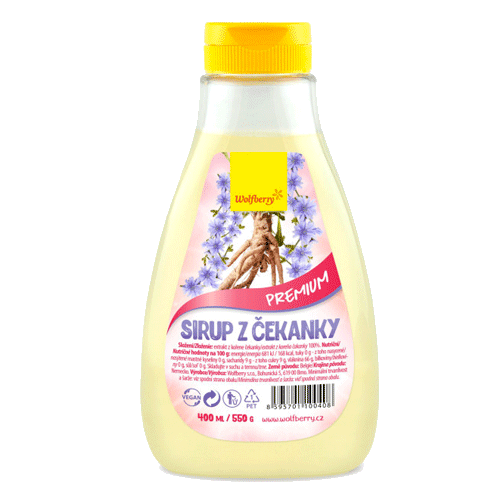
Chicory syrup is a 100% natural sweetener which, as the name suggests, is made from the root of the chicory plant. It contains a high proportion of inulin (a type of fibre) which not only makes it a suitable alternative sweetener, but will also support the health of our biome, prolong satiety and help us to meet our daily fibre intake very easily. Due to its inulin content, it has a probiotic effect, but can cause problems for people with impaired digestion.
It has a very low glycaemic index and the sugar content in 100 g is less than 5%. This also makes chicory syrup a suitable sweetener for diabetics. A small drawback is that it has a lower sweetening power, which is 30-50 % of that of sugar, so the artificial sweetener sucralose is sometimes added. As always, everything in moderation! Due to the high fibre content mentioned above (up to 71 g per 100 g), it can cause digestive problems in larger quantities for more sensitive individuals.
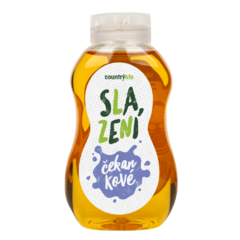
In 100ml of Country Life's Chicory Sweetener you will find, according to the information, approximately:
| Calories | 169 kcal |
| Fat | 0 g |
| Carbohydrates | 9,5 g |
| Fibre | 66 g |
| Protein | 0 g |
Health benefits of chicory syrup
As chicory syrup is a really healthy alternative, its use offers a range of health benefits, so let's take a look at the top five together!
Contains a high proportion of beneficial fibre
The basis of chicory syrup is the soluble fibre inulin. It's a polymer made up of dozens of fructose molecules and topped with a glucose molecule. When consumed, inulin absorbs water, gains volume and acquires a gel-like consistency. Because of the inulin in the fiber of chicory root, it passes through the body undigested and serves as nutrition for the intestinal bacteria. It acts as a prebiotic, which means precisely that it nourishes the beneficial bacteria found in our intestines. These beneficial bacteria play a role in reducing inflammation, fighting harmful bacteria and improving mineral absorption. It is especially beneficial in the treatment of constipation and difficulty in defecating.
However, it is important to mention one thing. Inulin is a type of fibre known as fructan or fructooligosaccharide - so it belongs to a group of substances fermenting in the gut known by the acronym FODMAP. As you already know from our earlier article, intake of FODMAP foods usually does not benefit people suffering from gas, chronic diarrhea, irritable bowel syndrome (IBS), leaky gut syndrome, Crohn's disease, ulcerative colitis or other digestive diseases. If you suffer from any of these conditions, using chicory syrup may not be the happiest choice.

It is an ideal sweetener for diabetics
The fibre from chicory root can improve blood sugar control, especially for people with diabetes. Again, this is due to the aforementioned inulin, which promotes the growth of beneficial bacteria involved in carbohydrate metabolism - which breaks down carbohydrates into sugars - and sensitivity to insulin, a hormone that helps absorb sugar from the blood. In addition to helping regulate blood sugar levels, it also reduces the amount of fat in the liver, which further increases the body's sensitivity to insulin.
Insulin is a hormone important for moving glucose from the blood to the liver or muscles. In diabetics, this process does not work as it should, but inulin can support it. In addition, cashew syrup has a very low glycemic index, so there are no glucose spikes after consuming it, making it an absolutely ideal sweetener for diabetics.
It can be beneficial in weight management
Chicory syrup is a low-calorie sweetener that serves as a great substitute for regular sugar, allowing you to reduce the amount of calories you take in quite substantially, and of course, this is really useful in weight loss.
Research suggests that substituting sugar with chicory syrup can be a really useful tool in fat reduction, of course, only if you don't have trouble digesting it. Studies have also shown that the oligofructose in chicory syrup can reduce levels of ghrelin, a hormone that stimulates feelings of hunger. The high fibre content also promotes a longer feeling of satiety.

Supports the immune system
As you're probably already well aware, our intestines are home to the largest part of our immune system ever, so it's not too much of a surprise that, given the benefits touted above, chicory syrup is also good for a strong immune system. In fact, the fibre it contains serves as a prebiotic - food for the beneficial probiotics whose activity is essential for our immune system.

Does not harm tooth enamel
Another great advantage is that, unlike conventional sugar and other so-called healthy sugar substitutes, chicory syrup does not damage tooth enamel. On the contrary! Its regular consumption contributes to the mineralisation of teeth and significantly reduces the risk of tartar formation. It's therefore great for children too, just be careful with the amount, because the fibre in it can really hurt them.
Where to use chicory syrup?
And that's the best part! It goes absolutely anywhere you would normally add sugar. Just beware - it has a liquid consistency, so it will behave a little differently than regular sugar in some recipes. It's perfect for sweetening teas, on porridge or pancakes instead of sugary syrups, but feel free to use it in baking healthy desserts too. Just be warned, it has a relatively significantly lower sweetness than sugar, so you need more of it to achieve a similar taste. It can also be used in savoury cuisine - it can be used to make marinades or sauces.

Recommended daily dosage
There is probably no recommended daily dose of chicory syrup. You need to test how much your body can digest and what amount will already cause the aforementioned digestive problems resulting from a high fibre intake. If you are starting out, we recommend not overdoing it completely at first and observing how you react to it. Although it is a truly natural and healthy sweetener, it may not be suitable for everyone. However, in smaller quantities, you can also give it to your children
Recommended
What to take away from the article?
Today we have introduced chicory syrup, a really healthy and natural sweetener that is a perfect alternative to regular sugar. It is made from the chicory root, has a very low calorie content and can be a handy helper in fat reduction. It contains a high proportion of beneficial fibre, which is important for the proper functioning of our digestive system and strong immunity.
However, it is the fibre content that can be problematic, especially for individuals suffering from digestive problems. Chicory syrup is also an ideal sweetener for diabetics as it helps regulate blood sugar levels and increases insulin sensitivity. As an added bonus, it has a wide range of uses and can be used virtually whenever and wherever you feel like it.
Thanks to its low glycemic index and high fiber content,chicory syrup is becoming increasingly popular as a healthier sugar substitute. Unlike sweeteners, where the harmfulness of maltodextrin is often discussed, chicory syrup is gentler on blood sugar levels and the digestive system. It is precisely because of the negative effects discussed, such as glycaemic fluctuations and possible digestive problems, that maltodextrin should be avoided, whereas chicory syrup is a more natural alternative.
Sources:
- Nwafor, I. C., Shale, K., & Achilonu, M. C. (2017). Chemical Composition and Nutritive Benefits of Chicory (Cichorium intybus) as an Ideal Complementary and/or Alternative Livestock Feed Supplement. TheScientificWorldJournal, 2017, 7343928. https://doi.org/10.1155/2017/7343928
- Flamm, G., Glinsmann, W., Kritchevsky, D., Prosky, L., & Roberfroid, M. (2001). Inulin and oligofructose as dietary fiber: a review of the evidence. Critical reviews in food science and nutrition, 41(5), 353-362. https://doi.org/10.1080/20014091091841
- Micka, A., Siepelmeyer, A., Holz, A., Theis, S., & Schön, C. (2017). Effect of consumption of chicory inulin on bowel function in healthy subjects with constipation: a randomized, double-blind, placebo-controlled trial. International journal of food sciences and nutrition, 68(1), 82-89. https://doi.org/10.1080/09637486.2016.1212819
- Watson, A. & Houghton, D. & Avery, P. & Stewart, Ch. & Vaughan, E. & Meyer, P. & Kuil, M. & Weijs, P. & Brandt, K. (2019). Changes in stool frequency following chicory inulin consumption, and effects on stool consistency, quality of life and composition of gut microbiota. Food Hydrocolloids. 96. 10.1016/j.foodhyd.2019.06.006.
- Zhang, Q., Yu, H., Xiao, X., Hu, L., Xin, F., & Yu, X. (2018). Inulin-type fructan improves diabetic phenotype and gut microbiota profiles in rats. PeerJ, 6, e4446. https://doi.org/10.7717/peerj.4446
- Azay-Milhau, J., Ferrare, K., Leroy, J., Aubaterre, J., Tournier, M., Lajoix, A. D., & Tousch, D. (2013). Antihyperglycemic effect of a natural chicoric acid extract of chicory (Cichorium intybus L.): a comparative in vitro study with the effects of caffeic and ferulic acids. Journal of ethnopharmacology, 150(2), 755-760. https://doi.org/10.1016/j.jep.2013.09.046
- Guess, N. D., Dornhorst, A., Oliver, N., & Frost, G.. S. (2016). A Randomized Crossover Trial: The Effect of Inulin on Glucose Homeostasis in Subtypes of Prediabetes. Annals of nutrition & metabolism, 68(1), 26-34. https://doi.org/10.1159/000441626
- Parnell, J. A., & Reimer, R. A. (2009). Weight loss during oligofructose supplementation is associated with decreased ghrelin and increased peptide YY in overweight and obese adults. The American journal of clinical nutrition, 89(6), 1751-1759. https://doi.org/10.3945/ajcn.2009.27465
- Bonnema, A. L., Kolberg, L. W., Thomas, W., & Slavin, J. L. (2010). Gastrointestinal tolerance of chicory inulin products. Journal of the American Dietetic Association, 110(6), 865-868. https://doi.org/10.1016/j.jada.2010.03.025
No posts have been made yet.