





Warm-up is the basis of a good workout! The 5 best warm-up routines
 Author:
 A proper warm-up can be crucial to your training. We're talking about actual sets and reps performed before heavy exercises, not a treadmill or 15 minutes of lounging on your back.
Your warm-up can have different purposes depending on your goals, but you should do it mainly for the following reasons:
- For injury prevention and to prepare the muscles you'll be exercising.
- For a neurological warm-up that will help your body perform better.
- For pre-fatigue of the muscles you will be training.
- So that you can train the position, movement and activation of the muscles you will be exercising.
So where do you start? With this simple rule:
Always start with an empty axis
The longer you take to warm up before your first exercise, the better you'll feel about working sets. If you start with an empty axis, it tells you quite a bit about your form on the day. Work your way up to the point where you can tell how good your workout will be by the empty axis.
If you have heavy fives planned and you already feel from the empty axis that it's not going to be right, you might as well lower the intensity that day. This has saved me from injury many times, and it will help you too.
Even the best crossfitters in the world put a lot of emphasis on warm-ups. In our articles you can see for exampleTia C's snatch warm-up.Toomey, or you can read an interview withMathew Fraser, who talked about the warm-up in an interview.

Empty axis heating rules
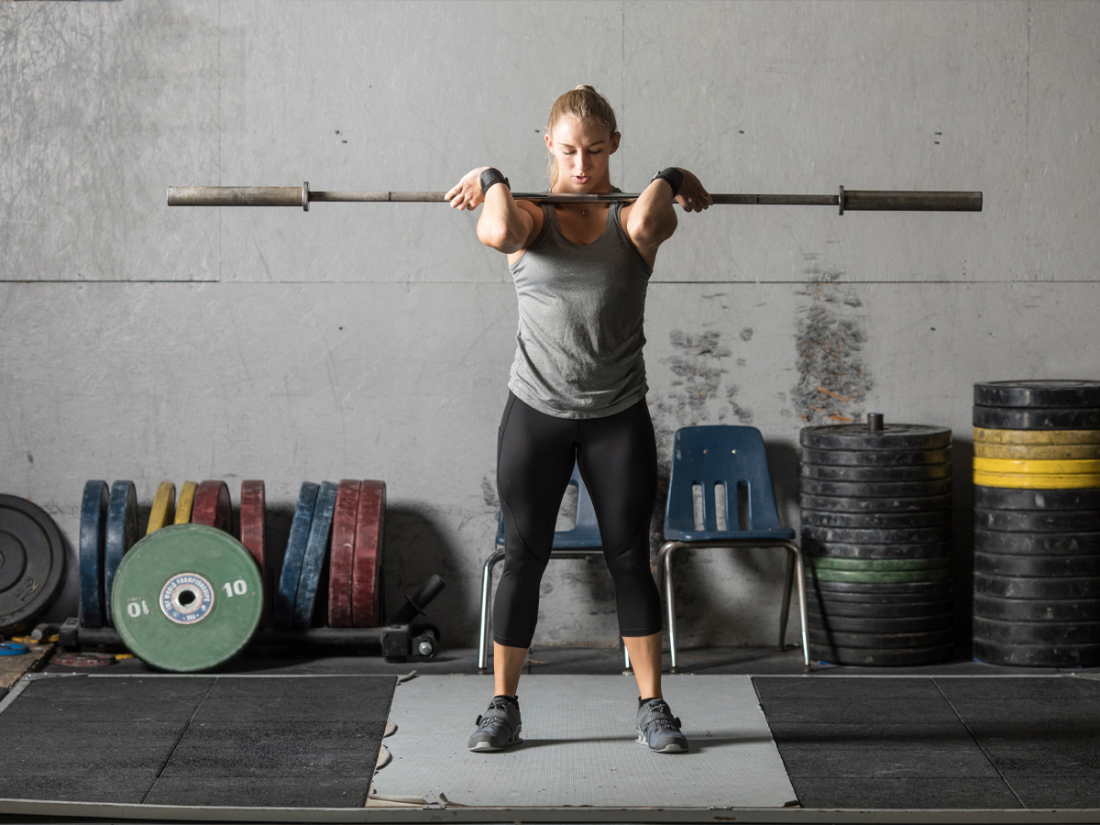
Treat the empty axle with respect and set yourself in the same position as you do for the heaviest sets. Treat reps the same way. Just because it's easy doesn't mean you'll be throwing the axle with poor technique. We want technical reps where you pay attention to your joints and the overall condition of your body.
Give yourself 2-4 sets of 20-40 reps. That's a great range. If you feel great after two sets, add weights. If you're still stiff after two sets, no one said you had to add. Practice with an empty axis and perfect technique until you feel ready.
5 proven warm-up methods
1 - Pyramid
With each successive set, add weights and decrease the number of reps. After sets with an empty axis, if you were going to get to, say, 5s with 230, the pyramid will look something like this:
| Series | Reps | Weight |
| 1 | 12 | 60 |
| 1 | 8 | 100 |
| 1 | 5 | 145 |
| 1 | 3 | 185 |
| 1 | 2 | 210 |
| Working series | 5 | 235 |
Notice what's going on here. You don't want to get tired before the work series, you want to get ready.
If your working weight is lower for, say, biceps raises, the jumps in the pyramid will understandably be smaller, and there will be fewer sets overall. For example, like this:
| Series | Reps | Weight |
| Warm-up with empty axis | ||
| 1 | 12 | 30 |
| 1 | 8 | 40 |
| 1 | 5 | 50 |
| Working series | 5 | 60 |

2 - same number of reps in all sets
I like this method because it prepares me well and limits the weight I can use during the working sets. Why should I do it? I'm glad you asked. The weight on the axle is not the most important thing. It's just one of the tools. If I give myself a hard time in training, I will grow regardless of the weight used.
In this method, I use 5 reps for all sets.
| Series | Reps | Weight |
| 1 | 5 | 60 |
| 1 | 5 | 85 |
| 1 | 5 | 100 |
| 1 | 5 | 145 |
| 1 | 5 | 165 |
| 1 | 5 | 185 |
| 1 | 5 | 210 |
| Working series | 5 | 230 |
If you really want to have fun - and by that I mean work out - keep your breaks as short as possible. It's going to be really hard at the top. I usually prefer this scheme for heavy exercises like squats,deadlifts and bench presses so I can use decent weight jumps.
3-adaptation series
If you warm up properly before the bench and then proceed to bench on the positive bench, you don't have to go through the whole process again. You just have to adapt to the new exercise.
Such adaptive series exercise with due margin from failure. It only serves to get used to the new movement. So, if you are coming from benching and were going to take the 45 pound one-handers for the maximum number of reps, two adaptation series before that will be sufficient:
| The series. | Reps | Weight |
| Adaptation Series | 6 | 20 |
| Adaptation series | 4 | 35 |
| Working series | max repetitions | 45 |
4 - moderate sets
This is somewhere in between the warm up and work sets. It's just another form of getting ready and preloading for the work series. You'll be close to failure during these sets. These sets are excellent for people who use less volume during working sets. It is essentially another warm up, just with more effort.
With moderate series you can again follow the pyramid, so for our 230's they would look something like this:
| Series | Reps | Weight |
| Warm-up with empty axis | ||
| Normal warm-up | 12 | 60 |
| Normal warm-up | 8 | 100 |
| 1 | 5 | 140 |
| Medium series 1 | 3 reps from failure | 165 |
| Intermediate series 2 | 2 reps from failure | 185 |
| Intermediate 3 sets | 1 repetition from failure | 210 |
| Working series | 5 or more reps | 230 |
In this example, the exerciser would have accumulated enough volume of work with still enough energy left over for the main series of the exercise. Technically this is still only one work series, but our moderate series are also quite a bit of work. That way you can accumulate the volume of work pretty well without going all out. Save that for the last series.
5-heavy warm-up series
This is where you get higher than the targeted work weight, which will then seem lighter. So for our example 230, we would go up to over 230 during the warm up. But for the minimum number of reps, usually 1. It would look something like this:
| Series | Reps | Weight |
| Warm-up with empty axis | ||
| 1 | 12 | 60 |
| 1 | 8 | 100 |
| 1 | 5 | 140 |
| 1 | 3 | 185 |
| 1 | 2 | 205 |
| 1 | 1 | 230 |
| Heavy series | 1 | 250 |
| Working series | 5 | 230 |
You may find that the heavier weight before the work series will neurologically make your own work weight seem lighter than if it were the top of the pyramid. It seems pretty obvious, but the effect on the breaststroke weight is significant, so it's certainly worth mentioning.
Conclusion
Remember that warm-ups should be respected and performed efficiently. In fact, it is often the difference between a successful workout and a failed one. Don't rush through your warm-up sets, and you'll do quality work afterwards with minimal risk of injury.
Recommended
Maxsport Protein X-Cream

Nebbia ERA 28 Exkluzívní tričko 100
Caffeine 100cps 1+1

Nebbia NATURE-INSPIRED Squat-Proof dámské legíny 543
By Paul Carter
No posts have been made yet.








