





Try our 13 variations of shoulder shrugs and work your trapezius muscles!
 Author: Šárka Randáčková
 Today, in the following lines, we will offer you several variations of the shoulder shrug exercise, some of which you have probably never heard of before. Find your favorite among them and build bulletproof trapezius muscles!
1 - Shrugs with trap axis
The common shoulder shrug can be practiced with a large axle or single-arm dumbbells, but I recommend the trap axle, which eliminates pulling weights across your body. The weight here is also placed nicely under the tendon of the upper trapezius, which will force you to stand upright.
- Concentrate on shortening the space between the trapezius, the tops of the shoulders, and the earlobes.
- Pause at the top for a moment, then lower in a controlled manner.
2 - Reeves' crouch
It is said that bodybuilder and movie star Steve Reeves built his classic physique using this variation. Instead of an axle, grab the discs.
Shoulders in abduction (arms to the sides) will hold the axis. This will reduce the weight you can lift, so it won't be the best volume exercise, but it will engage your shoulders well, improving your V shape.
If you don't have discs with perforations, use discs with a protruding edge. Although some coaches might protest, compared to discs loaded with the edge out, at least you'll be able to catch them.
- Load light weight. Strong individuals should be able to get started with 20 pound discs.
- Grab the top of the reel and deadlift yourself into the starting position.
- Keep your elbows tight and lift and retract your shoulder blades, which will raise the axle.
- Pause at the top for a moment, then lower in a controlled manner.
3 - Reeves twist with trap axis
The trap axle allows you to stand upright and does not force you to pull the axle across your crotch.
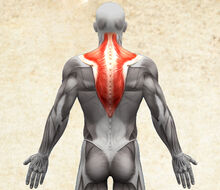
If possible, use a long trap axle. With a short one you won't have a wide enough grip, which is the purpose of this variation.
4 - Eccentric or Starr's crouch
This variation is attributed to Coach Bill Starr. It's supposed to be practiced with heavy weight, so I recommend snatches. It's an isometric to eccentric exercise, so you need to load up more than you would for a regular squat.
- Set your axis on the stops. In an upright stance, you should have the axis at the height of your outstretched fingers.
- Brace yourself and push your hips back far enough so that you can grip the axle just a little more wide than where your thighs reach.
- Squat your shoulders up and slightly back so that you pull your body deeper under the axis. In an upright posture, keep your shoulders raised like this.
- Lower the axis by allowing the shoulders to drop. Assume the starting position and repeat.
5 - Shrinking with rubber
This is a variation suitable for home practice or on the go. All you need is a thick rubber band.
Since the rubber puts the most resistance at the top, you need to stop there. Depending on the thickness of the rubber, you may need to practice significantly more reps to get the desired training effect.
- Grab the rubber so that you have an equal length end in both hands.
- With your arms at your sides, stand on the rubber.
- Bend your shoulders towards your ears.
- At the top, stop and let your shoulders drop back down.
6 - Gittleston's crouch
It should be practiced with each hand separately. A greater range of contraction of the trapezius will be required than for the normal shoulder shrug.
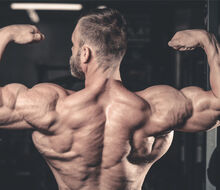
To achieve a peak contraction, the neck needs to move as the arm is raised.
- Sit on a bench with your feet wide apart. Grab a kettlebell or single-arm kettlebell and place it at your hip. Hold the bottom of the bench with your non-exercising hand for stability.
- Bend your shoulder. The top of the movement is higher than you think.
- At the real peak, your neck will bend slightly toward the exercising arm and your head will bend back a little. This movement is natural and there is no need to resist it.
- Pause for a moment at the top, then lower in a controlled manner.
7 - Gittleston twist with landmine attachment
The strength curve of the upper trapezius corresponds to the classic shoulder shrug with landmine. You can use jerks and load up with some serious weight, or ditch them and train your grip with the extension to strengthen your axle thickness.
8 - Kneeling overhead
Variations of the overhead squat are unique because they force the shoulder blades to rotate upwards. The upper trapezius is still heavily engaged, but these variations will also exercise the front sawtooth muscle and the lower portion of the trapezius.
This variation will also improve your positional strength on overhead exercises. It can also be practiced standing, but kneeling will limit the involvement of the legs and force the mid-body to work harder.
- Adjust the stops so that you have to keep your elbows slightly bent. Kneel on a foam roller. Use a wider grip (ideally a market grip).
- Get into position by extending your elbows.
- Raise your axis as high as possible by pulling yourself up through your shoulder blades.
- Keep your elbows extended and lower the axis by working the shoulder blades.
9 - Kneeling kettlebell on one leg
This variation also favors upper scapular rotation. Unilateral loading increases the demands on the middle of the body. The kettlebell's shifted center of gravity presents a unique challenge to your shoulder musculature.
For safety reasons, I recommend practicing this variation with a spotter first. If the kettlebell starts to drop unexpectedly, try catching it with something other than your teeth.
- Hold the kettlebell with your forearm in front of your chest so that it rests on your outer elbow.
- The knee of the working side will kneel on the foam and the non-working foot will be flat in front.
- Push the kettlebell up over your head. It will be held on your forearm and will be behind your body and slightly away from it.
- Pull it up towards the ceiling. Reach for the sky.
- Slowly return your shoulder blades to the starting position. Keep your torso upright and still the entire time.
10 - His breathing contraction
Squat your shoulders with the axis perched on the upper trapezius, as if you were practicing squats with the axis high. This variation takes the arms out of the equation and loads the shoulder blades uniquely and squarely.
There are 2 variants. Both are great for learning the ability to breathe and clench under axial load, but the first variation (video above) focuses on breathing, the second on heavier weight.
Joseph Curtis Hise and other early bodybuilders used breathing squats and shoulder shrugs for "chest expansion". Whether or not this method worked, breathing under load is essential for high repetition training. If you want to train your respiratory muscles, try this variation.
- Load the axle. The weight shouldn't prevent you from taking a full inhale or limit your range of motion while crouching. Use about 30% of the weight for a normal shoulder shrug.
- Place the axle on your upper trapezius, which is above your shoulder blades.
- Slowly take a deep breath while lifting your shoulder blades. Concentrate and get the maximum amount of air into your lungs. Use your full range of motion.
- Pause for a moment at the top, then exhale in a controlled manner and lower your shoulder blades.
- Repeat, including the inhale cycle. Multiple repetitions (15-25) are usually practiced.
11 - His force contortion
Again, you're hunching your shoulders with the axis perched on your upper traps, but instead of focusing on breathing while lifting the load, you're exhaling like you would with typical strength exercises.
Some triathletes load more than their squat max on this exercise. I don't recommend starting out at this weight, but the load should be substantial.
- -Put the axis on your upper traps.
- -Raise your shoulder blades by pushing the axis towards the ceiling. Don't help yourself by moving your hips or pushing with your arms.
- Pause for a moment at the top, then lower in a controlled manner.
12 - His forcetwist with safety axis
If you have it available, the safety axis is the best tool for this variation. It can also be practiced in a standing lunge machine. The comfort and stability of these machines will allow you to load more weight.
13 - Forceful twisting of the vise
Here you will help yourself with a hip movement that allows you to overcome the resistance of the weight and overload this variation. Once you've mastered the technique, your working series should be harder than a classic squat. Since we're not trying to train for weightlifting exercises, the trap axis is also helpful.
- Get into the starting position with a deadlift.
- Get into the vis position by pulling your hips back slightly and dropping the axle a little.
- Bring your hips into extension as if you were trying to jump. Transfer this momentum to the axis and perform a shoulder shrug.
- At the top, pull in and hold the axis. These are not chin-ups. If you have a heavy weight loaded, the bend in your elbows should be minimal.
- Slowly return to the starting position.
Equipment and technology
Foams on the axle
The truth is that a well-developed trapeze will serve as a foam. However, if you don't have a sufficient muscle layer or proper cervical spine morphology, His crouch could be considerably uncomfortable, or even silly, without a foam roller.
If this variation already hurts you during warm-up sets, put that damn foam on your axis. If someone laughs at you for that, they're probably not entirely sure of their sexuality. You're in the gym for a goal, not for your ego.
Tears
Most people can work out with more weight than they can hold long enough. If your primary concern is trapezius development, work out with snatches.
Shoulder rolls
This is a habit in which exercisers intentionally roll the braids of the shoulders as they hunch them. This causes the target muscles to lift and rotate the brachial plexus upward. This causes protraction, retraction, and tilt of the shoulder blades, which are also out of alignment so they do not resist the axis of the load force.
At best, this design of shoulder shrug is lazy and unnecessary. At worst, it is offset by the lower cervical spine and generates a swinging motion. Keep your execution as clean as possible.
Source: www.t-nation-com -Different Shrugs for Different Thugs
By Merrick Lincoln
Author: Šárka Randáčková No posts have been made yet.








