





Focus on your shoulders with these three smartest ways to train them!
 Author: Šárka Randáčková
 Years in the gym can take a toll on your shoulders. The last thing you want is to destroy one of the most important joints in your body even more. Shoulder training should improve this area aesthetically and functionally.
Here are some pain-free strategies to reduce the load on the shoulder joints and maximize the pumping that will lead to growth and strengthening.
1 - Use rubber bands with the one-armed muscles
Increasing tension rubbers are typically used for core exercises, but they should also be the norm in shoulder training. The only problem is the limitations of the equipment. Rubber bands are often too thick and chains too heavy to train a complete range of motion.
The secret is to use the thin rubber bands you find in all gyms now. These have so little resistance that you can use them with one-handed grips.
You can hold both the rubber bands and the handles of the one-handers at the same time when you do the pull-ups and variations of the pull-ups. Stick with the weak elastics and add weight on exercises that you perform with each hand separately. This will train strength, volume, endurance and create metabolic load without overdoing it with range of motion or losing control of shoulder stability.
Another benefit of rubber banding is the ability to train explosively without losing shoulder stability at the top of the movement. The upward resistance of the rubber will allow you to train explosively, but the rubber will increasingly inhibit the contraction at the top. This will exercise the fast motor units in your shoulders well and give them a new, pain-free stimulus to grow.
Remember, you want to train the shoulders explosively with this method. Concentrate on the speed of contraction in the positive part of the exercise and slow down in the negative part. Don't let the rubber pull you down quickly.
2 - Train between traditional planes of motion
Open any anatomy textbook, and you'll see that the deltoid muscles are divided into three basic fiber orientations: anterior, lateral, and posterior. Although common training protocols dictate you practice shoulder flexion, abduction, and extension, this is not the most effective way to train.
Yes, separating the different parts of the shoulders is more effective than working your way to a joint injury using overhead presses alone. But let's try for something more than the standard.
Training not only the three basic planes of motion, but also the space between them, will help you figure out which variation of shoulder exercises is best for your somatotype. You'll be taking into account functional instability, weaknesses, or past injuries. This strategy will give you endless angles to emphasize, add variation to traditional movement patterns, and minimize the chronic stress on the joints that comes from poor execution of overhead presses and pull-ups.

Try the scapular plane strokes that work between the sagittal and frontal planes. These will exercise the fibres between the front and lateral head of the shoulder muscles.
Since many people over-train vertical and horizontal presses, it is imperative to directly exercise the lateral and posterior deltoid muscles. In order to protect your shoulders and build some muscle in these areas, do 2-3x the amount of work on the back shoulder exercises than the front shoulder exercises.
3 - Trigger the metabolic pumping effect
The shoulders usually don't respond to a huge loaded load. The deltoid muscle is composed of mostly slow-twitch fibers, which means that for the average person, training in the range of around 15-20 reps will yield the best results.
Although not everyone is built the same, higher repetition numbers should work for most people, plus they reduce the cumulative load on the joints. In short, less load is less stress on the joints. However, that doesn't give you a reason to train your shoulders softly and not try.
Building shoulder strength and size isn't just about progressively overloading basic movement patterns, it's also about inducing a tissue-pumping metabolic effect. Pumping up has been derided for decades by elite triathletes and other strength athletes who mostly have one thing in common. They are chronically injured. However, working with metabolic load is one of the most intelligent variables you can work with in training to achieve performance, aesthetic, and orthopedic benefits.
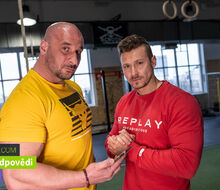
There are a few key methods that will increase the metabolic load on your shoulders, plus they work extremely well for pain-free growth..:
- Increase the rep range over 20 and pump the muscle full of blood.
- Increase the overall volume of work by doing more sets.
- Do both, and shorten your pauses to 20-40 seconds. This will create cumulative tissue fatigue. It's brutal, but your shoulders will grow without joint pain.
Watch a video of upping in a slight forward bend for 30 painful reps and you'll see that metabolic loading is no walk in the park.
I also recommend good supplementation during training to kick-start recovery as soon as possible and get the best possible results from this torture.
Recommended

Nexgen 60 kapslí 2+1
Prom-in Vitamin MK7+D3
Intense Legíny GOLD Nebbia print 827
Nebbia Tank top SNATCHED 627
Source: www.t-nation.com - The 3 Smartest Ways to Train Shoulders
By Dr. John Rusin
Author: Šárka Randáčková No posts have been made yet.








