





Follow these tips and improve your bench!
 Author: Šárka Randáčková
 Below we offer you 6 things you didn't even know you needed to improve your bench press performance!
1 - Footwork - the nerd version
First, let's go over the basics:
- Your head, upper back, glutes and legs are in contact with the bench or floor.
- Shoulder blades are retracted to keep your chest up. The back is slightly arched.
- You lower your axis onto your nipples and keep your elbows vertically below the axis.
- Push the axis up to shoulder level. No further, so you don't lose the retracted shoulder blades.
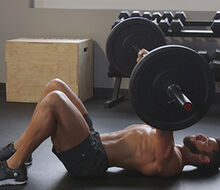
Now something about footwork. The axis may feel like we are pushing away from the chest, but it is actually being pulled by the floor. We're just trying to keep her from falling on it. For maximum force, we have to push ourselves into the floor as well.
The biggest mistake I see is the position of the feet. The classic 90° angle at the knees and feet flat on the ground works with lighter weight, but with a little fatigue and heavier weight it becomes a problem.
Too much angle at the knee joint will force you to lift your butt. And that's not only inefficient, it's literally shameful.
It will be a little harder to lift your butt if you have a little less than a 90° angle at the knees and you have your heels elevated a little bit. The bellies of your feet and toes will do most of the work.
Since the force of the legs will be exerted not only upward, but also a little forward, you will be engaging the quadriceps and the posterior chain. This will improve the quality of the entire exercise. Try it.
2 - Push off the stops as often as you bench
This exercise doesn't get enough love. Not only does it protect your shoulders due to the shortened range of motion - taking away even the trickiest portion - but it also forces you to push from a complete stop.
This is essential for developing strength because it doesn't help your momentum. Moreover, this exercise, by its gentleness, will help you to Bench longevity.
3 - Isometrics to strength
Isometric work generates positional force at different flexion angles in the joint and can also increase mobility. However, here we use it to jumpstart the nervous system before a hard workout.
You can also use this method as a stand-alone workout by simply adding more time and volume to your isometric series. The goal is to exhaust the motor units with a high threshold of engagement and repeat series of about 15 seconds in length.
The key is to work as hard as possible. If you just take it easy, it won't be effective. And remember, with isometrics, the risk of injury is very low. Without movement, it's harder for something to go wrong. So set the joints to the desired angle and go for it.
Practice 1-2 sets before a heavy benching workout. It will be better quality then.
4 - Don't forget the compound sets
A compound series is not a super series. A superseries pairs exercises on unrelated muscle groups. For example, bench and biceps.
A compound series pairs exercises on the same or synergistic muscle group. Like bench and pushups on the bars. This will definitely fatigue the muscles and make them grow. My favorite compound series is quite humbling. It includes a variation of benches and push-ups.
Bench variation doesn't matter much. It could be one-armed push-ups or one of the inclines. It doesn't even matter what version of the push-ups. Circles, on the ground, hands together. It doesn't matter.
What matters is that the bench will force you to train harder and with fewer reps, and the push-ups will get your shoulder blades moving more freely.
5 - Don't forget the contrasting sets
If you want to go even further, make the compound series a contrast series. This will force your muscles to use more of the fast-twitch muscle fibers that you've prepared with heavy exercise first.
In the case of the combination described above, you would practice plyometric push-ups after a heavy bench.
The rules are simple. If you're doing 3 reps in benchi, don't take the 3 rep max. That would leave you with no energy left. Take a weight that you can accelerate with, but is still heavy enough. If you normally load 150 for 3 reps, take it down to 130.
When it comes to plyometric pushups, don't hold back. You're building strength and getting your hands off the ground. Try to get to at least double the reps from benching. 6-8 reps will do.
6 - Power that won't cost you your life - variants without spotter
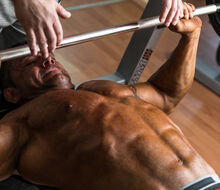
One-handers are a great option. However, the heaviest ones are a challenge to lift into position. And most people will agree that one-handers are not well suited for low-rep training.
So what to do if you don't have a spotter or interest in throwing a barbell on your head?
First, get rid of the cotter pins
If the weight is going to be too heavy and you're going to train without the safety cotter pins, you can always tilt the axle and let the discs fall off. Better to break a few tiles than your ribs.
Take a break underneath like a triathlete
You'll get better reps and the lighter weight will seem heavier. If you're used to bouncing the axis (and you're not overdoing it), I don't disagree, but you have no backup plan when the weight gets heavy.
If you can do 150 with a bounce, you'll probably be dealing with 130 that you run for 3 seconds and pause for 1 second at the bottom. Lower weight is generally a good idea when you're training alone. Save the attempted personal bests for workouts where someone can stand up for you.
Use bulk sets and reps
These are especially useful if you're training with heavy weight and without a spotter.
If you're getting tired, or trying to max out at 5 reps for example, split your sets into bulk. Do 3 reps, rest for 10 seconds, and work off the remaining 2. You'll definitely do better.
You'll manage to recover a little ATP, which will squeeze out another 2 reps. This can be used to your advantage if you're not testing maxes right now.
Practice to technical failure, not absolute failure.
The moment you can't push the weight off your chest anymore, the spotter comes in handy. Without it, I recommend only technique failure. Just stop when your technique starts to fail. If you feel your hips lifting off the bench or your shoulder blades coming off the base, it's time to end the set.
It's not worth risking injury when you're alone in the gym. In that situation, don't go over the edge. Be smart.
Author: Šárka Randáčková No posts have been made yet.








