





Floor press, an unknown but for many exercisers much better exercise than Bench-press!
 Author: Šárka Randáčková
 Floor press is not just for competitive triathletes. It's for everyone, including you. Here are a few reasons why I think so.
There is no other horizontal press with as wide a range of uses as the floor press. It can and should be used by everyone, from beginners to experienced triathletes.
It's basically a bench press without a bench. As you can guess from the name, it is performed lying down on the floor. The floor press was invented by the creator of the hack squat, George Hackenschmidt, when he threw a large axle on himself in 1899 and had to somehow lift it.
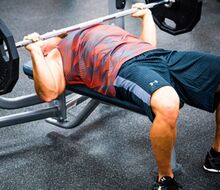
How to train the floor press with a large axis
- Lie down on the floor in a squat rack.
- Assume the normal position for bench pressing (eyes below the axis).
- Keep your legs extended to completely eliminate their work. Do not bend your knees.
- Push your shoulders back and down by bringing your shoulder blades together and trying to push them down toward your ribs.
- Lift the sternum as high as possible.
- Inhale and lift your axis off the rack. Be tight.
- Lower the axis to the sternum in a controlled manner.
- When the triceps touch the floor, hold the tension, pause for a moment to let the momentum gained on the way up help you on the way down, and push the axis back up.
- Push up with maximum effort, straightening your elbows and maintaining good position and tension in your back. Imagine you want to push off the axle and sink into the floor.
How to train floor press with single arms
- Place the single arms on your thighs, then bend your knees and bring them to the starting position. Or someone can hand them to you.
- Push your shoulders back and down by bringing your shoulder blades together and trying to push them down towards your ribs.
- Raise your sternum as high as you can.
- Push the one-armed arms up with maximum effort, bending the elbows and maintaining good position and tension in the back. Imagine that you want to push off from the one-arms and sink into the floor.
- When your triceps touch the floor, keep the tension, pause for a moment so that the momentum gained on the way up doesn't help you on the way down, and push the uniarms back up.
Why floor press?
Floor press is mainly used by triathletes. It has not yet found its way into the general public's awareness. Let's explain why everyone should practice it:
It teaches you the correct technique of pressure
The floor press is a foolproof exercise and instills in you the basic rules of proper pressure. You'll keep your elbows and wrists underneath you. If you don't, the weight will probably fall on either your head or your stomach. The correct path of movement for you will be more or less inevitable.
Because of the omission of the legs, the exercise is a pure push
Omitting the legs simplifies the entire exercise, and the technique focuses only on the push and the muscles involved. The exercise is therefore much simpler. You get more stimulus and more feedback for the push movement. In theory, the exercise is also great for movement pattern awareness.
The exercise is more controlled
You don't have to be a genius to know that holding a weight in your hands and slamming your elbows into the ground is probably not going to be pleasant. The floor press will force you into a controlled pace this way.
Increases tension throughout the body
When your elbows touch the floor, you can't catch your breath. The loss of tension instantly robs you of stability. Since the exercise requires constant tension and a controlled pace, it is great for accumulating volume of work while under tension for long periods of time.
Recommended
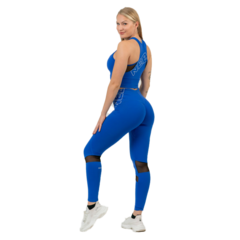
Nebbia FIT Activewear legíny s vysokým pasem 443

Nebbia Crop top mikina MUSCLE MOMMY 619
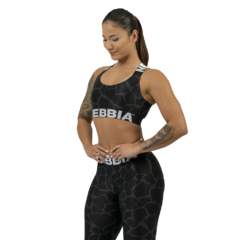
Nebbia NATURE-INSPIRED Sportovní podprsenka 552
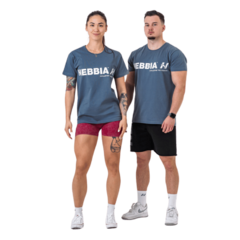
Nebbia Tričko GYM ESSENTIALS 380
Limited range of motion protects your shoulders
Most newbies have problems at the bottom of the benches. This is usually due to shoulder instability or lack of strength and control in the shoulder blade area. Often because of this, they have to change position during reps, which increases the risk of injury. The floor press strengthens the shoulders and the floor itself serves as a feedback increasing the retraction of the shoulder blades and tightening of the upper back.
It is versatile
By avoiding leg assistance and back flexion, the floor press becomes a difficult exercise even for advanced exercisers. It focuses only on upper body strength and by alternating the width of your grip and using special equipment (different axes, chains, etc.) you can target specific weaknesses.
More work, more stress, less risk
The floor press will inevitably increase your strength in the middle and upper benches, without compromising your shoulders. Since the bottom of the benches is the weakness for most exercisers, you can load more weight on the floor press. It's a great way to overload the exercise overall and increase the amount of work done.
For people who have problems with their pectoral muscles and shoulders, this is a great way to be able to continue to bench press. Skipping the extreme positions saves the joints and connective tissues. For the same reason, the exercise is also good for those who have problems with the tendons around the biceps and forearms.
Source: www.t-nation.com - Tip: Better Than Benching
Author.
Author: Šárka Randáčková No posts have been made yet.








