





Improve your bench press in 4 weeks
 Author:
 Regardless of what you call yourself, you should bench using the triple bar technique. It protects your shoulders and handles heavier weights better.
Bench from the stops allows you to improve your technique and understand the feeling of pushing your whole body into the bench and away from the centerline.
The floor press forces us to go through almost the entire path of the bench press movement without engaging our legs (leg drive).
Is your bench press stuck somewhere between 100 and 125 pounds? For most non-competitive exercisers, it is. Those elusive three reels on each side are in sight, and with them comes a bench press max worth talking about.
I was one of those mediocre benchers a few years ago. In fact, I even stopped practicing benches completely. I used the classic excuses like shoulder health and that the bench press was useless for building decent mass on my upper body. At the moment I consider both to be nonsense.
Fast forwarding from two years ago, I've added 45 pounds to my bench. As I approach those elusive 4 reels on each side, I have some advice for anyone who wants to push more in benchi.
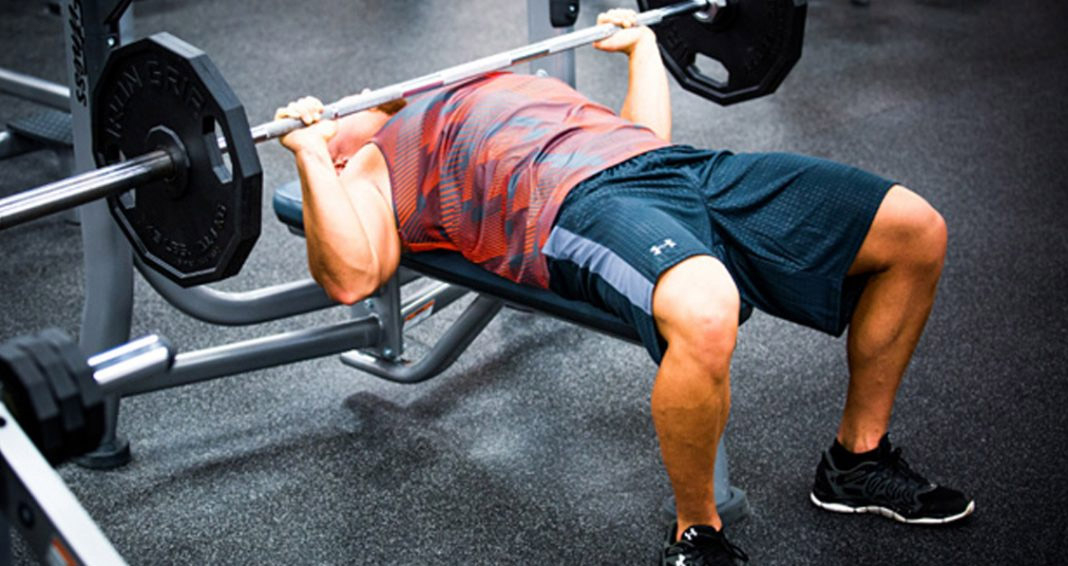
1. Practice the Bench Press a lot more often
Improve your technique. Most people have much more strength potential; they just lack the technique to make it happen. In order to improve, you have to train, a lot. Increasing the volume and/or number of times you train the movement in question will in itself lead to improvement. You simply need to train more so that the body has to recover from more stress, and can do more.
The evidence supporting this claim is everywhere. Why do most gym exercisers have much better numbers in benching than in other exercises? It's simple: since they set foot in the gym, they have some variation of benching in their workout every week. If they could put it together intelligently and someone showed them the technique, most men over 25 would be pushing three reels on each side of the axle in the gym, if they don't already.
Recommended

Nebbia Lounge šortky CLUB D’OR 643

Czech Virus Kidney MAX

Czech Virus Joint MAX InflamaCare
Nebbia Dámský crop top s vysokou podporou INTENSE Mesh 842
This is not an article about technique, but you should push in a triathlon style. It saves your shoulders and you can handle heavier weights better. No matter what you call yourself - bodybuilder, triathlete or fitness enthusiast - you should push like a triathlete. In short, upper back arched and squeezed together, back arched, two points of contact with the bench (upper back and small of lower back), middle grip and feet on the floor. We understand each other.
But the main point is this: Almost every program I do includes at least two variations of the bench press; some as many as four. The frequency with which you bench is also important. If possible, spread out three to four bench press variations over 2-3 training days when you're using lower weights, and cut back to 1-2 variations on 1-2 training days when you're adding weight.
2. Make your bench press heavier
There is never a shortage of people who simplify things. Too often we resort to bench press variations that allow us to load more weight. In a triathlon, this can mean more board press, more bench press with inverted bands, more chains, and a bunch of other tricks designed to overload our presses. They have their place in training, but should be lower on the priority list.
In more commercial facilities where these things aren't available, people usually turn to hidden assistance ("You gave it to yourself."), partial reps, and ridiculous techniques to give them the proper leverage to load more weight. Think of the goofballs who have their ass thirty inches above the bench, or the ones who bounce their axis off their sternum. They usually push the same weight every week, the same style for months, or even years.
In order to bench more often, you'll need to find productive ways to do it that will even take weight off your axis. This will allow you to improve your technique, target weak points, and in return, you'll get the opportunity to improve in both areas and keep your effort level at a level that you can recover quickly.
Two effective ways to make your bench press harder:
- Change your grip
- change the tempo
In terms of grip, narrower improves wider, so I recommend you push more with a narrow grip.
As for tempo, work with breaks. Do multiple chest stops for 1,2 or even 3 seconds, and do similar at different points in the concentric portion of the bench press (for example, 5cm above your chest and halfway through the burst).
3. Practice pushing away from the chest and LOCK-OUT
It's very important to train two crucial points of your bench press - the bottom from the chest and the lock out (push up). I can safely guess that the most common place to have a problem during the bench press is the bottom. Having said this, if you have enough strength at the top of the movement, it can make up for a lackluster push off from the bottom, and possibly save the entire attempt.
To train more strength from the chest, bench from the stops. The barbell bench can do great things. One of them is understanding that you have to want to push into the bench and away from the centerline. Then it prevents the stretch reflex from helping with stored kinetic energy during the attempt. Finally, it minimizes eccentric pressure because the exerciser can essentially throw the weight into the stops in a controlled manner. That minimal eccentric pressure makes this exercise another great way to push but not interfere too much with recovery.
Use the floor press to overload the muscles responsible for the upper part of the pressing motion. The floor press forces us to push through most of the range of motion of the bench press (depending on how wide your torso is) without using leg drive. Not being able to use the legs will often force us to use lower weights, making this exercise another useful tool to bench more but not add too much to your overall fatigue.
4. Build your training smarter
How do you bring it all together? You can organize your training in different ways, but you can use this right away. It's a simple 4-week training system that takes into account the advice described above.
Put this mini program in place of your regular benching-based exercises. You can continue with lighter one-arm pushes for more reps in any workout - just limit it to one workout and one type of one-arm push.
Note: If you can only bench twice a week, combine days 1 and 3. If you can only bench once a week, combine days 1 and 3 and cancel day two completely.
WEEK 1
Day 1:Bench Press 6x5 (30 Reps) @ 65% 1RM
- All reps with chest pause
Day 2: Floor Press 4x6 @ 50% 1RM
- Light pause with elbows on the floor.
Day 3:Bench press from the stops 10x1 @ 60% 1RM
- Bars 5cm from chest , 30-45 second pause between reps.
WEEK 2
Day 1:Bench Press 5x5 (25 ,.O") @ 70% 1RM
- Pause on chest for 2 seconds for first and last reps.
Day 2:Floor Press 3x6 @ 55%1RM
- Light pause with elbows on the floor.
Day 3:Bench press from the stops 8x1 @ 65% 1RM
- Bars 5cm from chest , pause 45-60 seconds between reps.
WEEK 3
Day 1:Bench Press 5x4 (20 Reps) @ 75% 1RM
- Stop first rep at chest for 3 seconds.
Day 2:Floor Press 4x4 @ 60% 1RM
Light pause with elbows on the floor.
Day 3:Bench press from the stops 6x1 @ 70%
1RM
Bars 5cm from chest , pause 60-90 seconds between reps.
WEEK 4
Day 1: Bench Press 4x4 (16 Reps) @ 80% 1RM
- Stop first rep at chest for 2 seconds.
Day 2:Floor Press 3x4 @ 65% 1RM
- Light pause with elbows on the floor.
Day 3:Bench press from the stops 4x1 @ 75% 1RM
- Bars 5cm from chest , pause 90-120 seconds between reps.
Note: RM or REP MAX means rep max.
Support your performance with quality supplementation!
In our shop you can choose from a lot of proteins, gainers, amino acids(bcaa, glutamine, ...), vitamins and minerals, creatines,fat burners and much more. So don't hesitate and step up a notch!
Source: www.t-nation.com
Author.
No posts have been made yet.








