





Damn good alternatives to the basic exercises!
 Author: Šárka Randáčková
 Although it is not a popular opinion, it is possible to improve strength and volume without squats, benches and deadlifts! This tunnel vision is even the reason why many athletes don't improve as much as they would like in the gym! Too many people are practicing exercises that their body isn't ready for (yet).
If you can't do a squat with your own weight without pain, you definitely shouldn't try to add a barbell to your back! That is, until your mobility allows you to perform them painlessly.
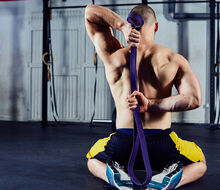
You have countless options. There are choices that won't hurt or irritate your injuries. Before we get into them, let's take a look at why basic exercises can cause pain for some people.
1. Bench press with a large axle
This is all about internal rotation of the shoulders. A lot of people cause it by sitting endlessly. Bench pressing exacerbates this shoulder position.
Add to this the fact that the large axis doesn't mean any great freedom of movement of the shoulder joint, and you have a recipe for shoulder pain.
2. Strict pressure with a large axis overhead
Very few people can do this exercise without pain. Why? You need to keep the center of the body retracted (ribs down) at all times to protect the spine. Since most people can't do this, hyperextension of the lower back and shearing forces on the spine occur. And that's not good.
You need proper mobility of the shoulders and thoracic spine for quality overhead presses. At the same time, you need to be able to keep your midsection and glutes contracted/engaged.
3. Deadlift with straight axis
If you're practicing it wrong, it's probably the most damaging exercise for your spine! Bending over to lift a load puts high demands on your ankles, hips and spine. It's hard to get them into a safe position.
My clients rarely practice this variation. There are many safer alternatives that still build strength and volume.
4. Back squat
I love squatting, but that doesn't mean everyone should do it. Even without a loaded axle on your back, a deep squat requires good ankle, hip and thoracic spine mobility. However, most people can't do a competitively acceptable squat even with their own weight.
Add to that the axle, and you'll be putting a strain on a dysfunctional movement pattern (borrowed from Gray Cook). And that's not good.
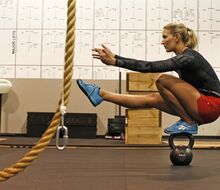
Now let's take a look at some alternatives that will make you feel better and get rid of the nagging pain.
Bench press alternatives
1. Floor press with Swiss axis
- Any floor press will reduce the range of motion for your shoulders, which is a benefit in terms of injury prevention.
- With the Swiss axis, you can choose a neutral grip that will induce external rotation in the shoulders.
- With a straight axis, the rotation in the shoulders is inward.
- You will also be able to load more weight compared to the single arm.
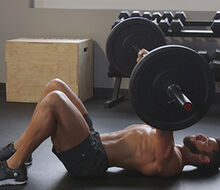
2. Floor press with single arms (with external rotation)
- You'll use a shortened range of motion in your shoulders, which will increase triceps involvement.
- Rolling the palms inward will cause the shoulders to externally rotate, saving them pain/tension.
3. One-arm pressure (slightly negative)
- Stuff one or two discs under the front leg of the bench. This will reduce pressure in the shoulders and help to engage the pecs more.
Alternatives to overhead pressure
1. Overhead press with rubber band and landmine attachment
Any overhead pressure performed with both hands is very demanding on the safe position of the spine. Pressures performed strictly and directly overhead also require considerable mobility of the shoulders and thoracic spine.
- Since the aforementioned attributes are lacking in most people, this one-handed variation with a landmine attachment can be great.
- The forward tilt and arm angle help reduce the range of motion of the shoulder and reduce hyperextension of the lower back, which relieves the spine.
- This variation can be practiced with or without a rubber band. The latter adds more resistance at the end of the exercise.
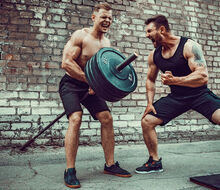
2. Overhead pressure with trap axis (from stops)
In terms of mobility, it is easier to practice overhead presses while kneeling on one leg. In addition, a neutral grip ensures a more secure shoulder position.
- This exercise looks a little strange, but it's great.
- It's definitely more comfortable for the shoulders than strict overhead presses.
Alternatives to the deadlift
1. Deadlift with trap axis
This is my favorite exercise for clients. They improve fantastically with it, and they don't risk spinal injuries. Why is that?
- Weight distribution. The handles on the sides require less mobility and allow you to use more leg strength. In a classic deadlift, the entire exercise can work out your lower back.
- Yes, the classic deadlift is great for anyone who can get into an optimal position that doesn't compromise the spine. But unfortunately, that doesn't apply to the mass public. It's more likely to harm the masses.
- This variation is safer, allows exercisers to increase strength and volume, and greatly reduces the potential stress on the spine.
Alternatives to the back squat
1. Box squat with landmine attachment
This is one of my favorite variations of the squat, for several reasons.
- Healthy shoulder position. The front weight is definitely safer for the shoulders than the classic squat.
- Engaging the center of the body. The latter has to work to stabilize the spine, as there is a decent load on the front of the body.
- Potential for loaded weight. This can be considerably higher than goblet squats with single-arm or kettlebell dumbbells.
2. Squat from the vis with landmine attachment
- This variation puts even less strain on your spine because your weight is right in the middle and between your legs. This allows you to rely solely on your legs and more or less leave your back out of the equation.
Remember this
- You definitely don't have to limit yourself to squat, bench and deadlift for volume and strength.
- These are great ways to get to your dream goal, but they're not the only ways.
- Work with exercises you can perform without pain and don't force your body into risky positions.
Source: www.t-nation.com - Damn Good Alternatives to the Big Lifts
By Dan North
Translated by: Jaromír Uhlíř
Author: Šárka Randáčková No posts have been made yet.








