Liposomal vitamin C | A miracle or a money-maker?
 Author:
 If you've been exercising for a few decades, you may have gotten used to it and it doesn't excite you at all. But if you're just getting started with going to the gym, you may be tempted from time to time. Don't know what we're talking about? It's about "revolutionary" supplements that work unlike any other. Everyone will remember how blessed were the would-be effective forms of creatine, or with what zeal in the eyes of many bikinis in an attempt to lose weight they bought l-carnitine. But the hottest current trend is liposomal vitamin C.
And while for some it is clearly a marketing ploy to make money, some believe it is the future of all medicine. Where is the truth? For the purposes of today's article, we decided to put impressions and preconceptions aside and study the available scientific studies.
Article Content:
- The most important things about vitamin C
- On what principle does liposomal vitamin C work?
- Do I need liposomal vitamin C?
- What can I take away from today's article?
The most important things about vitamin C
To make today's article easy to grasp and not get straight to the point, a brief introduction to vitamin C itself and its forms is necessary.
Vitamin C is one of the water-soluble vitamins and performs a number of indispensable functions in the body. Perhaps everyone is instilled from an early age to support immunity by eating fruit - but there is much more to it than that, this substance is responsible for collagen synthesis, supports iron absorption and the formation of white blood cells. It should also be pointed out at the outset that vitamin C is abundant in nature - the highest concentrations are found in acerola, rosehips, currants, kale, kiwi and the well-known citrus fruits.
The vitamin C found in fruit or vegetables has exactly the same structure as artificially produced l-ascorbic acid. It is therefore important to know at the outset that the metabolism, availability and subsequent effect of synthetic and natural vitamin C will be the same.

Orange juice contains the same vitamin C as l-ascorbic acid capsules
However, the truth is that if you consume a lemon, a currant or any other vitamin C-rich fruit, you are ingesting not only the vitamin, but also flavonoids, terpenes, minerals, pantothenic acid and other substances that we can synthetically produce, but usually do not add to vitamin C supplements because of their higher cost.
Of course, there is also a lot of research on this topic that finds no difference between the usefulness of l-ascorbic acid, l-ascorbic acid with bioflavonoids and the Ethyl-C form. The problem, however, is that the utility rate of either of these forms is not staggering because of the problematic metabolism in the digestive tract. And so comes liposomal vitamin C...
On what principle does liposomal vitamin C work?
Although the issue of liposomal drugs and dietary supplements is somewhat complex, we will try to explain it as simply as possible. You can think of a liposome as a kind of spherical structure made up of phospholipids (lipids containing phosphorus) enriched with phosphatidylcholine. These particles encapsulate either a drug or de facto any dietary supplement, such as vitamin C. The liposome itself then protects vitamin C against damage in the digestive tract and increases its bioavailability.

The stumbling block is that this issue would be worth more thorough research and more scientific papers. Although the technology of a certain "encapsulation" of the active ingredient in the liposome looks promising, today there are only 12-15 such drugs on the global market (these figures vary depending on the source). Current scientific studies, however, suggest that liposomal vitamin C actually has better utility than conventional l-ascorbic acid; on the other hand, the authors add in the same breath that not enough human studies have been done, although the concept looks really promising.
It is equally worth saying that injection, which is offered by certified laboratories in every major city and avoids any degradation of the active substances, has had several times better results on increasing the concentration of the vitamin in the blood plasma.

If you eat a healthy, balanced diet, you can cover a good portion of your vitamin C needs with your diet alone. Tablets can only be a supplement.
Do I need liposomal vitamin C?
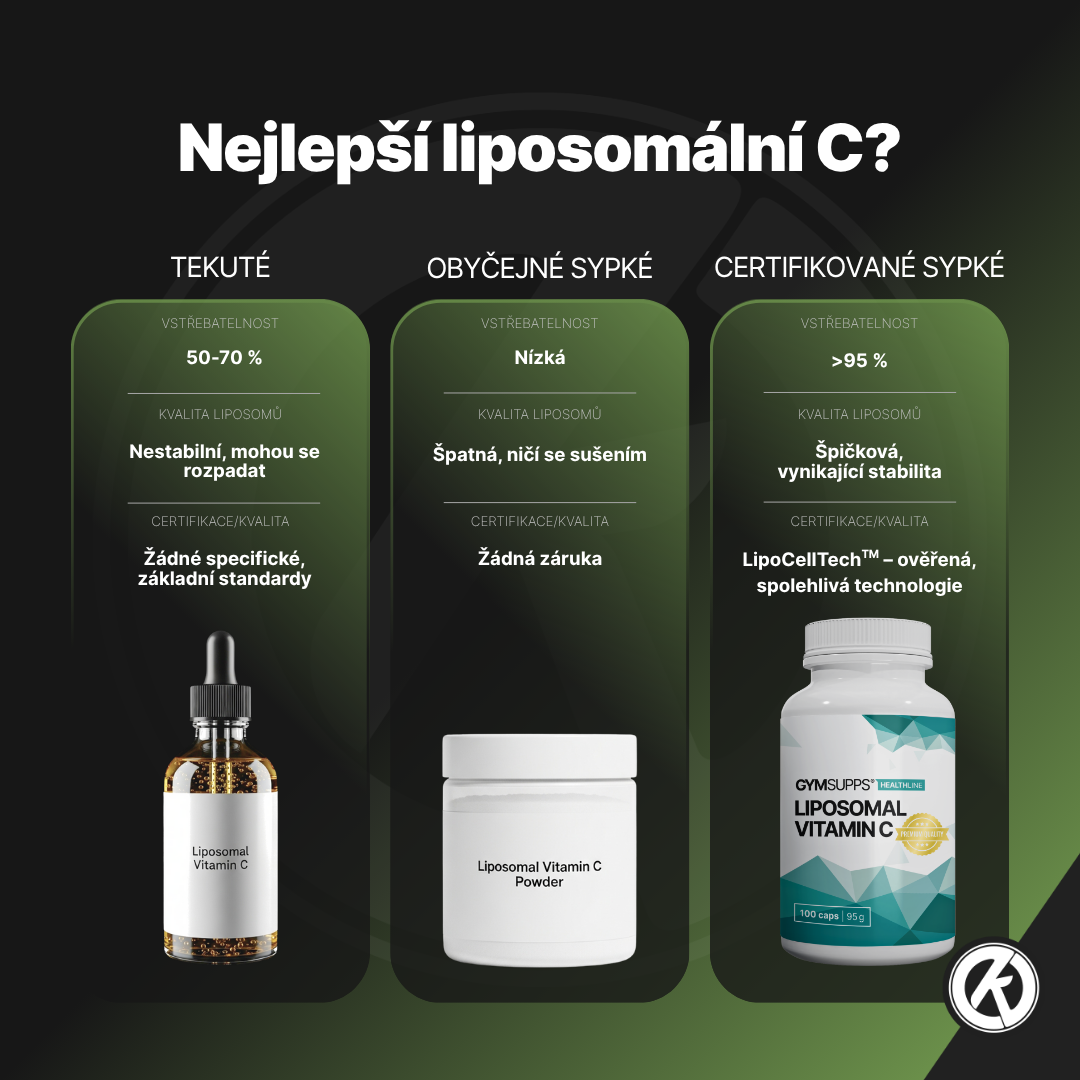
Let's summarize what we already know. Conventional vitamin C does not have who knows how dizzying a utility. While some findings suggest that at doses of around one gram, absorption is about 50%, others point to about 25%. In contrast, liposomal vitamin C seems to reach up to 95% availability, which is a really nice number. And the injectable "C" is unbeatable, and you get a dose in the order of a few grams into the body with maximum possible absorption. But of course you pay extra for it and the application is much more time consuming.
But is liposomal vitamin C worth it? It depends primarily on your financial means. It is important to know that while the prices of the average vitamin C start at around 100 CZK, the prices of the liposomal one start at four times that. And that's a difference that most of us have already made up our minds about.
If you have long-term problems with vitamin C and, for example, you cannot eat fruit for health reasons, it is definitely worth thinking about a better form and we would even recommend it. But if you are a classic athlete, who would like to supplement some vitamins in the winter months to support your immunity in addition to a varied and healthy diet, ordinary "C" will be sufficient for you.
.png)
What to take away from today's article?
If you have a vitamin C deficiency for a long time and you have decided to invest more money in food supplements, the intravenous application, which is offered by a number of different clinics and other medical facilities , seems to be the sovereign best. It may be more expensive, but it raises the vitamin level much more and much more effectively. The second choice in order may actually be liposomal vitamin C, which achieves a higher potency.
However, if you are a recreational athlete who eats fruit regularly and wants to boost your immunity with some supplements, capsules of plain l-ascorbic acid will be more economical and quite sufficient. Although liposomal vitamin C may have some benefits (either due to its better bioavailability or those related to its phosphatidylcholine content), it is not a fundamentally better solution for ordinary athletes due to its higher price.
Recommended

GymSupps Vitamin C
Vitamin C 100cps 1+1
Czech Virus Liposomal Vitamin C
GymSupps Liposomal Vitamin C
No posts have been made yet.