





Ghee can offer you more than just butter!
 Author:
 With the ever-increasing popularity of nutritional trends such as various ketodiets, fats have established a firm position in our diets, and this is of course only good. Fats are a very important macronutrient that has many important functions in the body.
But that's not really what we're going to talk about today - today, we're going to take a look at ghee, a transfused butter that has been around for many years, but has become really popular in recent times and is rightly considered a health-giving fat. Ghee is one of the basic healing ingredients in Ayuvedic therapies, and today we'll take a closer look at this food packed with health-giving fats.
Article content:
- Theoretical window - what is ghee?
- Ghee vs. butter
- Benefits of eating ghee
- How to make ghee at home?
- Where to use it?
Theoretical window - what is ghee?
We can't start with anything other than the traditional theoretical window. Ghee is very similar to regular butter, but unlike butter, ghee takes longer to heat up, giving it a natural nutty flavour and a higher smoke point than butter, meaning we can heat it to a higher temperature before it starts to release harmful substances.
Although ghee is actually made from traditional butter, it does not raise cholesterol levels and has a very positive effect on digestion. Ghee is also rich in beneficial nutrients and contains several important fatty acids that are important for health. Due to its nutritional content, ghee is recommended as a suitable fat even for reducing body fat.
Ghee vs. butter
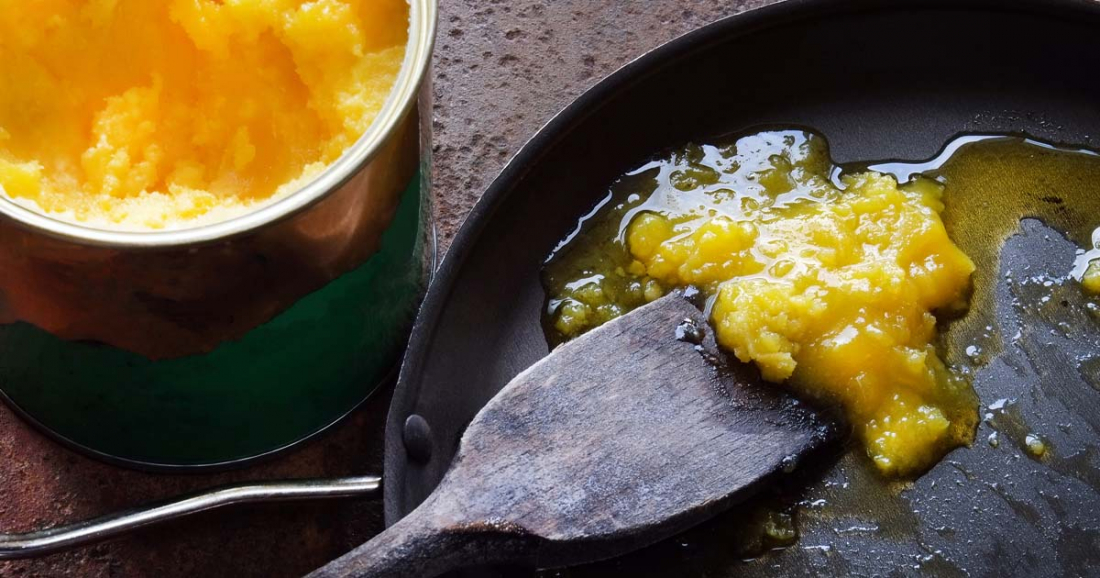
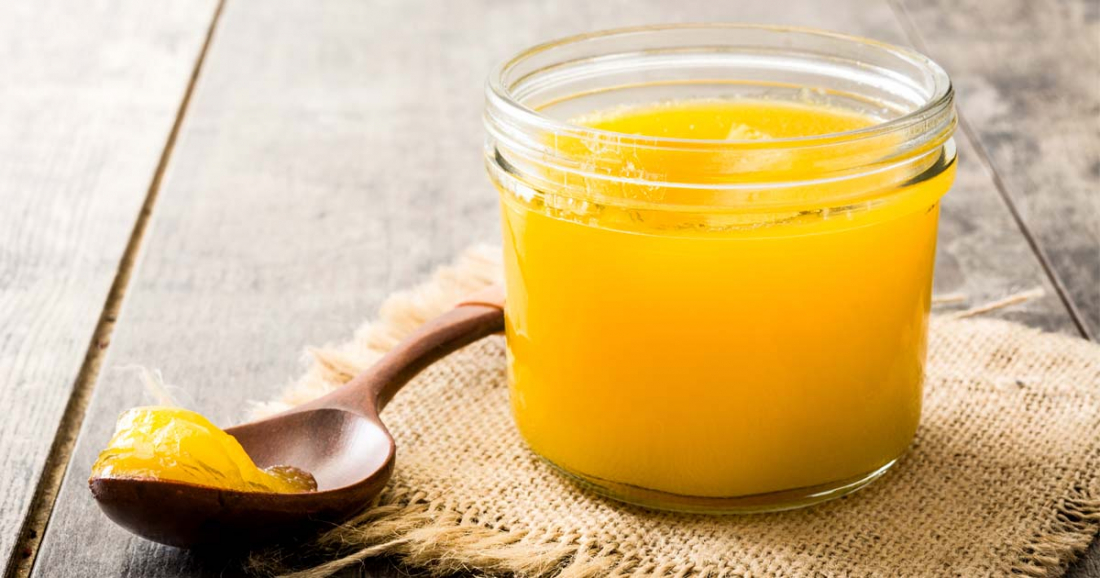
Ghee is created by slowly heating regular butter. The heating starts to separate the individual components such as lactose, sugar and milk proteins. After a while, all the water evaporates and the sugar and lactose are manually removed. At the end, we are left with a clear golden liquid - ghee. In terms of nutritional composition, ghee is essentially 100% fat compared to butter. Compared to butter, ghee contains almost double the amount of short- and medium-chain fatty acids.
These types of fats are metabolized differently in the body than long-chain fatty acids and studies show that they are not associated with the development of heart disease. Ghee retains all of its health-promoting micronutrients - especially vitamins A and E and minerals such as potassium, magnesium and iron - even after it has been defatted. It also contains butyric acid, which protects the intestinal mucosa, is anti-inflammatory, helps maintain insulin levels, lowers cholesterol, breaks down fats, promotes muscle growth and acts as a powerful antioxidant.

Ghee also has a higher smoke point than butter, which means it can be heated to a higher temperature without the risk of oxidation and the formation of harmful free radicals. In addition, the removal of casein and lactose makes ghee a nutritional alternative for people who are lactose intolerant or allergic.
In addition, ghee does not need to be refrigerated because it does not contain water, which causes rancidity. There is also a slight difference in taste - butter tastes creamy and essentially sweet, whereas ghee is nutty, more pronounced and intense. It adds great flavour and a wonderful aroma to dishes. Let's take a closer look at the nutritional benefits of ghee.
Benefits of eating ghee
High smoke point
The first and key benefit of ghee is the fact that it has a high smoke point. The smoke point is the temperature at which the oil or fat begins to burn and smoke. Heating the fat above its smoking point increases the risk that the fat will oxidize and begin to produce harmful free radicals. Unfortunately, most cooking oils with a high smoke point are not exactly extremely beneficial to health. Canola oil, peanut oil, corn oil and soybean oil are usually genetically modified and also often partially hydrogenated to increase their stability.
Ghee, on the other hand, is an excellent choice for cooking food due to its high smoke point and health benefits. The smoke point of ghee is around 250 °C, while that of butter is only around 130-150 °C. This means that you can safely use ghee for baking, roasting and frying without the risk of destroying the important nutrients it contains and without having to worry about the formation of harmful substances.

Ghee contains a variety of fat-soluble vitamins.
If you swap traditional butter or frying oils for ghee, you will add a good dose of important fat-soluble vitamins to your diet. Ghee is rich in vitamins A, E and K, nutrients that are absolutely crucial for optimal functioning of the body. This can be especially important if you suffer from any digestive conditions such as leaky gut syndrome, IBS or Crohn's disease, as your body may have difficulty absorbing these fat-soluble vitamins. In addition, ghee, as a pure fat, helps to improve the absorption of the aforementioned micronutrients, thus contributing to the fulfillment of the necessary daily doses.
It is suitable for allergy sufferers - it is lactose and milk protein free!
Another great advantage, which will be appreciated by people with milk allergies or intolerances, is the fact that ghee does not contain casein or lactose, as they have been removed from the butter during the reheating process. If you suffer from any dairy-related allergies, ghee is the ideal alternative to conventional butter or other frying fats.
It has a high CLA content.
Ghee is an important source of conjugated linoleic acid (CLA), a fatty acid that is associated with a long list of health benefits. Some studies have found that CLA may be effective in reducing body fat, preventing cancer, reducing inflammation, and may even play a role in lowering blood pressure. It is ideal to use ghee from grass-fed cattle, as the dairy products of these animals are the richest in CLA.
It is an important source of butyric acid.
Butyrate or butyric acid is a short-chain fatty acid that plays a central role in gut health. This very important fatty acid is also produced by the intestinal flora when we consume enough fiber. As the primary source of energy for the cells in your colon, butyrate is a key component to supporting a healthy gut microbiome, which plays an integral role in overall health and proper immune system function. Research suggests that it may also influence insulin levels, suppress inflammation, and may also help alleviate the symptoms of digestive diseases such as Crohn's disease and ulcerative colitis.
Ghee - will also support bone health.
We mentioned above that ghee contains vitamin K. Vitamin K is essential for many aspects of health - it affects blood clotting, heart health, brain function, and to top it off, it is very important for bone health and strength. This is because vitamin K is directly involved in bone metabolism and increases the amount of a specific protein that is needed to maintain calcium in the bones. Ghee may not be the greatest source of vitamin K, but when combined with a healthy, balanced diet and adequate amounts of exercise, you are well on your way to ensuring adequate intake.
It has a beneficial effect on digestion.
As mentioned above, ghee is an excellent source of butyrate, a short-chain fatty acid that is essential for maintaining optimal digestive health. Butyrate provides energy to the cells in the colon, supports optimal intestinal barrier function and combats the development of inflammation. In addition, some sources state that butyric acid may help with constipation and promote peristalsis (motility) of the intestines.
It reduces the development of inflammation.
Once again, we praise ghee as a source of butyric acid because one of its important effects is that it blocks inflammation that can lead to chronic diseases such as arthritis, inflammatory bowel disease, Alzheimer's disease, diabetes, and even some cancers. Of course, just eating ghee is not enough, but you need to pay attention to your overall lifestyle and healthy diet.
How to make ghee at home?
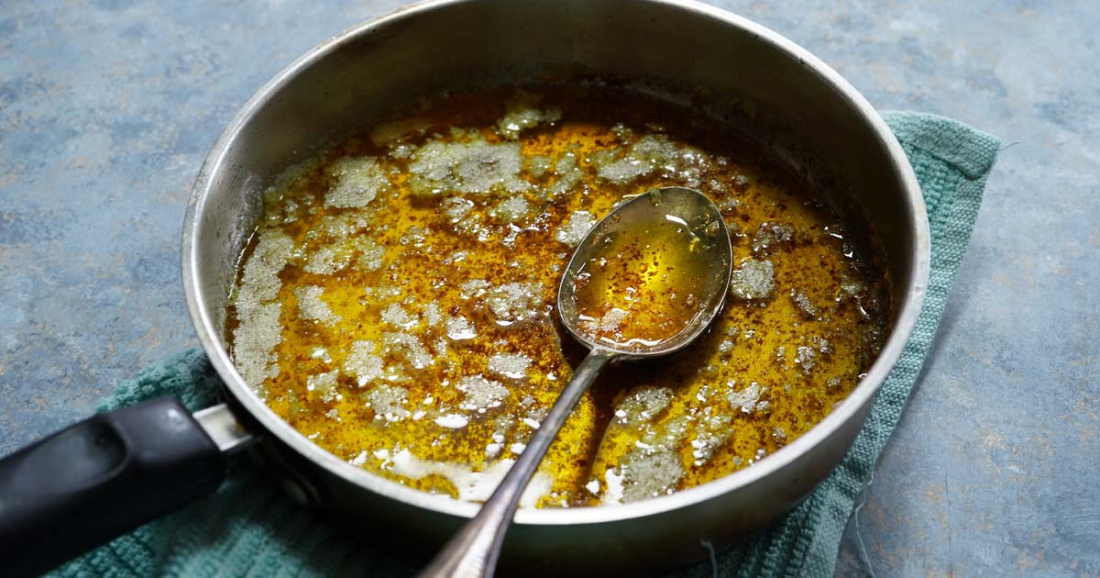
You can make ghee very easily at home, you just need to follow the procedure so that the milk proteins don't burn too much. All you need are a few ingredients - butter, ideally from grass-fed cattle, a suitable container for reheating, a cloth and a container to store the ghee in. Heat the butter and let it bubble for about 20 to 30 minutes. During this time, three layers will form - a foam on the top, which you remove with a spoon, a layer of liquid butterfat in the middle and a milk protein deposit on the bottom, which will eventually strain out.
The signal that the ghee is ready is a golden colour, a slight nutty aroma and a brownish protein deposit at the bottom of the butter. Allow the ghee to cool slightly and strain it through a cloth to catch the milk protein and transfer it to the container in which the ghee will be stored. Yes, that's how simple making homemade ghee, the nutritional treasure of diets, is.
Where to use it?
You can use ghee in place of regular butter - that is, under eggs and other fried foods, in desserts, in savoury doughs and even on bread. Just beware, although it is a good part of a healthy diet, it should be consumed in reasonable quantities as it is a high calorie food. Although it contains many beneficial nutrients and fats, this does not mean that its consumption can be unlimited. But I'm sure you already know that!
What to take away from the article?
Ghee butter has been known around the world for many years, but it is only in recent years that it has become really popular here. It is a source of healthy fats, heaps of fat-soluble vitamins and has a high smoke point, making it an ideal fat for cooking foods. Ghee has a beneficial effect on digestion and a host of other health benefits thanks to its high butyric acid content. You can easily prepare ghee at home and benefit from its rich list of benefits.
Recommended
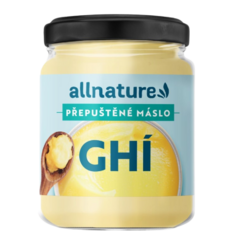
Allnature Ghí
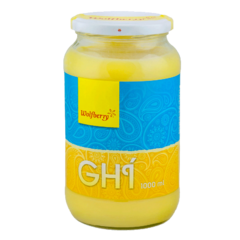
Wolfberry Ghí
Sources:
Gaullier, J. M., Halse, J., Høye, K., Kristiansen, K., Fagertun, H., Vik, H., & Gudmundsen, O. (2004). Conjugated linoleic acid supplementation for 1 y reduces body fat mass in healthy overweight humans. The American journal of clinical nutrition, 79(6), 1118-1125. https://doi.org/10.1093/ajcn/79.6.1118
Zulet, M. A., Marti, A., Parra, M. D., & Martínez, J. A. (2005). Inflammation and conjugated linoleic acid: mechanisms of action and implications for human health. Journal of physiology and biochemistry, 61(3), 483-494. https://doi.org/10.1007/BF03168454
Daley, C. A., Abbott, A., Doyle, P. S., Nader, G. A., & Larson, S. (2010). A review of fatty acid profiles and antioxidant content in grass-fed and grain-fed beef. Nutrition journal, 9, 10. https://doi.org/10.1186/1475-2891-9-10
Cushing, K., Alvarado, D.. M., & Ciorba, M. A. (2015). Butyrate and Mucosal Inflammation: New Scientific Evidence Supports Clinical Observation. Clinical and Translational Gastroenterology, 6(8), e108. https://doi.org/10.1038/ctg.2015.34
Gao, Z., Yin, J., Zhang, J., Ward, R. E., Martin, R. J., Lefevre, M., Cefalu, W. T., & Ye, J. (2009). Butyrate improves insulin sensitivity and increases energy expenditure in mice. Diabetes, 58(7), 1509-1517. https://doi.org/10.2337/db08-1637
Booth, S. L., Broe, K. E., Gagnon, D. R., Tucker, K. L., Hannan, M. T., McLean, R. R., Dawson-Hughes, B., Wilson, P. W., Cupples, L. A., & Kiel, D. P. (2003).Vitamin K intake and bone mineral density in women and men. The American journal of clinical nutrition, 77(2), 512-516. https://doi.org/10.1093/ajcn/77.2.512
Rivière, A., Selak, M., Lantin, D., Leroy, F., & De Vuyst, L. (2016). Bifidobacteria and Butyrate-Producing Colon Bacteria: Importance and Strategies for Their Stimulation in the Human Gut. Frontiers in microbiology, 7, 979. https://doi.org/10.3389/fmicb.2016.00979
Pituch, A., Walkowiak, J., & Banaszkiewicz, A. (2013). Butyric acid in functional constipation. Gastroenterological Journal, 8(5), 295-298. https://doi.org/10.5114/pg.2013.38731
Hunter P. (2012). The inflammation theory of disease. The growing realization that chronic inflammation is crucial in many diseases opens new avenues for treatment. EMBO reports, 13(11), 968-970. https://doi.org/10.1038/embor.2012.142
Montgomery, M. K., Osborne, B., Brown, S. H., Small, L., Mitchell, T. W., Cooney, G. J., & Turner, N. (2013). Contrasting metabolic effects of medium- versus long-chain fatty acids in skeletal muscle. Journal of lipid research, 54(12), 3322-3333. https://doi.org/10.1194/jlr.M040451
No posts have been made yet.








