





Train better even if you don't have ideal body proportions! Part 1
 Author: Šárka Randáčková
 Have you ever wondered why some practitioners are exceptional at one exercise and completely average at another? A big part of it has to do with leverage ratios, which can be attributed to your body proportions.
Take Lamar Gant, for example. In 1985, he became the first person to deadlift five times his bodyweight. He weighed 60 pounds and managed 300. Gant had some of the longest arms ever seen on a human being. This means that even in a normal stance, his range of motion was miniature.
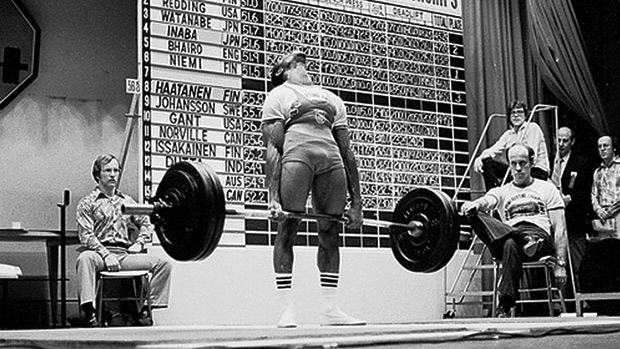
Don't get me wrong, Gant was an incredible triple jumper who, despite his long arms, also held records in the benches. I don't dispute his accomplishments. I'm just saying that in the deadlift, it helps your bridge if you can scratch your knees with your hands while standing.
What does this have to do with training
It's not rocket science. Most people just need a reasonable training plan with some additions and consistent effort to achieve their goals. The real secret is constant work on weaknesses. And that's a two-stage process:
- Weakness identification.
- A training plan that will improve the weaknesses.
This is where most people make mistakes. It's also often hard to see weaknesses when you don't have an outside view of yourself.
Understanding your body proportions and mechanics can help you spot weaknesses. You then have to make a training effort to keep your body in balance.
Why are body proportions important?
Because it will determine the load on your muscles during training. This will then determine how much those muscles will be stimulated by specific exercises.
We all know that guy who has fantastic, well-developed quadriceps just from squatting. Many people will also tell you that they don't do many pull-up exercises for their back, but rather just do heavy deadlifts.
Proportions are behind a lot of this.
Take me for example. I have ridiculously long legs, especially my thigh bones, and my torso is like I stole it from Gimli in Lord of the Rings. That's about the worst physique imaginable for squatting.
In order to keep usu above my center of gravity while squatting, I need such a ridiculous forward bend that my squat looks like good morning. I'll never train my legs right like that. Most of the work goes into the glutes and lower back.
My wife, Naomi, is built the opposite way. Even on the bottom of a squat, she can be pretty upright. So the load is much more even on the squat and her lower back and glutes are rather underloaded.
So if we were both aiming for an even training for full body strength, we should already make a difference here.
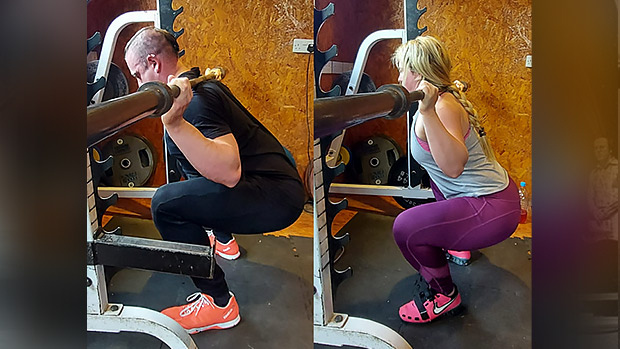
In the picture you can observe a giraffe with the torso of a dwarf (me- left) versus a human with human proportions (Naomi - right).
You can also see that I have a bigger butt than Naomi, thanks to all those years of squatting. It's the levers.
Which proportions are important?
To plan an effective workout, gather some simple information and measurements:
- Height - Please, I don't want to explain this.
- Leg length - Measure the distance between the anterior superior iliac spine (ASIS - look it up) and the bony prominence of the ankle.
- Calf length - Measure from the bony prominence of the ankle to the bottom of the kneecap.
- Femur length - This is the length of the leg minus the length of the fibula.
- Arm span - Measure from one middle finger to the other with the arms extended. You will need help with this one.
- Arm length - Measure the length from the top of the shoulder to the elbow.
- Elbow length - Measure from the elbow to the bent wrist.
You can use these values to determine your anatomical proportions, and create your workout accordingly.
Upper body proportions
Here you will compare your arm span to your height:
- Short arms - your arm span is less than 1 cm greater than your height.
- Average arms - your span is 1-5 cm greater than your height.
- Long arms - your span is more than 5 cm greater than your height.
What if you have average arms? You'll need to dig deeper and measure your ulna against your humerus:
- Short ulna - will make up 75-78% or less of the length of your arm bone.
- Average ulna - will make up 79-84% of the length of the humerus.
- Long ulna - will make up 85% or more of the length of the humerus.
Notes:
- If you have a short or average ulna, it basically means you have long arms.
- If you have a long ulna, you will have short arms.
Recommended
Czech Virus Essential Minerals
Nebbia Bubble Butt legíny LIFT UP 558
Nebbia Crop top tílko GYM THERAPY 618
Nebbia Legíny se síťkou s vysokým pasem PERFORMANCE 480
Training recommendations for long-armed exercisers
They will have a mechanical advantage in deadlift exercises. The opposite will be true for push exercises.
Plan your training according to these recommendations:
- Practice 25-50% more assistance work for push exercises than for pull exercises.
You'll probably be relatively weaker on these exercises, so you'll need to spend more time on them.
- Concentrate more on unilateral exercises.
Long arms lead to easier imbalances. Unilateral exercises should keep this in check.
- Concentrate on exercises that emphasize shoulder stability.
Longer range of motion requires greater stability. This can be achieved by slow starts, pauses, techniques using elastics and special axes. Or it can be as simple as holding the top position at the beginning and end of a set.
- Concentrate on push exercises that improve pure push power.
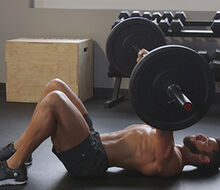
Your compression muscles will naturally lag. Complex exercises where other muscles can do the work probably won't work as well. In benching, for example, a good leg drive can take a lot of work off the pectoral muscles. Push press is the same thing. Try the floor press, spot press and positive bench press.
- Practice isolated assistance exercises for chest and arms.
You will need to train isolated biceps and triceps. Otherwise, you won't grow. Some don't consider them necessary functional muscles, but they are essential for steady body development.
Long arms can also cause the shoulders to do most of the work. So it is wise to engage something where the pecs will do most of the work. (Barbell push-ups, overhead presses) or isolation exercises. I like single arm presses with a squeeze. But practice anything where you feel the pecs working.
Training recommendations for exercisers with short arms
You'll be strong in compression exercises and your compression muscles will be well developed even without isolation. Deadlifts will be a problem for you. But by following the rules below you will see that your life will be a little easier than the people mentioned above.:
- You won't need to practice too many unilateral or isolation exercises.
Short levers mean there won't be as much room for imbalance.
- Try to be strong in just a few pressing exercises.
You won't need much variety for good results. You can get by with one horizontal, one vertical pressing exercise, and maybe one positive bench exercise (in one workout).
- For deadlift exercises, practice 50-70% more assistance work than for push exercises.
Your main goal is the deadlift exercises. You have short arms, so look for exercises with proper range of motion and back involvement. Examples include seal pull-ups (see video below), one-arm pull-ups (with emphasis on clenching at the top and stretching at the bottom), and pullover variations on the pulley.
Whatever you choose, the goal is to feel like the right muscles are doing the work. You can also try to practice with slow starts, which will engage more of the fibers of your back and make them work harder.
The next installment will focus on the lower half of the body.
Source: www.t-nation.com - Body Proportions & Lifting - What You Need to Know
Author.
Author: Šárka Randáčková No posts have been made yet.








