The best exercise for strength, hypertrophy and fat loss? Maybe there is! Find out what it is in our exclusive article!
 Author:
 People often ask me which exercise is the best for gaining strength, muscle mass and losing fat at the same time.
It would be a mistake to answer unequivocally, because as it happens, it's hard to answer without taking other variables into account. We don't even need to debate the fact that exercises like shrugs, dips, overhead presses, bench presses, squats, deadlifts, Olympic weightlifting exercises and variations of these exercises stand far above all others and simply cannot be replaced by any isolated exercise.
Now that we've established this basic point, I can say that if I had a gun to my head and had to say one exercise that I would choose to fulfill the 3 basic prerequisites of gaining strength, muscle mass and losing fat at the same time, I wouldn't hesitate.
Now you may be holding your breath... And for good reason! Because I think you've never done this exercise before, or just happened upon it without paying close attention.
An exercise that, when performed, shows a maximum level of concentration, a maximum tension of almost every muscle in the body, and a determination higher than any other exercise.
Ladies and gentlemen, this is the SNATCH GRIP DEADLIFT.
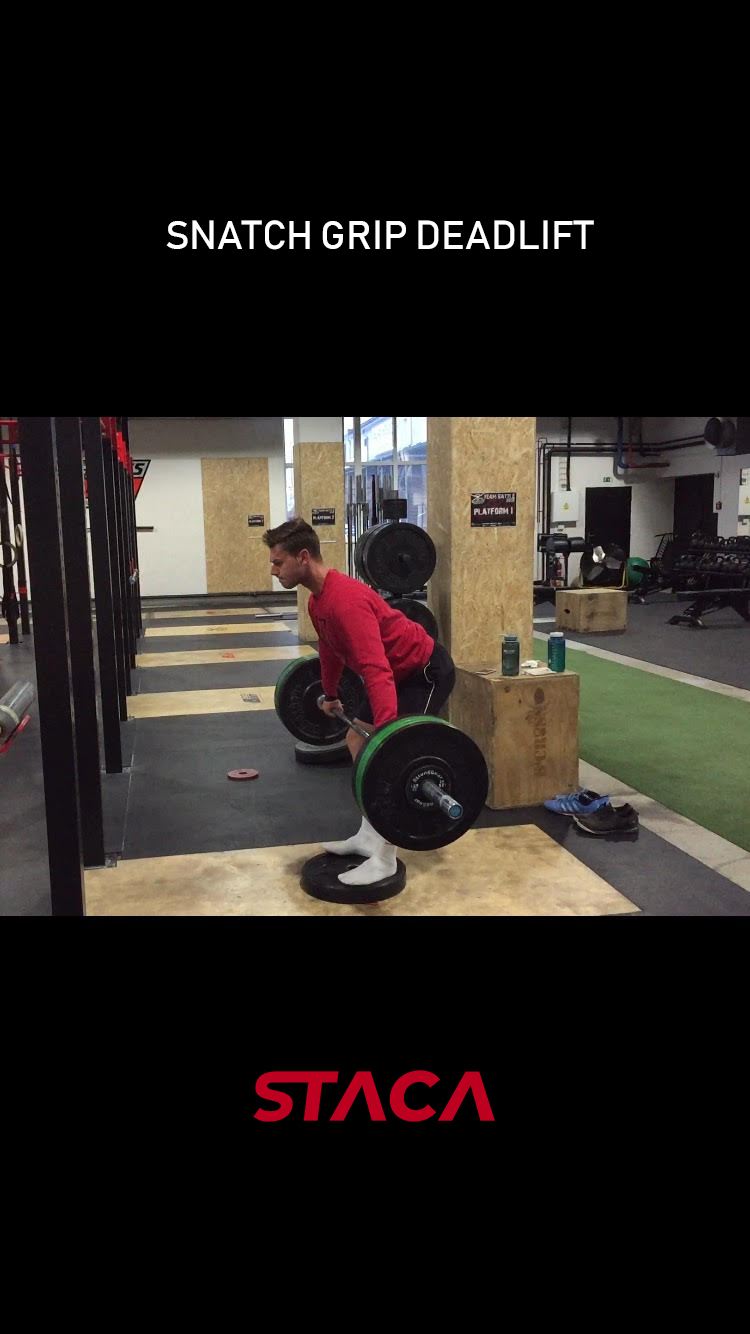
Basic Explanation
Snatch Grip = snatch (Czech for market), is one of the disciplines of Olympic weightlifting, where weightlifters try to move the highest weight overhead, while holding the barbell with a wide grip. And that is exactly what our exercise is about, the dumbbell is held with a snatch grip, i.e. as wide as possible.
Deadlift = deadlift. Almost every trainee is familiar with this exercise. Despite its great popularity, I rarely see it performed with the correct technique. Therefore, if you are not so prepared for the deadlift, or you are not 100% sure of the technique, don't do it and find a (properly educated!!) trainer who will advise you with it.
Differences between the Snatch Grip DL and the conventional DL = yes, although it is also a deadlift, the snatch grip variation is very different from the conventional deadlift.
While I consider the conventional deadlift to be a fantastic exercise, it must be said that not everyone is able to perform the deadlift without lower back pain, primarily at L4 and L5, and the conventional variant carries an increased risk of injury, especially if performed with improper technique or with too much weight that the body is not prepared for. In this case, the compressive forces on the discs are high and injury can easily occur. So if you are unable to get into the correct starting position of the deadlift, your knees are going together, you are rounding your back, you are unable to activate your abs properly, you need to start with the pre-requisites and work your way up to the deadlift.
Again, I'm not talking about the minority, which includes weightlifters, powerlifters and strongmen, who usually have very strong lower backs and will only benefit from the deadlift.
And that's the case with me. During heavy sets of deadlifts, my abs didn't contract enough and my lower back couldn't hold the weight, for which I subsequently suffered from lower back pain for several months, which I had to (again) self-remove. After a few months, I jumped back into deadlifts, but this time avoided the classic option. Instead, I included mainly Trap Bar Deadlifts (in the beginning to restart the movement pattern), but mainly Snatch Grip Deadlifts.
Why? Because they are simply gentler on the lower back. Period.
Benefits of the Snatch Grip Deadlift
Perhaps I should mention at the outset that they are brutally heavy. So if you're a classic gym-goer and your first workout consists of three sets of selfies of five, you don't even need to read any further.
Otherwise, if your goal is true body transformation, gaining strength, muscle and losing fat, then get ready for a hell of a ride that will leave you proud of your new results.
1. Increased range of motion.
The wider grip automatically makes it necessary to sit lower than, for example, the conventional deadlift. So the quadriceps, which we have to use to get the barbell off the ground, come into play more in the initial phase. The increased range also puts more emphasis on whole-body tension.
2. Load on the entire back chain.
If we take it from the bottom, it engages the entire posterior chain, which can't really be said for many exercises.
3. Improving athletic performance.
Another benefit is that the Snatch Grip DL will also improve your athletic performance.This point goes hand in hand with the previous one, as the posterior chain plays a role in many sports, especially where running and kicking are involved. In short and simplified terms - if you want to increase your speed, acceleration or kicking dynamics, you need to strengthen your rear chain.
You'll also be more likely to prevent injuries, primarily hamstring and lower back injuries, because (perhaps not surprisingly) strong muscles are far less prone to injury.
If you look at the best athletes, the common traits tend to be extreme trapezius, gluteals, hamstrings, and hamstrings.
4. Grip training.
It's certainly not that the conventional deadlift doesn't train grip, quite the opposite. However, in the case of the Snatch Grip variation, the wider grip makes greater demands on grip strength.
Here we come to the use of snatch grips: it is recommended not to use them if strengthening the grip is the primary goal, such as in grappling sports (BJJ,MMA...), powerlifting or weightlifting. On the other hand, if the goal is to improve athletic performance, the strength of the posterior body chain, grip strength can be the limiting factor in the weight used, in this case I see a significant advantage in the use of snatches.
5. Targeting a large number of muscle groups.
That being said, there is probably no other exercise that targets such a multitude of muscle groups.
If we break the movement down into phases:
(a) Getting the dumbbells off the ground - using primarily the quadriceps.
b) Phase two - after the ground is cleared, the glutes come into play.
c) The knees-off phase - once we get the dumbbell to the knees, the hamstrings and spine get a really good workout.
d) Upper phase - the higher up to the hips we get, the more the upper back (traps, scapular fixators, rhomboids) get involved.
e) In the last phase of the touch, the whole posterior chain is active, the gluteals are active and we try to tighten them as much as possible in the top position. In the upper position we also need to have the whole upper back active.
We have to keep the shoulder blades together all the time and have the latissimus activated!
6. Effect on fat burning.
If we choose a variation with a slowed eccentric (negative) phase and multiple reps in one set (8+), you will be gasping for breath throughout the rest interval. This exercise is so extremely metabolically demanding that I find it to be one of the most effective fat burning tools.
Don't believe it? Try the following variation, however, where you must be sober in your weight selection.
Workout prescription:
Snatch Grip Deadlift on the Floor 8x8 (or 6x6 with higher weight), tempo 4110, rest 75-90 sec.
Read more about tempo, if you're not familiar enough with it, in our exclusive article HERE.
7. Improving hip mobility.
If you have trouble getting into a comfortable position in the beginning, the problem may lie in hip mobility. The more often you incorporate the exercise, the better and more comfortable you will feel in the basic position as we gradually build dynamic mobility and flexibility in the hips.
What to do if you don't get into the basic position?
A great way to gradually increase mobility and flexibility in your hips is to start from a low box with weights on top of it. You can use anything to increase this, the simplest option being to support the weights with some discs. Gradually try to reduce the deficit until you get to the base position.
Who will benefit from the Snatch Grip Deadlift and when to skip it?
The exercise is a very effective tool in many areas, yet I would definitely not recommend it to anyone who hasn't perfectly mastered the technique of the conventional deadlift, someone who has major mobility and flexibility issues (ankles, hip flexors, hamstrings...) and complete beginners with training. If you can't properly activate the HSS, breathe into the abdomen, or if you have back problems (primarily lumbar), the exercise is not for you yet.
Under these circumstances, practitioners should progressively work their way up to our exercise within a few months at the latest.
But what groups of exercisers should include this exercise?
1. Athletes.
As I mentioned above, this is the ultimate exercise for increasing athletic performance because it targets the entire posterior chain, the body's "powerhouse" from which most of the energy comes.
2. Weightlifters.
The correlation with snatch (the snatch, one of the weightlifting disciplines) is definitely spot on. The Snatch Grip Deadlift is important primarily to strengthen the first and second pull and can also serve as a great diagnostic tool to identify weak points.
Chinese (e.g. Lu Xiaojun - in the video he demonstrates the Snatch Grip DL from a deficit) and Russian weightlifters (e.g. Dmitrii Klokov) include it extensively in their training.
3. Powerlifters (triathletes) and Strongmen.
One of the disciplines of triathlon is the deadlift, but that doesn't necessarily mean that only one variant has to be trained! Since training variability is one of the keys to continuous progression, the snatch grip variation can be tactically incorporated to break a stereotype, strengthen the grip, or lower and upper back. It all depends on what specifically is the limiting factor for each individual.
Strongmen will enjoy the same benefits as powerlifters.
4. CrossFit athletes.
Similar to weightlifters, the snatch is regularly included in CrossFit competitions, so the exercise should not be absent from the arsenal of exercises of any dedicated "CrossFitter".
5. More advanced exercisers with the goal of physique transformation.
Again, I emphasize that there is probably no more effective exercise for gaining strength, muscle mass and burning fat at the same time. So why not include it in the training plan of someone who wants to achieve maximum results and is ready to master the exercise without any problems?
Technique of performing Snatch Grip Deadlift
This is by no means an easy exercise to perform, on the contrary I think it is brutally hard. But should that discourage you? Not at all, it's important to set new goals all the time and performing the Snatch Grip Deadlift correctly should be one of those goals.
For all of you who are bored with the theory and want to finally try the exercise in practice, let's do it!
How to do it?
1. Load a weight (light will suffice at first) on the barbell so that the barbell is lifted off the ground. It is very difficult to practice this exercise with an empty bar.
2. Stand next to the barbell with your shins touching the barbell. Stand approximately shoulder width apart, toes pointed slightly away from your body.
3. Grab the dumbbell with a wide grip (snatch grip). In this grip, you should keep your elbows fully extended and not bend them.
4. Squat down to a position where your butt goes slightly below parallel. With a breath, pull your shoulder blades together and down to activate the latissimus! Shoulders are level with the barbell, not in front of the barbell or behind the barbell.
5. With an exhale, push into your legs and push the dumbbell off the ground, the dumbbell must be touching your body the entire time and not coming away from your body! Then slowly lift your butt up and straighten up. Again, note that you must keep your shoulder blades pulled together and down at all times!
6. In the top position, the chest should be pushed up, the shoulder blades kept together, the arms should not be bent at the elbows but extended. You must feel the contraction of the whole upper back.
7. We slow the weight down in the opposite sequence to the way we went up (logically). It is valid that you start by pushing your hips behind you and only then start to slow the weight down.
The video shows the Snatch Grip DL performed by Catalyst Athletics athletes:
How to breathe?
Breathe into your abdomen before starting the movement.
On the way up, slowly EXHALE the air out of your body.
At the top position, INHALE again.
On the way down, keep the breath RESTRAINED.
In the lower position, exhale all the air held in, inhale deeply into the abdomen again and repeat the whole process.
What if I am not technically good at the exercise?
If you can't keep your back straight, if your butt is rising earlier than it should, if the dumbbell is getting away from your body, or if your knees are clamping together when you try to push the dumbbell off the ground, you need to first address your weak spots and eliminate them!
Incorporating the Snatch Grip Deadlift into your training plan
Proper periodization and incorporation of the Snatch Grip Deadlift is, in my opinion, far more complex than just performing the exercise itself. Because I want you to take away immediately applicable knowledge, I've broken down the periodization into four basic objectives, which will be the training variables. But the truth is that everything goes hand in hand and if we focus on one area, we will automatically improve the others (for example, if our goal is maximum strength, don't worry, you will definitely gain functional muscle mass through this workout).
I won't include improving athletic performance in these goals, that field is very specific and beyond the scope of this article.
Goal 1: Mastering the movement pattern.
If you're starting out and have never performed the exercise, it's important to master the movement pattern so that your brain can fix it and you can continue to get the most out of the exercise.
To achieve this, a higher volume of work is used, especially a higher number of repetitions with a controlled, yet faster, pace.
Training to master the movement pattern (exercise, sets x number of reps, pace, pause between sets):
Snatch Grip Deadlift from the floor, 4x10-12, 2120 (2 seconds down and 2 seconds up), 120s
Goal 2: Training to gain muscle mass (muscle hypertrophy).
If our goal is to recruit muscle mass, we will modify the training variables slightly and focus more on recruiting functional muscle mass.
Training for gaining muscle mass (exercise, sets x number of reps, tempo, rest between sets):
Snatch Grip Deadlift from the floor, 6x6-8, 4120 (4 seconds down and 2 seconds up), 100s
3. Fat Burning Workout.
If our goal is maximum fat burning, we make the exercise more metabolically challenging.
Training for fat burning (exercise, sets x reps, tempo, pause between sets):
Snatch Grip Deadlift from the floor, 8x8, 4110 (4 seconds down and 1 second up), 75-90s
! Be forewarned, this is absolute, fat-burning, carnage !
4. Training for maximum strength.
For those of you who want to increase maximal strength, we will change the intensity. If the intensity is increased (in the context of strength training, this means the weight used), the number of repetitions must automatically be reduced and the pauses between sets increased. Also, the negative phase is slowed down.
The breakdown will look like this:
Training for maximum strength (exercise, sets x reps, tempo, pause between sets):
Snatch Grip Deadlift from the floor, 8x3-5, 6110 (6 seconds down and 1 second up), 240-300s
Note: As you may have noticed, there is always a 1-second pause in the down position (second digit in the tempo) after the negative phase, which is used to re-adjust to the correct position, breathe in and start the movement, so don't bounce the barbell off the ground!
Different variations of the Snatch Grip Deadlift
To make things even more complicated, we'll add a section about how even the wide-grip deadlift variation can have countless other variations depending on your current condition, goal, training plan, your weak and limiting points, etc.
Below I list some variations you can use in your training (I've only listed a few basic ones):
1. Snatch Grip Deadlift from Blocks.
The variation mentioned above is that if you can't get into the right starting position due to mobility and flexibility, you can make things easier and prop up your blocks with boxes, extra blocks or whatever. Gradually, however, try to lower the blocks.
2. Snatch Grip Deadlift on Podium.
This is definitely my favorite option! Even though it is clearly the hardest, you can get fantastic results with it in minimal time.
The execution is simple: you stand on an elevated place (platform, one disc, two discs next to each other...), in short you extend the movement path even more.
Save this variation for when you have perfectly mastered the deadlift with a wide grip off the blocks and off the ground! You need to be well prepared for it in terms of strength.
The variation is often used by weightlifters and powerlifters to strengthen the first pull and get the barbell off the ground.
3. Paused Snatch Grip Deadlift (Paused Variation).
As the name suggests, we will pause the movement for a few seconds during the movement.
This can be a pause for 1-8 seconds for example below the knees, at the knees, above the knees and while going up, down, or both.
Where we pause determines which muscle groups are most active in that part of the movement and by pausing we can make them extremely strong (for example, pausing at the knees makes the hamstrings and lower back the strongest).
In the video, you can see a variation of the Snatch Grip Deadlift on Podium with a 2 second pause at the knees during both the positive and negative phase, focusing on maximal strengthening of the hamstrings and hamstrings:
4. Hybrid and other variations.
As funny as the name may seem, the combinations are really countless and we can play with them in different ways. It's up to you, your trainer, their imagination and most importantly, a thorough identification of weak points that need to be strengthened.
An example would be the Snatch Grip Deadlift on Podium with added chains on both sides and an eight second pause at the knees when slowing down.
Now, you know a lot about the Snatch Grip Deadlift, so I wish you the best of luck incorporating it into your training program.
!! If you liked the article and it enriched you, please share it !!!
In case you want to consult the execution of the exercise, its inclusion in the program, or have other questions, please email me at kodras@staca.cz with the subject: Snatch Grip DL.
No posts have been made yet.