





New ways to train your biceps!
 Author: Šárka Randáčková
 YOU'LL WORK UP A GOOD SWEAT DURING YOUR NEXT BICEPS WORKOUT!
The best way to make your muscles bigger and stronger is by practicing kaizen, which is Japanese for "continuous improvement". You apply this principle by trying to increase the weight or number of reps, no matter how small the increase is. This principle works for biceps training as well, but your progress will still stop at some point. We call this factor stagnation.
To break the stagnation, change the stimulus. This usually means changing the exercise, angle, resistance profile or technique. Here are ten biceps exercises to help break stagnation when basic exercises stop working:
1. Reverse Lifts with Landmine Extension
- (video at 00:09)
Do not condemn this exercise until you have tried it. It's a useful way to train the biceps at their weakest position, and it's a real stagnation buster.
From a high kneeling position, grab the bar from a point directly in front of your junk down the center of your body. Keep your elbow tucked and your wrist neutral during the stroke. Your fist should travel slightly outside the shoulder line, allowing you to feel the intense contraction of your biceps and forearms at the top.
Try to press your forearm against your biceps. If the big axle is too heavy for you, start with the smaller axle or EZ.
The palms-down (pronation) grip emphasizes the brachial and coracobrachial parts of the upper arm. The thick axis will require your forearms to do much more work.
2. Inverted rack lifts
- (video at 00:24)
This is similar to the previous exercise, but with the help of stops you stand up in a rack. I saw John Meadows do it and it has since become my favorite exercise.
This version has a slightly different feel, although the benefits are the same. Try both variations and play around with angles and body position until you find the best one that flattens your shoulders, elbows and wrists.
And yes, technically this counts as using a squat rack to train your biceps, but you're actually out of it, so you're exempt!
3. Hammer lifts 6/6/12
- (video at 00:30)
Perform a mechanical shuffle series where you transition from seated hammer raises to standing hammer raises and finish with a pump with a higher rep count. There aren't many things you won't like about this exercise.
- A1. Seated hammer raise, 6-8 reps (no rest)
- A2. Standing Hammer Lift, 6-8 reps (same weight, no rest)
- A3. Hammer lift with rubber band, 12-20 reps
These exercises can also be performed well with an underhand grip.
4. Hercules lifts with one hand
- (video at 00:45)
In Hercules lifts, you usually put yourself between pulleys set to a high position. You then perform an exercise that somewhat resembles a front double biceps pose. It is good for training the long head of the biceps in their shortened position.
Go for the version with support and one arm, using a bench for additional stability and elbow and shoulder support. The angle of the pulley is key. The load is greatest when the angle of the pulley to the forearm is about 90 degrees (due to leverage factors), so play around with the height of the pulley and the angle of the bench to get the best feel.
5. Inverted lifts on the Scott bench
- (video at 01:00)
Sit with your back to the bench and your upper limbs resting on the mat. This eliminates cheating and the humerus stays directly perpendicular to the floor, allowing you to truly isolate tension.
You can also perform this exercise by sitting backwards on an overhead pulley machine, where you can adjust the height of the knee pads to match the height of your upper limbs. It's surprising how comfortable these two settings are!
6. Triple series with one-arm pulleys
- (video at 01:10)
Triple sets increase the volume of your workout, increase the variety of your workout and give you amazing strength. Here's one that Christian Thibaudeau shared with us.
Each position has a purpose and loads the biceps at a different point. It's usually done with single-arms, but works great with the EZ axle as well. Try 5-7 reps in each position:
- A1. Bicep lifts with back support: the point of maximum loading (PML) is at the bottom of the exercise. Same weight, no rest.
- A2. PML is located approximately halfway through the stroke. Same weight, no rest.
- A3. Bicep Lunges in Prone Position: PML is closer to the top of the stroke.
Put them all together and you get one killer biceps exercise.
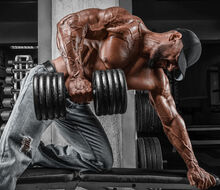
7. Triple series on pulley
- (video at 01:35)
Here's another way to do a triple series, this time using pulleys. This works like a mechanical crashing series:
- A1. Bicep lifts on the pulley with a forward lean (pulleys just slightly behind you): the PML is approximately mid to top of the lift. Without resting, use the same weight and move on to the next part of the exercise.
- A2. Pull-ups on the pulley (pulleys at your feet): PML is approximately mid-stroke. Without resting, use the same weight and move to the next position.
- A3. Pull-ups on the pulley(pulleys behind you): the PML is approximately in the middle to bottom of the exercise.
8. Triple set with pulley on positive bench
- (video at 01:57)
If you want to isolate your biceps, a great strategy is to use an incline bench to isolate them. Perform 6-10 repetitions in each position consecutively:
A1. Bicep Raises on Positive Bench: PML is in the bottom (extended) position. Same weight, no rest.
A2. Lifts with positive bench support: PML is closer to the center of the exercise. Same weight, no rest.
A3. Spider lifts with chest support: PML is close to the top (shortened) position.
The bench stays in the same place the whole time, which makes this series very practical. The pulleys also stay in place. Just make sure they are properly aligned with the shoulders and at the lowest height. Just two to three sets and your biceps will be fried.
9. Pistol lifts with kettlebell dumbbells
- (video at 02:16)
While some biceps exercises fail to maintain tension throughout the entire movement, kettlebell lifts are the exception. They also help to emphasize prolonged eccentric contraction, which causes a great deal of microtrauma that is necessary for muscle growth. As a result of the high tension, kettlebells also produce an occlusion effect: the restricted blood flow acts as an additional volume stimulus.
This exercise specifically targets the brachialis and brachioradialis at the top of the movement.
10. Kettlebell lifts in the squat position
- (video at 02:31)
A neutral grip will shift the focus to the brachialis, which can add thickness to the upper limbs when trained effectively.
The squat position isn't some ridiculous way to hit the quadriceps at the same time; it's so that the knees can provide support to the elbows, like a Scott bench This helps isolate your elbow flexors while emphasizing the load at the top of the exercise.
How to build a workout from this
Start by substituting some of these exercises for your current biceps exercises to change the stimulus. Stick with them for at least a few weeks (usually 4-6 workouts) before changing them again, and always keep the kaizen principle in mind: biceps grow when surprised, not forced.
Source: www.t-nation.com - 10 Exercises to Re-Ignite Your Biceps Workout
Author.
Recommended
Prom-in 100% Magnesium Bisglycinate
Nebbia Fitness tílko FLEXIN' 360

Nebbia Crop mikina s kapucí ICONIC 254
Nebbia FIT & SMART cyklistické šortky FIT 575
Author: Šárka Randáčková No posts have been made yet.








