





"Kipped movement should be preceded by strict force!" Means crossfitter Marek Vácha
 Author:
 Author Marek Vácha and RUFF training team
Maybe you belong to a group of people who have a slight knowledge of CrossFit, but have never been much interested in it. You perceive CrossFit only as a kind of an embodiment of simplifying movements, or de-blood training so that we can then roll on the ground.
We admit without torture, sometimes it is true, but it doesn't mean that such training should be your daily bread. But maybe you're in the latter group, you do CrossFit, you enjoy it, but you sometimes get lensed by others for what it is you're actually doing to your body. Let's face it, CrossFit can be done badly, and to a really great extent. It's just that it's each individual's game.
If grasped well, it is a very diverse tool for how to work the body and how to develop the brain as well.
Since kipping tends to be a much criticized thing in CrossFit, and sometimes it seems like there really is nothing else but kipping, we feel the need to set the record straight on how it is. Or rather, maybe bring a slightly different perspective (ours) and some thought.
There is no need to immediately criticize everything, just because the background is not so visible.
Knowing what and why I practice
For starters, it's important to tell yourself why you want to do a particular exercise. Let's say, for example, a push-up. Are you practicing them to build muscle and core pulling power? Do you mainly want to get your back into a V-shape? Or do you want to compete in CrossFit or learn some harder gymnastic elements on the trapeze?
Just by asking yourself these few questions, the main idea of why to use a kip starts to take shape. We won't claim that this exercise is suitable for everyone or even necessary. It is not.
We need to put things in context. What is our goal in the exercise. That's where it all ends and begins. Do we need to be able to lift 300 kg off the ground, squat 250 kg? From a functional point of view, probably not, from a health point of view, probably not at all, yet somebody does it. Why?
Likewise, if it's important in a CrossFit competition to be able to do intense push-ups, it's easy to train them that way. Just like any exercise, there are certain regressions and given exercises that are good to know before we even start kipping to avoid potential injury.
When to use kipping?
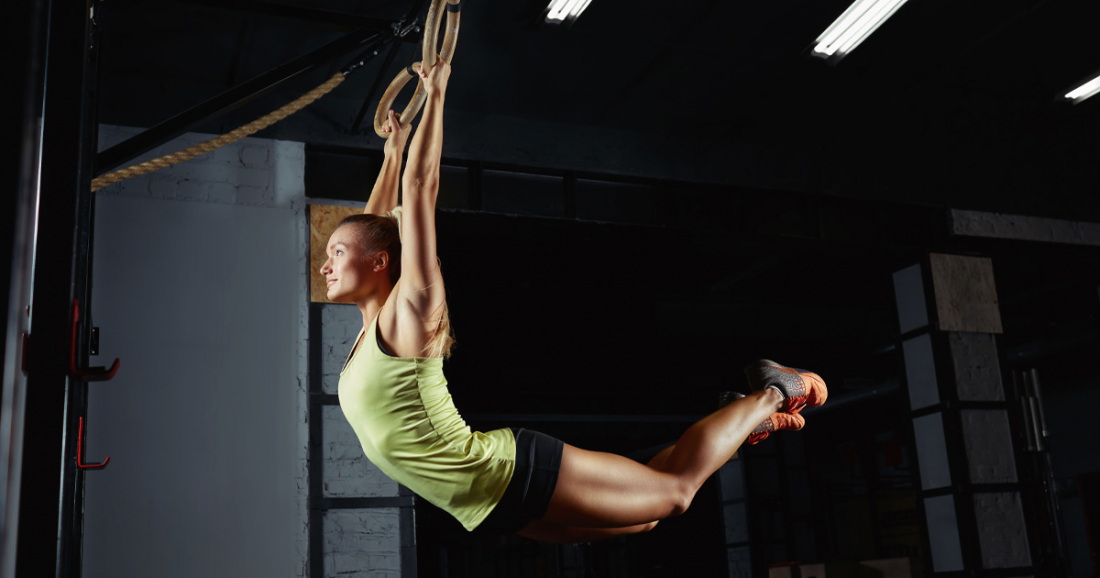
Kipping is a way to bring intensity to gymnastic exercises. It uses proper timing and a strength base that is built from strict exercises. It is NOT meant to act as a shortcut or an easier execution, this is important to mention. It doesn't mean that if I can't do a strict hunch, I automatically go kipped. On the contrary, one should proceed to a different regression (lighter variation) of strict pushups (such as negative pushup, use of band, leg rest pushup, etc).
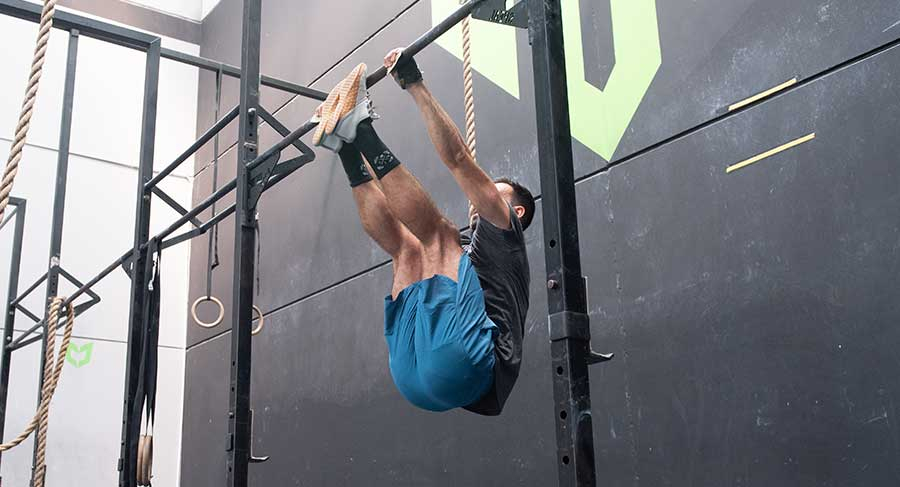
Kipping is a build-up of the previously mastered element (the bend). It should be taken as another variation in which the exercise can be performed (e.g. Toes To Bar).
As already mentioned, in order to get into kipping at all, it is necessary to have the musculoskeletal system prepared with strength. Thus, for kipped lunges, it is good to first know how to perform strict lunges, for kipped muscle-ups, again to know how to perform strict lunges, etc.
Knowing how to kip the hips is a prerequisite for learning muscle-ups and other skills on the trapeze. It is necessary to understand the kip movement.
The straight CrossFit rationale (we borrowed the wording from Jakub Hanzlik) for its use is based on the laws of physics. In kipping the range of motion is the same as in strict execution, the weight of our body is also the same, therefore the work is constant (W=F.s), but the power is higher because we do the given work in less time. (P=W/t). This is how CrossFit works with exercise intensity. More work in less time. There's something to this, but as we know, intensity has a downside.
Feet on the ground
Again, we come back to the importance of being able to say no to your ego, learning techniques over and over again. To realize that the quality of the movement decreases with intensity, so a given exercise needs to be really automated from rehearsals with enough time for rest.
Don't want to kick up (we're talking about a hunch), don't jerk, but lunge. Knowing that the downward phase has rules too and it's not about dropping down like a boulder.
Recommended

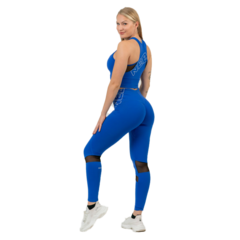
Nebbia FIT Activewear legíny s vysokým pasem 443
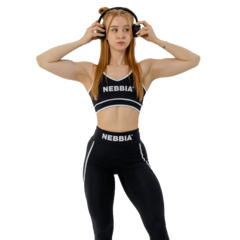
Nebbia Sportovní podprsenka střední podpora MY RULES 608
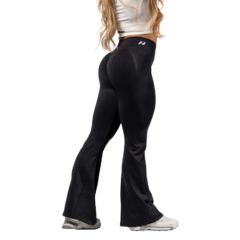
Nebbia Tvarující bezešvé flared legíny FLOW SEAMLESS 498
A special category is even butterfly pull-ups, or flying push-ups. We are of the opinion that this type of push-ups really only makes sense for athletes.
It is up to each individual to weigh the benefits/risks of such an exercise. We won't claim that it is completely harmless. CrossFit is a sport like any other. It has its own specifics and rules. The difference, of course, is the level at which one does it. The way one trains should also depend on that.
Once again, maybe even for CrossFit beginners
For an example, can we compare the execution of a gymnastic element that is specifically scored - is it difficult, maybe even dangerous? Yes.
Will anyone who wants to do gymnastics do it? No. He's not strong enough or even coordinated enough to do it. CrossFit works the same way (it should!).
In a race, points are awarded for the time it takes an athlete to complete a given workout. The rules allow for a kipped movement and therefore an experienced athlete will use it. But he will also use it because he has thoroughly prepared his musculoskeletal system for the movement. With strict exercises! For the kipped hunches it is necessary to know the strict ones. That they are difficult and take time to learn? That's just the way it is. It seems like having everything right away is a must these days. But wanting to skip stages at all costs, to have a quick instant result is not the way we want to go.
And if you answered yes to the first two questions, simply avoid the kipped push-ups.
If you have any questions, feel free to contact us on our IG - riseupfromfailures_training.
Want to start CrossFit training yourself? Feel free to contact us at riseupfromfailures.training@gmail.com or on Instagramriseupfromfailures_training.
No posts have been made yet.








