





Heel-padded squats - good or bad idea?
 Author: Šárka Randáčková
 Have you ever wedged a couple of discs under your heels when you were doing squats? Or have you seen someone do it and wondered what it's for? Arnold Schwarzenegger and Tom Platz, the owner of the best thighs in bodybuilding history and nicknamed "The Quadfather", also did heel squats!
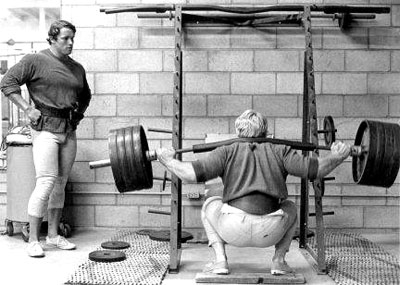
Athletes usually have one of three reasons for doing them:
- Increasing squat depth
- It makes them feel better
- It keeps their torso more upright, which increases the load on the quadriceps
The most common reasons not to use pads:
- You're training a dysfunctional movement that increases the risk of injury.
- You are teaching your body to squat incorrectly. Why not teach your body to squat with your feet flat?
- It will ruin your athletic performance.
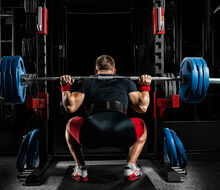
Are you squatting in the right shoes?
Are they right?
Remember one thing. No matter how good an exercise is, there will always be trainers who don't like it! In fact, the arguments listed above could be used against all the hated exercises.
So let's take a closer look at the heel tuck squats so you can decide whether to practice them.
You're not training a dysfunctional movement
The reason coaches give for this criticism is that this variation prevents dorsiflexion at the ankle (flexion of the foot towards the body). Because of this, people with ankle mobility issues find that they maintain a better trunk and knee position when their heels are supported.
Therefore, this exercise does not support the limitations of such people because it does not increase them in any way. This technique simply helps people with limitations to squat with better feeling.
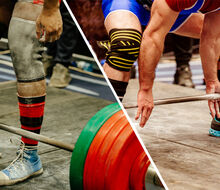
I am definitely in favor of pursuing limited ankle mobility. This is associated with ankle and knee injuries, and can lead to abnormalities in biomechanics during complex exercises.
So ankle dorsiflexion definitely needs to be worked on if you have any limitations. And if you don't have them, you need to maintain that condition.
However, this certainly doesn't mean that heel tuck squats are a bad exercise to avoid. You simply need to engage in other exercises that exercise the ankle in a range of motion that this squat variation will not provide.
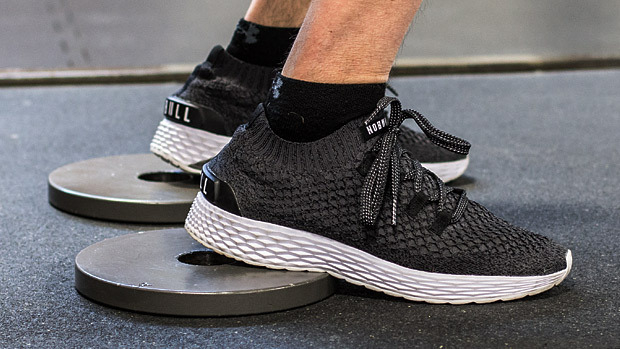
In other words, heel-padded squats will not rob you of ankle dorsiflexion. You will deprive yourself of it by not working on it in any way. That's why we train different exercises on different parts of the body to compensate for each other.
So don't be afraid of this squat variation. Just make sure you also practice something for the calves and ankles in a range of motion that you can't get into with the heel supported.
You don't reduce your performance in the squat without a heel support.
People who are good at classic squats like to practice with a heel pad because it puts more focus on the quadriceps. Others relieve their lower back because a more upright torso can do this.
Critics then claim that this technique makes your body forget how to squat without supported heels. There are a few snags to this line of reasoning.
With such logic, I could ban people from cycling and claim that this will make their body forget how to walk or run properly. Every step would be an effort for their body to make the circular motion that is cycling.
However, we all know that learning to ride a bike does not mean forgetting how to walk or run normally.
Recommended

Czech Virus Bulgarian Tribulus

Czech Virus Supreme Creatine
Nebbia Honey Bunny legíny 820

Nebbia Teplákové kraťasy GYM BRO 352
A new skill doesn't displace the old ones. On the contrary, your body's functionality improves. New movements force it to adapt in new ways.
It's a different story if you only squat with your heel supported. Then it's true. If you only do that movement, your body will get used to it.
The best method is to expose the body to different variations of squats so that it has to constantly adapt to them
It won't ruin your athletic performance
The first argument is that an elevated heel will hurt your body's performance. This is where we get beyond the squat rack. Whenever you post a video of an exercise somewhere, there's a smartass who will write, "This will make him unable to run, jump, hit a golf shot, ..."
Coaches who say this think that the nervous system is so fragile that a few (safe) sets of an exercise a week will somehow disrupt functional movement patterns acquired through hours and hours of training accumulated over years of athletic performance.
In reality, however, you won't lose your athletic performance until you stop playing your sport regularly.
True functionality only comes from training your specific sport. Everything we do in the gym is artificial. There is a big difference between movements in the gym that are constrained and robotic, and the fluid and dynamic movements performed in sports.
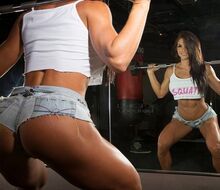
Squat variations - do you know them all?
The last thing is that one exercise won't make you a specific type of athlete. Many trainers shy away from bodybuilding principles because they claim they don't need to make bodybuilders out of their athletes. That doesn't make any sense!
If you have all five together, you can surely guess that a few sets of biceps lifts will hardly make you Ronnie Coleman, and a few sets of sprints, on the other hand, will not make you Usain Bolt.
Dangerous exercise and hard-working trainers
So why do heel tuck squats get so much hate? In short, coaches are trying to help people, trying to analyze things, and above all, trying not to hurt.
However, if taken too far, they come up with a type of thinking that actually makes every exercise dangerous. There is always someone who can find a cause for a new dysfunction, a halt in progress, an injury ... you get my drift on any exercise. Add to that a jumble of five-syllable words, erudite articles abound.
What often happens is that such people ridicule proven, functional exercises. After reading some articles, one feels that one is actually stupid for not practicing the exact technique described in them.
However, improving your training is not nearly as complicated a discipline, and the human body can do considerably more than what many aspiring trainers will tell you.
Source: www.t-nation.com - Heel-Raised Squats: Good or Bad?
Author.
Author: Šárka Randáčková No posts have been made yet.








