





Build massive triceps, traps, broad back and leg muscles!
 Author: Šárka Randáčková
 Not all muscles respond the same way to the same training methods. Why? It has to do with tension and range of motion.
Some muscles grow better under mechanical stress: damage to muscle fibers and activation of mTOR, which repairs muscles damaged by training. These then recover larger and more durable.
Muscle damage occurs when a muscle is stretched/extended under tension. The greater the tension, the greater the damage to the muscle.
So what does this mean? First, you need to exercise through a full range of motion. Secondly, a high level of intramuscular tension is required, hence a higher load. Third, the tension must be sustained in the muscles even when their fibres are stretched.
Other muscle groups respond better to metabolic stress. This is created by the accumulation of lactate in the muscle and the denial of oxygen to the muscle.
So you need a fairly long set (at least 30-70 seconds) and constant tension. Releasing the tension will wash away the lactate and allow oxygen to flow.
Do you understand? Good. Now it will be clear to you why the exercises and methods described below work so well.
Triceps: California press
The triceps is one of the muscles that is most dominated by fast-twitch muscle fibers. It responds well to heavy weights and emphasis on the eccentric part of the movement. That's why I like this exercise. It's a combination of extension and compression.
Choose a heavier weight than what you would take for a supine extension, but less than for a bench press. Lower slowly (5 seconds) as you would for an extension. Push up like a bench.
- Use a shoulder-width grip or even narrower.
- Lower slowly (5 seconds) like an extension.
- Lower the dumbbell to your chest with your elbows bent (like a pullover).
- Push the weight up.
You can even make it harder. Once you can no longer lower the weight as in the extension, finish the set with a classic bench press. If you choose a weight that you can do 6-8 reps of the California press with, you should do 3-4 more reps of the normal bench close-up with it.
Trapeze: Static-dynamic method
The main problem here is the short range of motion. You will either have to practice a very high number of repetitions (25-30) or find another method to extend the time under tension.
I prefer the second option because when you train a high number of reps on the traps, forearms or calves, they are usually frantic and jerky reps. And that's the opposite of what you want to achieve.
So my favorite method for trapezius is to hold for 2-3 seconds at the top of the movement.
And don't just hold, push the trapezius to the max.
Also, at the bottom of each rep, pause for a moment so the weight doesn't bounce back. The range of motion is very short, so every bit of cheating takes away dramatically from the effectiveness of the exercises.
Practice 10-12 reps and hold each rep for 2-3 seconds at the top. This will flush out the lactate and cause a buildup of growth hormone.
Wide back muscle: pre-fatigue with superseries
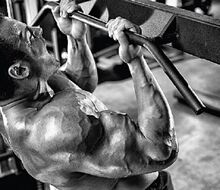
The lats have two main functions: shoulder extension (think pullover on a pulley) and shoulder adduction (think pulley contraction with a wide grip). My favorite method of developing them is to pre-fatigue using a pullover superseries on the pulley and pulling the pulley down with a wide grip (pronated).
Practice 10-12 reps of the pullover and 6-10 reps of the pull-up. When pulling down, focus on pulling your elbows toward your ribs and don't shorten the path. Pull the extender up to your chest.
Quadriceps: slow eccentric part of the exercise
There's nothing better than the classic quadriceps exercises: squats, front squats, hacken squats, leg press and Bulgarian squats. These exercises are even better when you lower the weights slowly and aim for the maximum range of motion that good technique will allow.
How slow? Easy 4-6 seconds per repetition at a constant speed. Train 6-12 reps in this style. Advanced Method: Once you get close to failure with slow starts, squeeze out a few more reps at conventional speed.
Hamstrings: Technique 2/1
Maximum development of the hamstrings will be achieved by incorporating a stumbling technique. The best method is the 2/1 technique. The legs should be alternated.
Emphasizing the negative part of the exercise will bring more strength. This is due to structural and neurological adaptation. The negative part of the exercise is also the main stimulus for muscle growth because it causes the most damage. This will kick start the muscle growth process.
The hamstring is one of the muscles where fast twitch muscle fibers dominate the most. It responds well to heavy weights and emphasis on the eccentric part of the movement.
The weight should be light enough that you will be able to accelerate during the exercise, but heavy enough that lowering with one leg will give you a hard time. A good weight is about 70% of what you could handle with both legs. You should be lifting quickly, lowering for about 5 seconds. Practice a total of 6-10 reps in a set (that's 3-5 lowering with each leg).
Calves: stretching under tension
The calves have a very short range of motion, which makes getting some lactate into them quite difficult. And if you exercise hard, stretching the Achilles tendon will do a lot of the work.
Not only do you need to extend the duration of the set by using an isometric hold at the top of the exercise, but you'll also add a pause at the bottom to break up the Achilles tendon stretch reflex. This requires a pause of about 2 seconds at the bottom.
- Lower slowly until fully extended.
- Hold tension across the bottom and pause for 2 seconds.
- Slowly lift. Concentrate on slow execution.
- At the top, hold the contraction for 2 seconds. Really tighten your calves.
- After 8-12 reps, slowly work your way to the bottom position, holding the stretch for as long as you can. This is a stretch under tension. Don't skip it.
This is a thermonuclear weapon for calf development. If they don't explode after this exercise, they don't stand a chance.
Are advanced training methods necessary?
They are not necessary for progress. But they can dramatically accelerate your progress. They also make training more fun and varied.
However, even the best method won't work for all muscles. Understanding which tool to use for which work will save you a lot of time, effort and frustration.
Source: www.t-nation-com - How to Really Build Tri's, Traps, Lats, and Legs
By Christian Thibaudeau
Recommended
Nebbia Crop mikina s kapucí ICONIC 254

Nebbia Crop top tričko POWERHOUSE 279
HMS Twist Stepper s úchopy S 3085

Czech Virus L-Tryptophan & Valerian Root
Author: Šárka Randáčková No posts have been made yet.








