





Build bigger thighs and glutes without unnecessary back pain!
 Author: Šárka Randáčková
 Most people think that to build big, strong legs you need to squat with a loaded axle on your back. Back squats are definitely effective, but some practitioners don't even have the mobility to get into a position with the axle on their back.
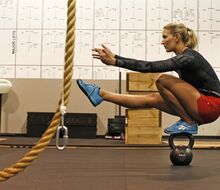
If traditional squats aren't for you, that doesn't mean you can't squat. Nor does it mean you can't load up properly. Front and goblet squats are just two examples. While they are great variations, they both have their negatives.
- Front squats require even more mobility in the shoulders, wrists, and upper back than back squats.
- The loaded weight ceiling is much lower in goblet squats than in the classic variation.
So what can I replace squats with? Squats with a landmine attachment seem to be ideal.
However, if you have lower back pain, squatting with the landmine box attachment may be an even better solution.
Box squats with landmine attachment
This attachment is one of the most versatile pieces of equipment in the entire gym. However, not many people use it for box squats. And that's a mistake. Let me explain why...
- Box squats increase glute involvement. It also takes some of the load off your lower back and serves as a depth indicator.
- You don't need to be super mobile. It's much easier than traditional squats. If you can bring your hands together in front of your chest and sit on the box, you can practice this variation.
- You can increase the load. The weight loaded can be significantly higher than goblet squats with one-arm dumbbells or kettlebells.
Here's the execution.
1. Start by pushing your hips backwards
One of the main benefits of using a landmine is that it forces you to start by moving your hips backwards. Some people start squats by moving their knees forward. This shifts their center of gravity too far forward, lifting their heels and putting too much strain on their knees.
I'm not saying you can't get your knees in front of your toes, but start the movement with your hips back so your feet are rooted in the floor. You will need to learn to push through your heels and engage your glutes. This will save your knees a lot of strain.
2. Only put half your weight on the box
This will keep your hips and mid-body engaged even before you bounce back up. Thanks to Mr. Joe DeFranco for this insight.
Try to sit on the box with only half your weight. Don't slack off on it.
There are different methods of squatting on the box. It's done with touch only. Westside lifters basically sit on the box with their whole weight and lean over when they get up.
Both methods have their advantages, but for most people, sticking somewhere in the middle will be optimal.
3. Try to spread the floor with your feet.
Imagine squatting on a sheet of paper and trying to tear it with your feet as you lower it. This will help you maintain optimal knee position and encourage glute involvement.
A traditional problem with squatting is knee buckling. This can be attributed to weak stabilizing muscles (hamstrings, vastus medialis muscles), weak/restricted movement around the hips, limited ankle mobility or poor movement patterns. Try not to push the heels and little toes of the feet into the floor.
Back squats are not the only method for building leg strength. If you have trouble mastering the position in traditional squats or want to lift more than single-arm or kettlebell dumbbells will allow, try box squats with a landmine attachment.
Source: www.t-nation.com - Tip: Huge Legs, Bigger Glutes, No Back Pain
Author: Dan North
Translated by Jaromír Uhlíř
Author: Šárka Randáčková No posts have been made yet.








