





A strong midsection is a fundamental pillar, and we'll show you how to work it out in just 4 minutes!
 Author: Šárka Randáčková
 If you have been doing weight training for a long time, you know that one of the main pillars of training is a strong middle of the body, CORE if you want, or also HSSP, or deep stabilization system of the spine and trunk.
We have addressed its neglect in this comprehensive article, in which we have not only given you reasons to train it, but also offered some good training tips.

Today, we're going to look at another, equally effective workout that can help you with your CORE, in just 4 minutes of training!
This is what you need to know...
- Don't devote too much time to your midsection. An impressive six pack and strong midsection can be built in just a few minutes a day.
- Heavy, complex exercises are not enough for a strong midsection. There must be direct abdominal work in every workout.
- Try our core pillar workout that works like a mechanical crash series.
- You don't need equipment. All you need is an elevated surface and 3-4 minutes at the end of the workout.
The best way to do a "functional" mid-body workout
Almost every training program requires direct abdominal training. The myth that you can just do squats and deadlifts for abs needs to finally die.
Your goal must be effective mid-body training that minimizes the potentially dangerous forces acting in the lumbo-pelvic region. Such training also strengthens the connection of the core pillars (shoulders, middle, hips). Only abs trained in this way will be as functional as they are sexy.
And let's be honest, people devote a ridiculous amount of time to abs. This is how to destroy the midsection and create a functional connection between shoulders, abs, and hips in 3-4 minutes.
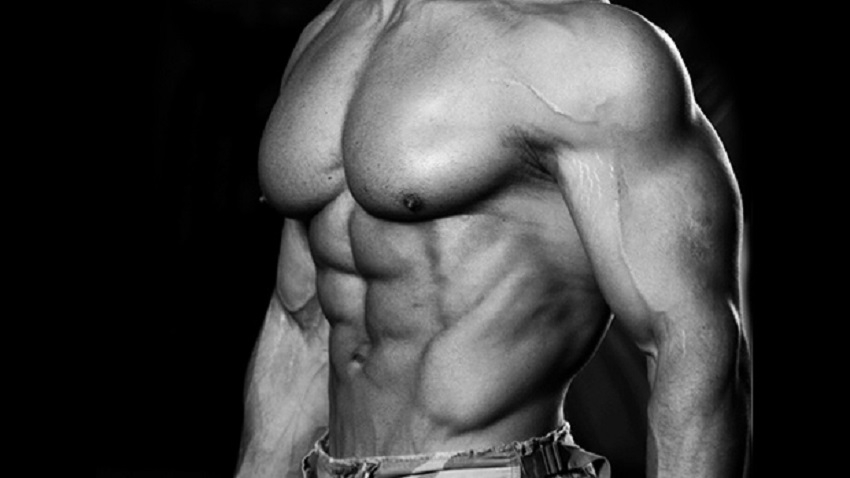
Destroying the fundamental pillars
This is the best way to punish the midsection after a hard workout. As well as the body, it will also test your willpower.
| CVIK | SERIES | REPEAT | |
|---|---|---|---|
| 1) | Quick Positive Exercises | 1 | MAX |
| 2 sec. eccentric lowering, constant tension | |||
| 2) | Controlled from climber position to hip extension | 1 | MAX |
| 1 sec. Isometric contraction at the top, pause between repetitions | |||
| 3) | Hip extension in push-up position | 1 | MAX |
| 1 sec. Isometric contraction at the peak, pause between repetitions | |||
| 4) | RKC Plank | 1 | MAX |
| Maximum tension throughout the body |
Do the entire cycle once and do not take breaks between exercises.
The whole thing is a combination of a mechanical crash series and the mid-body training needed for dynamic movements.
All you need is an elevated surface and your own body. You start with the most dynamic exercise and gradually work your way up to the most static, with a firm hold in tension. The whole thing is a circle, with no pause between exercises.
Now, let's break these exercises down so you can practice them as efficiently as possible.
1) - Quick positive push-ups:
On a raised surface, place your palms roughly shoulder width apart or in your normal push-up position. Tighten the muscles of your midsection and glutes and stabilize your shoulders (to the optimal position).
Once you have a stable position and connected the pillars, push up into failure with a 3 second trigger. This should be with constant tension, or no breaks at the top or bottom, and full range of motion.
Once you loosen up in the midsection, glutes or shoulder position, move on to the next exercise.
2) - Controlled from the climber position into hip extension:
In the normal climber's position, you set yourself up in a push-up position and clench the muscles around your spine. This is not what we want here. We're going to work slowly, in a controlled manner, and maximize the tension in the abs. This movement requires stable hips with the hands in an elevated position to allow the knees to move more and lift off the ground without bending the lower back.
Slowly draw one knee in toward the chest without breaking the neutral position of the spine. Hold the maximum contraction for a full second and lower the leg back to the crank. From the same position, repeat the movement with the other leg.
Tension in the rectus abdominis, obliques and deep hip flexors will quickly fire you up.
You will alternate legs until mechanical failure, i.e., until you cannot sustain a 1-second contraction at the peak. Then you move on to the next exercise.
3) - Hip extension in the push-up position:
Now it's time to get off the bench and onto the floor. As with the previous exercises, brace your shoulders into a stable position and hold an isometric contraction.
Reverse the movement of the previous exercise and practice controlled hip extensions with high tension. Remember that the hip has a range of motion of about 20 degrees in extension. If you go over this, you are compensating with the lumbar spine, and losing tension in the abdomen.
The rhythm is similar to the climber's position - controlled hip extension with a full second of contraction at the top of each rep. The glutes only really engage when you fully extend your knees and point your toes towards your shins. This will link the chain of the lower and mid-body nicely.
Again, it seems too easy, but since this is the third exercise, your glutes will basically be on fire already. Do as many reps as you can. When you can't hold the position or don't get your hips into extension, move on to the last exercise.
4) - RKC plank:
We'll end this brutal pillar workout with my favorite mid-body exercise, the RKC plank. I love this exercise because it's all about your internal tension, and you can make it harder each time by clenching your whole body harder.
Place your elbows on the ground and interlace your fingers to send real power through your whole body. Go backwards with each leg separately, keeping the tension in your legs and glutes. The butt position will be slightly higher than a regular plank, allowing for pelvic rotation and maximum glute engagement.
You will not be doing maximum reps here. You'll be practicing for 20 seconds, so enjoy them. The harder you can curl your whole body, the better. Shaking your whole body wildly is perfectly fine.
So the whole set will look like this:
When to practice training the basic pillars
Put it at the end of your next workout. If you really go to failure and clench extremely during the last exercise, one set will be enough. Don't sacrifice quality of execution and clenching to get through more reps or another round. Aim for more perfect reps the next week.
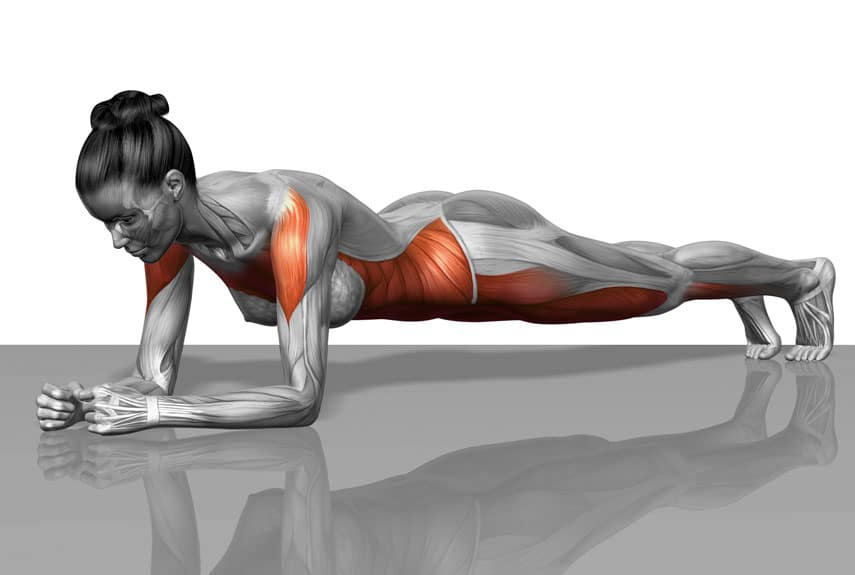
You can also try to destroy your abs along with your chest
You just need some serious balls to do it. Well, one proper ball to be precise.
A regular plank isn't exactly an exciting exercise, but it can be essential. If you can't perform it properly and hold it for a while, you should work hard on your core strength.
However, most coaches agree that once you can hold a regular plank for about a minute, it stops being effective. You need to start making it harder for yourself.
A variation on the gymnastics ball where you clench your abs is excellent. It'll also exercise your chest.
Plank with a clench on a gymnastic ball, a common execution:
Plank with elbow curl on a gymnastic ball:
Target:
The goal is to try to dent the ball with your arms or elbows, depending on the type of execution.
Due to the unstable ground, your centre of the body gets a lot of work. You will also be forcing your spine to stabilize, which will improve its endurance in this activity. Plus, it's a pretty heavy exercise for the chest as well.
Source: www.t-nation.com - 4 Minutes to Core Strength
Author: Dr. John Rusin
Source: www.t-nation.com - Tip: Hit Your Abs and Chest With One Exercise
Author: Kelvin King, Jr
Author: Šárka Randáčková No posts have been made yet.








