





How much caffeine is still safe for us?
 Author: Šárka Randáčková
 Caffeine occurs naturally in coffee, tea, cocoa, guarana and mate. It is also added to sweetened drinks, energy drinks and weight loss supplements. Most of us can't avoid it. But what is a safe amount? That's the subject of today's article.
For healthy adults, it's up to 400 mg per day, breastfeeding women are advised to take no more than 200 mg per day, and people with cardiovascular problems should also limit the amount of caffeine.
In 2016 alone, people ingested 7 million fat of caffeine and the energy drink market is growing steadily. Before we look at the numbers, let's find out where all that caffeine is getting into us.

How much caffeine is in popular drinks?
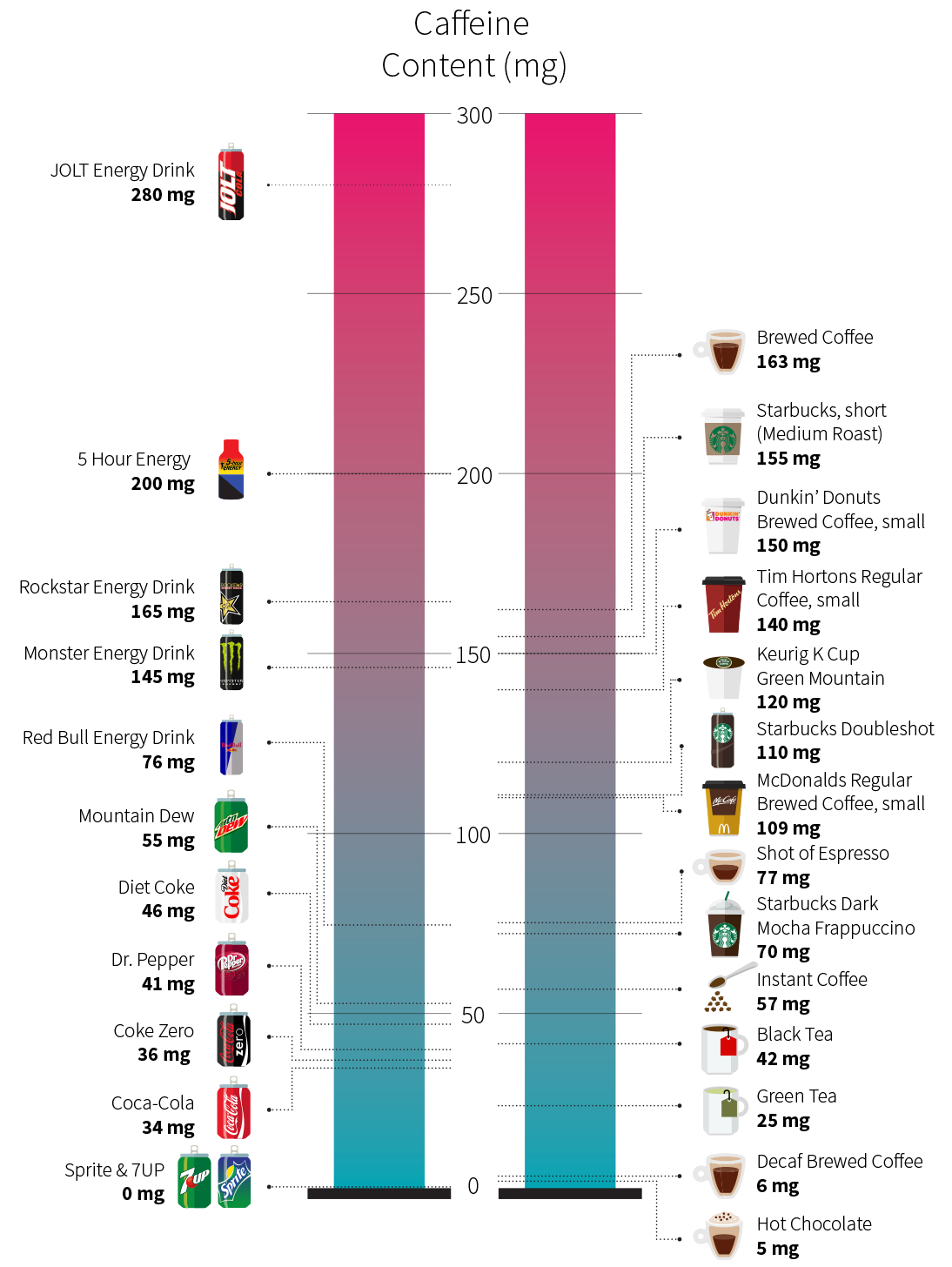
The image below shows the most popular caffeinated drinks. Note that for bottled drinks, the caffeine content will usually vary minimally, [1] while for tea and coffee, the differences can be significant.[2][3][4]
Caffeine content of popular beverages
What amount is too much?
The safety of caffeine is relative - it depends on the dose, but also on health. Some people don't mind several coffees a day, while others experience blood pressure anomalies, [5] sleep disturbances, irritability, and nervousness after one dose (some symptoms can be warded off by consuming theanine together).
People with caffeine withdrawal problems experience the same symptoms [6]. They are accompanied by yawning, drowsiness, impaired concentration and poor mental performance, flu-like symptoms and muscle stiffness. [7] In this article, we will give you recommendations on the safety of caffeine. Remember, however, that these are only framing issues. Caffeine issues are highly individual.
For healthy adults
The European Food Safety Authority (EFSA),[8] the US Academy of Sciences (NAS),[9] and the Canadian Health Organization[10] agree that caffeine up to 400 mg per day poses no health risk.
EFSA further states that a single dose of 200 mg is not harmful "even less than 2 hours before an intense workout".
However, it also states that even 100 mg before bedtime can affect sleep quality. Remember that the half-life of caffeine is 5 hours (on average, it's pretty individual) [11], which means you probably still have caffeine in you even if you last drank coffee 10 hours ago.
For breastfeeding and pregnant women
EFSA finds that such ladies should limit their caffeine intake to 200 mg per day[8] Other studies [10][12] [7] suggest 300 mg per day, but with caution, as higher doses increase the risk of nausea and, worse, miscarriage[13][14].
Tests on pregnant women are plentiful, but one thing is certain. The half-life of caffeine doubles in them[15] In other words, caffeine breaks down so slowly in pregnant women that the dose they are currently consuming may be much higher than they think.
For children and adolescents
EFSA says that we don't have enough information to determine the exact recommended dosage, but uses the lower adult level(3 mg per kilo of body weight) as the upper level for children and adolescents. [8] The Canadian Health Organization would like to see the limit even at 2.5 mg per kilo of body weight per day. [ 10][12][16] According to them, this would look like this:
- 4-6 years: 45 mg/day
- 7-9 years: 62.5 mg/day
- 10-12 years: 85 mg/day
Everyone would especially like to see more research, especially because of the energy drinks that kids are constantly drinking. The Institute of Medicine even suggests banning them for school-age children. [17] A group of scientists wrote a letter in March 2013 describing "the strong association between caffeine levels in energy drinks and adverse health effects in children, adolescents, and young adults." [18]
For people with cardiovascular problems
Caffeine has been shown to increase blood pressure for 3-4 hours after ingestion (with regular intake, this effect decreases). [19] For healthy adults, intake of up to 400 mg per day is not associated with health risks.[12] For people with cardiovascular problems or high blood pressure (i.e. those where stimulants are generally not recommended), the long-term effects of caffeine are less certain .[12] Reasonable doses may be fine, but this should be individually discussed with a doctor.
How much can I drink before I reach the 400 mg limit?
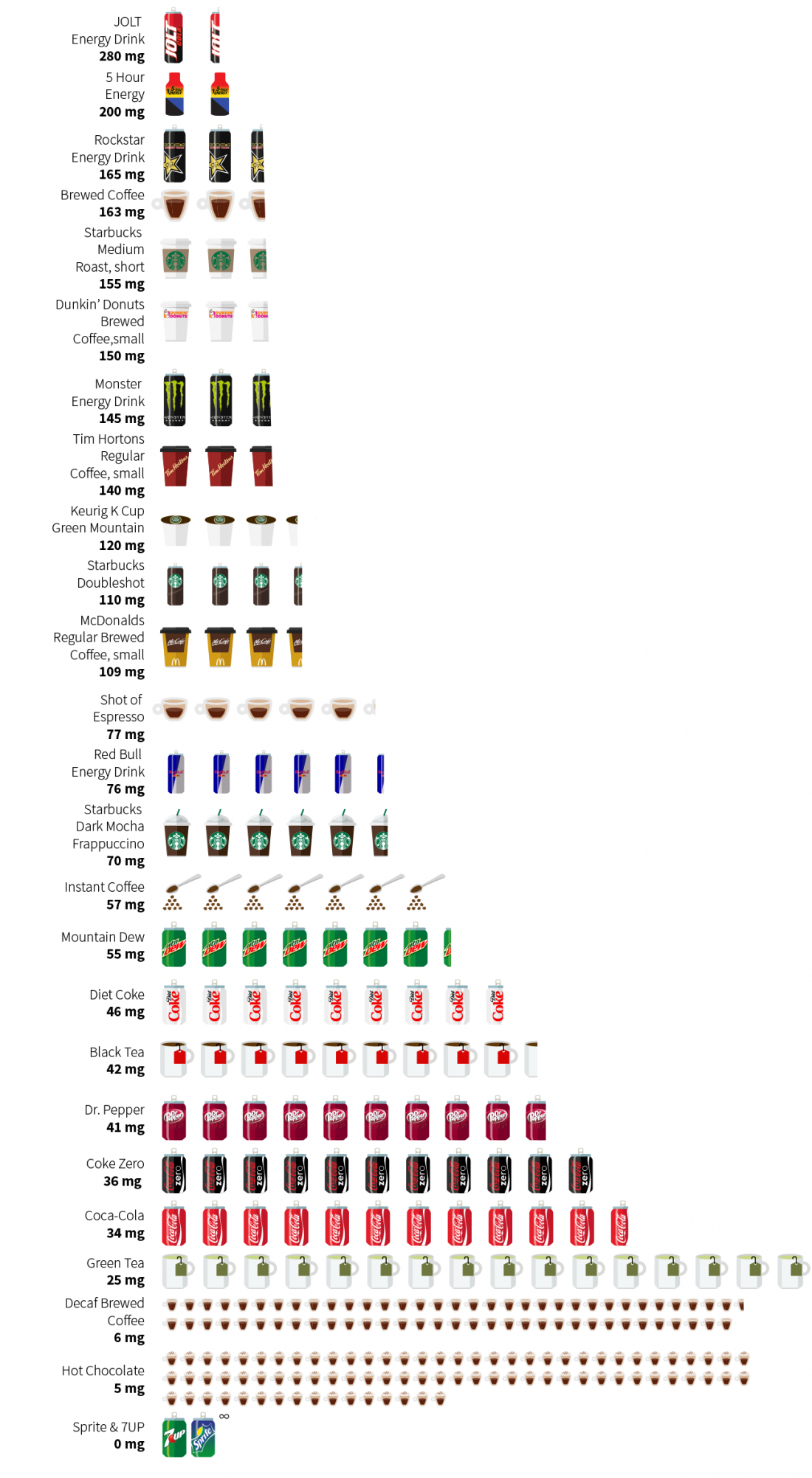
Watch the caffeine content of the drinks you drink. The figure below shows you how many of your favourite drinks you would need to drink to get to the above limit.
Number of servings needed to reach the recommended maximum of 400 mg of caffeine per day
What happens if I have too much caffeine?
At oral doses, 15 mg per kilo of body weight is considered a toxic dose and 150 mg is considered lethal. [ 20][21] So for a 68 kg person, toxicity starts at 1 g and the lethal dose is 10 g. Yes, caffeine can kill you. However, a healthy person would have to drink high amounts of the above beverages, and in very rapid succession.
Caffeine powder is something else. The U.S. Food and Drug Administration states that "one teaspoon of pure caffeine powder is equivalent to 28 cups of regular coffee." So it's much easier to accidentally overdose. Such deaths are rare, but they do happen occasionally. [ 22][23][24] Even scientists are not infallible. A Northumbria University study accidentally gave its students 30 g of powdered caffeine (the equivalent of 300 cups of coffee) when they should have been given only 0.3 g. Both survived, but were in hospital for some time.
Best habits
The upper limits given in this article are based on the long-term effects of regular caffeine consumption. Short-term studies looking at the effect of caffeine on athletic performance have used doses between 400 and 800 mg. [25] Such doses are unlikely to harm most people in the short term, but with regular use you may experience some of the adverse effects of caffeine.
One last thing, the beneficial effects of caffeine wear off for some people over time. Such people often cycle caffeine.
Sources:
- McCusker RR, Goldberger BA, Cone EJ. Caffeine content of energy drinks, carbonated sodas, and other beverages. J Anal Toxicol. (2006)
- Ludwig IA, et al. Variations in caffeine and chlorogenic acid contents of coffees: what are we drinking? Food Funct. (2014)
- Fox GP, et al. Variation in caffeine concentration in single coffee beans . J Agric Food Chem. (2013)
- McCusker RR, Goldberger BA, Cone EJ. Caffeine content of specialty coffees . J Anal Toxicol. (2003)
- Noordzij M, et al. Blood pressure response to chronic intake of coffee and caffeine: a meta-analysis of randomized controlled trials . J Hypertens. (2005)
- World Health Organization. The ICD-10 classification of mental and behavioural disorders: clinical descriptions and diagnostic guidelines . . (1992)
- Juliano LM, et al. Characterization of individuals seeking treatment for caffeine dependence . Psychol Addict Behav. (2012)
- EFSA Panel on Dietetic Products, Nutrition and Allergies (NDA). Safety of caffeine . EFSA Journal. (2015)
- Food and Nutrition Board. Caffeine in Food and Dietary Supplements: Examining Safety: Workshop Summary. The National Academies Press. (2014).
- Nawrot P, et al. Effects of caffeine on human health. Food Addit Contam. (2003)
- Committee on Military Nutrition Research, Food and Nutrition Board. Caffeine for the Sustainment of Mental Task Performance: Formulations for Military Operations . . (2001)
- Wikoff D, et al. Systematic review of the potential adverse effects of caffeine consumption in healthy adults, pregnant women, adolescents, and children . Food Chem Toxicol. (2017)
- Giannelli M, et al. The effect of caffeine consumption and nausea on the risk of miscarriage. Paediatr Perinat Epidemiol. (2003)
- Morgan S, Koren G, Bozzo P. Is caffeine consumption safe during pregnancy? Can Fam Physician. (2013)
- Knutti R, Rothweiler H, Schlatter C. The effect of pregnancy on the pharmacokinetics of caffeine. Arch Toxicol Suppl. (1982)
- Ruxton CH. The suitability of caffeinated drinks for children: a systematic review of randomised controlled trials, observational studies and expert panel guidelines. J Hum Nutr Diet. (2014)
- Committee on Nutrition Standards for Foods in Schools. Nutrition Standards for Foods in Schools: Leading the Way Toward Healthier Youth . The National Academies Press. (2007)
- Arria MA, et al. Letter to Commissioner Hamburg Re: The Use of Caffeine in Energy Drinks. . (2013)
- Mort JR, Kruse HR. Timing of blood pressure measurement related to caffeine consumption . (2008) Ann Pharmacother.
- Temple JL, et al. The Safety of Ingested Caffeine: A Comprehensive Review . Front Psychiatry. (2017)
- Yen M, Ewald MB. Toxicity of weight loss agents . J Med Toxicol. (2012)
- Beauchamp GA, et al. A Retrospective Study of Clinical Effects of Powdered Caffeine Exposures Reported to Three US Poison Control Centers . J Med Toxicol. (2016)
- Jabbar SB, Hanly MG. Fatal caffeine overdose: a case report and review of literature . Am J Forensic Med Pathol. (2013)
- Jones AW. Review of Caffeine-Related Fatalities along with Postmortem Blood Concentrations in 51 Poisoning Deaths. J Anal Toxicol. (2017)
- Desbrow B, et al. The effects of different doses of caffeine on endurance cycling time trial performance . J Sports Sci. (2012)
- Beaven CM, et al. Dose effect of caffeine on testosterone and cortisol responses to resistance exercise. Int J Sport Nutr Exerc Metab. (2008)
Source: www.examine.com -Caffeineconsumption: how much is safe?
Author.
Author: Šárka Randáčková No posts have been made yet.








