





Does drinking coffee affect fat burning? The truth and myths about caffeine and weight loss
 Author:
 With the summer approaching and the sight of exposed bodies in swimsuits, there is a growing interest in all sorts of fat burning supplements, whether directly some fat burners or various natural components. You've probably already heard that coffee, and the caffeine it contains, stimulates weight loss... but how does it really work?
Caffeine is the most widely used psychoactive substance in the world, stimulating both physical and mental abilities. It can be found in the ingredients of many products promising a boost and is also a component of most fat burners. Why? Because caffeine actually helps mobilize fat cells in the body and speed up metabolism. But let's stay grounded and look at this fact in more detail.
Coffee itself is not only a delicious drink, but since coffee beans contain many antioxidants, it can be beneficial for the body in many ways right away, and one of them is the ability to affect our metabolism and appetite. You can read about the other effects of coffee, or caffeine, in this article.
The ingredients of coffee
Let's get back to coffee and specifically what we actually find in it. Of course, the individual ingredients vary according to the type of coffee, how it is prepared and in the "ingredients" added, but the basic ingredients include:
- COFFEE - the most important ingredient in coffee, as a powerful simulant that affects the nervous system. The main function of caffeine in the body is to block the neurotransmitter adenosine, which is responsible for the feeling of fatigue and drowsiness. By blocking it, the release of the neurotransmitters dopamine and norepinephrine is stimulated and the overall nervous system is strengthened.
*neurotransmitter = a substance released by a neuron to specific target cells to produce specific effects.
- THEOBROMIN and THEOFYIN - substances, referred to as caffeine derivatives, which have a similar stimulating effect to caffeine.
- CHLOROGENIC ACID - a biologically active substance that helps the body absorb ingested carbohydrates.
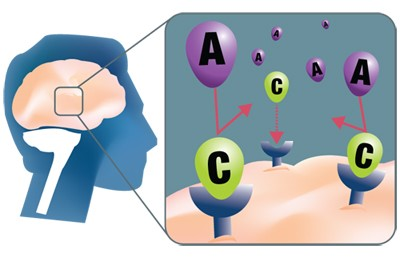
A simplified representation of the function of caffeine (c) relative to adenosine (a).
Now to the point of this article... Can coffee (caffeine) burn fat?
Caffeine is classified as a lipotropic substance, i.e. a substance that helps to convert fat into energy. It helps to mobilize fat cells, precisely by activating the nervous system, which gives stimuli to burn them. In addition, caffeine increases the amount of adrenaline in the blood. Adrenaline is a hormone that, among other things, sends a signal to break down fat cells and release them into the blood. This increases the availability of free fatty acids in the blood and this is a desirable effect especially for sports performance.
As far as the effect on metabolism is concerned, caffeine does not remain inactive here either. Caffeine has been shown to increase the metabolic rate by accelerating fat burning, logically. Studies show that caffeine can boost our resting metabolic rate by up to 3-11% depending on the size of the dose.
However, beware - the idea that you buy two large donuts for breakfast, wash them down with strong black coffee and it turns them into rainbows in your body.. is way off. Coffee does increase your metabolic rate (not significantly of course), but it is definitely not omnipotent!
If you are eating inappropriately and imbalanced, even coffee probably won't save you. It's even been shown that in obese and overweight people, much less fat oxidation and thermogenesis (how the body burns calories) is observed to be induced by caffeine. In comparison, the effects of caffeine on increasing fat burning in lean people have been found to be as high as around 29%, for obese people this figure is considerably lower, specifically around 10%. How caffeine works is also influenced by age - i.e. the younger the individual, the better the effects.
Recommended
So if you're happy to save money on burners when all you need to do is drink hectolitres of coffee, watch out. Just as was mentioned in the article describing caffeine's properties on athletic performance, when it comes to stimulating burning, the effects become weaker with increasing dose and time of use. In the short term, caffeine can indeed speed up metabolism and positively affect fat burning rates, but once the body adapts to its effects, its effects diminish. However, there is still the benefit that caffeine regulates appetite and downwards.

What to take from this? Drinking coffee may be a small aid to weight loss in the short term, but its long-term effects have unfortunately not been proven. Coffee is beneficial in many ways, being used to prevent many diseases and what is one of the richest sources of antioxidants ever. And if you're drinking it just for the fat burning effect, then it's probably best to opt for a strategy of some cycling, for example at two to three weekly intervals.
Sources:
https://www.healthline.com/nutrition/coffee-increase-metabolism#modal-close
https://www.ncbi.nlm.nih.gov/pubmed/6298543
https://www.ncbi.nlm.nih.gov/pubmed/18035001
https://www.ncbi.nlm.nih.gov/pubmed/7486839
https://www.ncbi.nlm.nih.gov/pubmed/20164566
https://academic.oup.com/jn/article/141/4/703/4743380
https://www.ncbi.nlm.nih.gov/pmc/articles/PMC3616086/
https://ascpt.onlinelibrary.wiley.com/journal/15326535
https://www.ncbi.nlm.nih.gov/pubmed/8201901
https://link.springer.com/article/10.1007%2Fs10068-010-0151-6
https://www.ncbi.nlm.nih.gov/pubmed/6287366
https://academic.oup.com/ajcn/article-abstract/49/1/44/4716276?redirecte... xml-ph-0012@deepl.interna
https://www.ncbi.nlm.nih.gov/pubmed/21773723
No posts have been made yet.








