





Does a slow metabolism hinder weight loss?
 Author: Šárka Randáčková
 The phrase slow metabolism is hugely overused today.
Very often we hear things like:
- "I can't lose weight anymore because my metabolism has slowed down."
- "I'm not like you. I can't eat everything I want. You have a faster metabolism than me."
Before we blame weight loss failures on metabolism, let's take a good look at how much metabolism actually varies between people, what determines it, and how it changes with exercise and diet.

What exactly falls under metabolism?
First, we need to understand a few terms. The energy your body burns in a day is called total daily energy expenditure. This has three components: resting metabolic rate, the thermic effect of food, and energy expenditure through activity.
1. Resting metabolic rate (RMR)
Technically, metabolism is the sum of all the processes that keep you alive.
Resting metabolic rate in sedentary people accounts for about 70% of total energy expenditure.1][2] And yes, there are people with faster metabolic rates (i.e. resting metabolic rate), but their metabolic advantage is not as overwhelming as you might think.
Most people (68%) are within 8% of the average RMR, and the vast majority (96%) fit within a 16% variance. In other words, 96% of people are within 200-300 kcal of the average RMR[3].
Your RMR is determined by the proportion of net muscle mass, even though most of it is water, which is not metabolically active.
Brain and internal organs also add active mass (12% total or less - depending on how much muscle you have). However, they need a lot of energy : 200-440 kcal/kg/day. In contrast, your skeletal muscles need only 13 kcal/kg/day, which is still much less than the 4.5 kcal/kg/day needed to maintain fat stores[2].
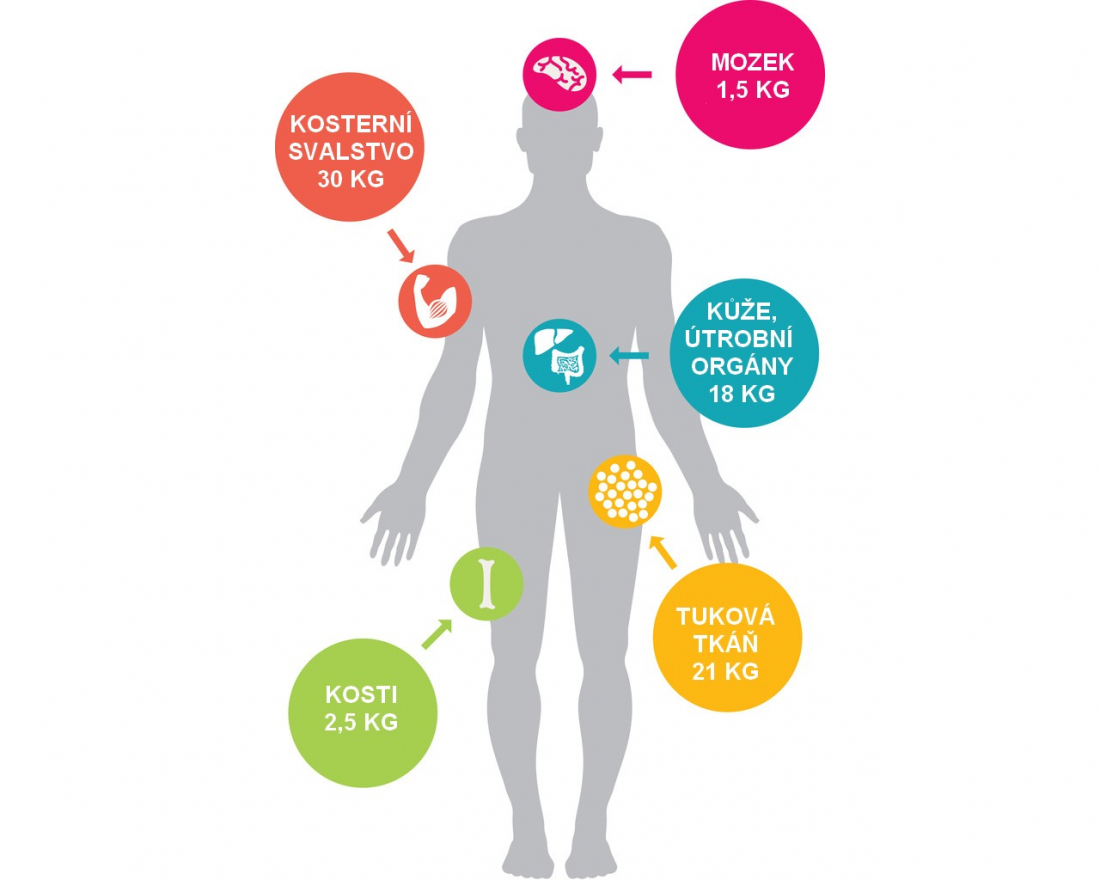
Natural RMR is a poor indicator of your future weight,[4][5] because people with high RMR simply eat more. People with a low RMR have it the other way around. Well, with one exception. One summary of 12 studies showed that high weight gain was associated with a 3-5% lower RMR in people who were previously obese. But was this their natural RMR? Probably not...
Despite popular belief, obesity is instead associated with high metabolic rate, [7] because a heavier body needs more energy to do everything. People who cut calories quickly to speed up weight loss risk slowing their metabolism below its natural limit - perhaps permanently.
They will be constantly hungry because their body will want to make up for the energy (especially fat) it lost too quickly.
RMR can also decrease with age, as you lose net mass. Ladies also usually have less of it (male organs also consume more energy). Genetics and perhaps gut bacteria[8] also have an effect.
But the biggest influence on RMR is temperature - both internal and external.
Even if you and the weather are cool, ⅔ of your RMR is consumed by maintaining your body temperature. For a 1 degree increase in temperature, your RMR increases by 10-13%."[9] Therefore, exposure to cold can aid weight loss.
2.The thermic effect of food (TEF)
Some of the calories of the food are used for digestion, the rest is burned as heat. Overall, this process is called the thermal effect of food (TEF).
TEF in healthy individuals with a varied diet is about 10% of total daily caloric intake, [11] but this number will be affected by various factors such as net muscle mass and the size and composition of the meal. The energy required to digest each nutrient (its TEF) can be expressed as a percentage of the energy provided by that nutrient:[12]
- Fats provide 9 calories per gram and their TEF is 0-3%.
- Carbohydrates provide 4 calories per gram and their TEF is 5-10%.
- Protein provides 4 calories per gram and its TEF is 20-30%.
This is one reason why increased protein intake can help with both weight loss and muscle maintenance when you eat less than your maintenance calorie level.
3.Activity energy expenditure (AEE)
This is the most variable component of total expenditure. It can be as low as 15% in very sedentary people and as high as 50% in highly active people[13].
It includes both physical activity (exercise, running, cycling) and spontaneous physical activity (chewing, short walking, maintaining an upright posture). Studies in respiratory chambers[16][17] have shown that spontaneous physical activity accounts for about 4-17% of total daily energy expenditure, or about 100-700 kcal/day.
So what can change the level of metabolism?
1. What can increase your RMR
Exercise! Yes, resting metabolic rate can be increased. And that increase can last longer than the workout itself. The increased oxygen consumption can last for more than a day after a workout, depending on the length and intensity of the workout.
Aerobic and anaerobic activities affect RMR differently. Aerobic activities burn more calories during training but not after. Anaerobic activities work the other way around.18 Anaerobic activities also build muscle, which uses more energy.19
But what if you're stagnant, and you're no longer gaining muscle? Should you only give them maintenance levels of calories? Even if you exercise daily? Don't. They need more, because you're damaging them by training, and they need energy to repair themselves. In fact, muscle destruction and repair is always going on.
As I wrote, a one degree increase in body temperature will increase RMR by 10-13%. That's why people wrap themselves in ice packs, turn off the heat at home, dress less, and even take ice baths. This will definitely increase their RMR, but without a doctor's supervision it can be dangerous.
We must also mention the frequency of meals. But only to the extent that there is no literature supporting the theory that more frequent meals increase RMR.20][21][22][23] Weight change is affected by total caloric intake.
A number of supplements also boast of increasing metabolism levels, but very few have evidence, even in a limited sample of people.
The most useful advice doesn't even address RMR, but spontaneous physical activity. If you spend half your workday standing, you'll burn up to 200 extra kcal compared to sitting,[24] and you'll do it easily, reliably, and without breaking a sweat.
2.What can reduce your RMR
Unfortunately, weight loss equals a decrease in RMR.[25] The very process of eating below maintenance calorie levels will reduce RMR by 5-15% as the body becomes sensitized to various hormones and neurotransmitters that regulate energy use[26].
This response is called adaptive thermogenesis.[27] In a diet, your body will not only crave more calories (you'll be hungry), but it will also prevent your cells from expending energy (you'll likely experience a decrease in athletic performance).
If you are on a sensible diet, your RMR should return to normal to match your total daily energy expenditure. You also maintain your RMR on days when you add calories. These will replenish your glycogen stores and convince your body that you are not dieting too hard.
Source: www.t-nation.com -Ismy "slow metabolism" stalling my weight loss?
Author.
Author: Šárka Randáčková No posts have been made yet.








