





Why is the squat the king of all exercises?
 Author:
 Did you know that there are fitness centers where you can't scream when you lift heavy weights? What kind of world is it where you go to the gym and you're not allowed to yell?
In addition to this prohibition, there is another vice rampant in gyms. It's the squat on the multi-press. Weight training started around free weights. So why are bodybuilders doing squats on the multi-press? They're easier. However, more muscle fibers are activated when squatting with free weights.
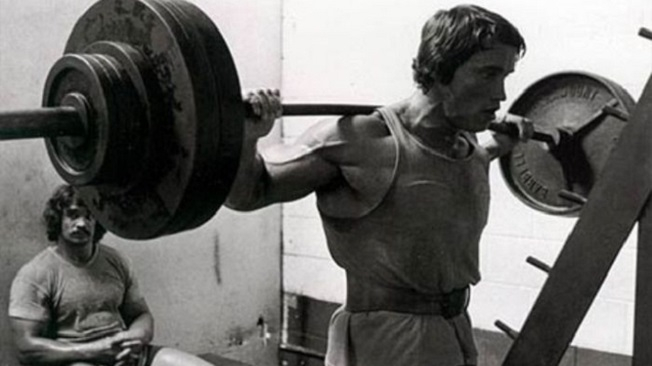
Squats raise testosterone levels
Testosterone levels are also affected by the amount of muscle mass activated in response to training. Overhead axel squats, jump squats, and free-weight squats all raise testosterone levels.1,2 Although we consider the bench a strength exercise, if you want your testosterone levels to skyrocket, take a squat axel to your back. Most people would choose the bench when making this choice. However, it won't raise your testosterone levels that much. The squat really is the king of all exercises.
Scientists examined the effect of 5 sets of 10 reps on the bench press versus 5 sets of 10 reps on the overhead axle squat, both with two-minute breaks between sets, on twelve men with weight training experience. This research suggests that exercises that engage the greatest amount of muscle tissue will produce the highest increases in testosterone levels.3 So forget about overkicking - if you want to get big, you'll need to slide under a cool, steely axis.
Research also emphasizes the importance of exercise sequencing. In general, exercises that engage large muscle groups (squats, deadlifts and bench presses) should be practiced before isolation exercises (overhead kicks, pulldowns and chest machines). One study, for example, measured changes in biceps strength during nine weeks of weight training. One group practiced biceps raises only, and the other practiced them as well but did squats before. Bicep lifts alone did not noticeably raise testosterone levels. However, with squats before biceps raises, testosterone levels were increased quite a bit and muscle strength increased more when both upper and lower body exercises were performed.
These data support exercising the large muscle groups early in the workout and the smaller ones later, if we are concerned about muscle strength.
Dynamic training schemes that seek to maximize explosive strength and functional performance also produce a noticeable androgenic response. For example, total testosterone levels increased by 18 percent and free testosterone by 30 percent in response to half-squat training with 50 percent 1RM.4 Then, if you want to increase volume and strength, use the overhead machine only for leaning between sets of squats.
Testosterone levels did not increase before or after training in young and older men who performed isolated exercises of 3 sets and 10 reps for upper and lower body on the Nautilus machine.5 In contrast , during high-intensity squat training, both groups of men showed a noticeable increase in testosterone levels.6
Now you understand that size and strength are entirely about activating more muscle fibers during a workout - and nothing hits as many muscle fibers as squats.
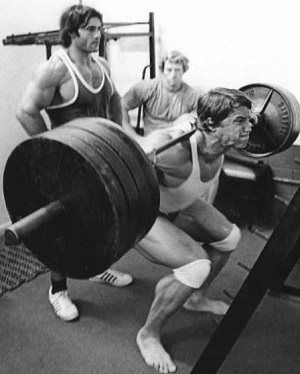 Squats increase overall strength
According to research, sudden increases in anabolic hormone levels (GH and testosterone) can improve strength gains. Systems that use moderate to heavy loads but more sets with peaks at 10-12 reps and shorter breaks (one to two minute breaks between sets and exercises) have been shown to cause greater increases in concentrations of both anabolic hormones than heavier loads (1-5RM), longer breaks (±3 minutes), and fewer sets (1-3). In addition, the increase in hormonal response has been shown to be proportional to the size of the muscle being trained (i.e., squats always produce a greater sudden hormonal response than overhead kicks).11,12
Researchers in Denmark have investigated whether the sudden hormonal response has any effect on increasing muscle strength. They had young men practice a rather unconventional training routine. One group practiced only biceps raises. They practiced 4 sets of seated biceps raises with 60 percent 1RM, followed by 4 sets of standing biceps raises with 60 percent 1RM. They performed a total of 8-12 repetitions in each series with 90-second breaks.
Another group trained both arms and legs. They practiced the exact same routine for the arms, but added the legs at the end of the workouts. After the biceps workout, they performed four sets of seated leg presses with a max of 10 reps. The subjects trained for nine weeks and at the end of the study their isometric arm strength was tested.
Recommended
Nutrend Delicious Bar

L-Arginine HCL 500g 1+1
Nebbia Legíny s vysokým pasem ELITE 465
Resting hormone levels remained unchanged in both groups after nine weeks. Plasma testosterone and cortisol increased markedly in the leg and arm training group, but no longer in the arm-only group. Plasma GH increased in both groups, but noticeably more in the group that trained both legs and arms.
The main finding of the study is that the greater relative increase in isometric strength comes when anabolic hormonal responses (GH and testosterone) are enhanced by training a larger muscle group in addition to training the arms.13 This points to a link between the magnitude of the hormonal response and the increase in strength that comes with physiologically inducible hormonal levels.
Come on guys: ditch the multipress!
Free-weight squats are generally preferred by bodybuilders and strength athletes over machines because they provide less stability, which forces the midsection musculature to engage more. Walk into any college or hardcore gym and you'll find a bunch of squat racks and very few multipresses. The machines are easier for beginners to use and less often require assistance. You might think you're doing a decent job on the multipress on your feet. However, researchers disagree with you.
Canadian researchers didn't stick sensors all over the men's legs and have them practice squats with free weights or on a multipress. They found that muscle activation was 43 percent higher during free-weight squats. Activation of the knee extensors and hamstrings was higher during the free-weight squats, while activation of the trunk stabilizers was the same during both exercises. This demonstrates that free-weight squats may be superior to multi-weight squats in training the large muscle groups of the legs, and would likely result in better development and greater hypertrophy of these muscle groups with long-term training.14
 Rubber to better squats
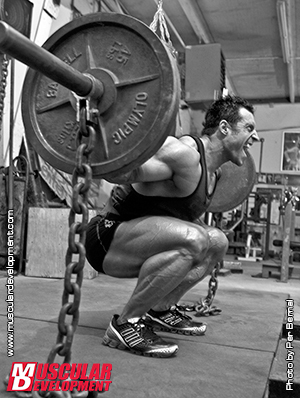
I'm talking, of course, about the use of rubber bands for strength training. The variable resistance that bands provide is advantageous because of something we call the muscle strength curve. The variable resistance provided by elastic bands better simulates the strength curve of most muscles. The force curve refers to how the strength of a muscle or group of muscles varies over different parts of the range of motion. Because of their structure, most muscles increase in strength with range of motion, up to a certain point.
Using squats as an example, when squatting from the bottom, the muscle strengthens to about the middle of the range of motion. Thus, the leg muscle is weakest at the beginning of the movement and strongest about halfway up. So with free weights you are limited in the weight by the weakest part of the movement, the bottom, bent over position. This implies that the muscle is not getting adequate load in the strongest part of the movement.
However, when you train with elastic bands, the resistance increases with the range of motion. This means that in the stronger part of the exercise, the muscle receives more resistance, and adequately stimulates its strength adaptations.
- One study in the Journal of Strength and Conditioning Research showed that athletes who used elastic bands as an adjunct in their training had noticeably more leg strength than athletes who used only free-weight training.15
- Another Journal of Strength and Conditioning Research study describes that bands are great for increasing strength! Athletes were randomly assigned to one of three groups: heavy load/slow execution, lighter load and faster execution, or fast execution and progressively increasing load, which involved bands. Testing was preceded by three weeks of "habituation" (12 training units), where participants learned proper technique and received basic fitness training. The results of this study in athletes demonstrate a clear advantage of training with greater speed of exercise execution, with the inclusion of bands, for the development of lower body strength.
These results support the idea that squats can be improved by using different training methods with elastic bands. This can be said based on the results of athletes who have increased their strength with the use of bands.16
Don't lean too far forward or backward
Sometimes you'll notice that anyone who can squat a lot of weight is pretty likely to have a big butt. Bodybuilders don't want this, so they choose a slightly different stance.
Many strength coaches and triathletes themselves will tell you to "sit back first" with a big weight. Many triathletes add box squats to their training to consciously sit back and then explode up. Sitting back engages the gluteus maximus more, and immediately allows it to contribute its strength to the execution of the reps, especially then on deeper squats. Without sitting back, the quadriceps will be more dominant during the squat. Even if you sit back, the quadriceps are essential to the lift, but the butt can help with the lift - and the forces applied are better distributed in the lower limbs.6
New modified 5x5 squat program
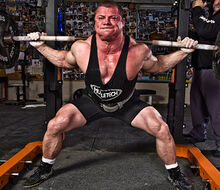
Many triple jumpers like the low axis position, where they lie all the way down on their lower delts. This technique is mainly used to develop hip and trunk extensor strength. The high axis position - when lying on top of the trapezius - primarily develops quadriceps strength.8
You may notice that many athletes lean forward when squatting - also a bad idea. One study showed that in recreational exercisers who performed squats with a limited range of motion-the knees were not allowed to come over the level of the toes-more moment of force was exerted on the hips and less on the knees than when the position of the knees relative to the toes was not monitored. Excessive forward bend (when the knees get over the toes) exerts excessive force on the hips and lower back. Researchers stress the need to not allow the knees to get past the level of the toes, or to keep the shins as perpendicular as possible. However, in order to distribute the force to all joints involved, it might be optimal to allow the knees to get a little over the toes when squatting to parallel.9
Only the "boys" squat with their buttocks to the floor
When I think of depth, the image of Tom Platz squatting comes to mind in bright colors - he really was sitting on the floor. Most bodybuilders squat just below parallel. Some, however, like to go deep. You might think that only pussies squat on the parallel... guys wipe the floor with their asses.
What a guy like that won't tell you is that deep squats put more pressure on the knees. Researchers at Duke University have studied both parallel squats and deep squats and measured the shear forces acting on the knees. Quadriceps, hamstring, and gastrocnemius activity generally increased as knee flexion increased, suggesting that healthy athletes should squat on the parallel bars (thighs parallel to the floor at maximum knee flexion). Furthermore, squatting on the parallels has been shown not to cause injury in people with healthy knees. The researchers concluded the whole thing by suggesting that athletes with healthy knees should practice squats on the parallel bars rather than the deeper version - because the risk of injury to the menisci of the cruciate and collateral ligaments can increase with deep squats.7
 Front squats activate the quadriceps just as much as back squats!
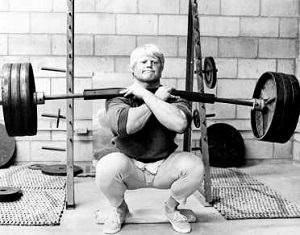
There is that classic photo of Arnold watching "Blond Bomber" Dave Draper squat 185 pounds in front. Not many people do front squats these days, but you should start!
The two squat variations are similar in some ways, but quite different in others. The back squat exerts significantly greater compression forces and moments on the knee extensors. The front squat is no match for the back squat in overall muscle engagement, with much lower compression forces and moments. The results of the study suggest that front squats may be beneficial compared to back squats for people who have knee problems such as torn menisci and long-term joint problems.10
Thus, alternating front and back squats may save your knees in the long run.
Support your performance with quality supplementation!
In our shop you can choose from plenty of proteins, gainers, amino acids(bcaa, glutamine, ...), vitamins and minerals, creatines,fat burners and much more. So don't hesitate and step it up a notch!
Source: www.musculardevelopment.com
Author.
Jaromir Uhlir (Cha Cha)
Why Squats are the King of all Exercises
No posts have been made yet.








