





Train better even if you don't have ideal body proportions! Part 2
 Author: Šárka Randáčková
 Have you ever wondered why some practitioners are exceptional at one exercise and completely average at another? Leverage ratios are a big part of it, and your body proportions are to blame .
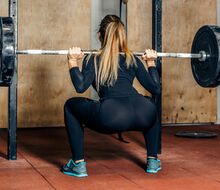
Proportions of the lower half of the body
This is where many people think that height is a crucial factor, especially for squats. But this is not entirely true.
The length of your legs in relation to your height is crucial. If you have relatively short legs, especially your thigh bones, your leverage ratios for squats will be good regardless of your height.
Just briefly on height and deadlift. For individual deadlift variations, height can play a major role. It's the only exercise where the starting point is not determined by your body proportions. It starts from an artificial point on the floor. If the practitioner is very tall, it may be better to start the deadlift from a base high enough to still manage proper posture.
Tall athletes usually have long arms as well, so this problem won't really exist for them, but if someone tall had short arms, it's a different story.
To determine the length of your legs, you will compare their length against your height:
- Short legs - they will be 40-43% of your height.
- Average legs - will be 44-47% of your height.
- Long legs - will be 47-51% or more of your height.
What if you have average legs? You'll have to dig deeper and measure your calf bone against your thigh bone:
- Short calf bone - will make up 75-78% or less of your femur length.
- Average calf bone - will make up 79-84% of the length of the femur.
- Long fibula - will make up 85% or more of the length of the femur.
Remark:
- If you have a short or average fibula, it basically means you have long legs.
- If you have a long fibula, you will have short legs.
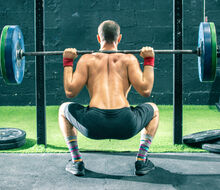
Training recommendations for long-legged exercisers
You will typically have a strong posterior body chain (hamstrings, glutes, lower back), and a relatively weak anterior body chain (quadriceps, abs).
Your squats will be pulled more with the back of your body, and will be very different from your deadlifts in muscle involvement. Squats alone won't be enough to develop your legs evenly. In deadlifts, on the other hand, you will excel even without much effort. Unless you have long legs and short arms. In that case, I'm sorry, but you are genetically destined to become a bench specialist.
That's the way to approach lower-body training:
- Focus more on unilateral exercises.
Long legs lead to easier imbalances. Unilateral exercises should keep this in check. Practice them, even if it's just to keep your balance. But unilateral exercises, such as single leg Bulgarian squats, are great for leg volume as well.
- Practice assistance exercises for both squat and quadriceps.
You probably won't need much work on the back of your body. You'll probably get better at the deadlift, even if you practice it infrequently. You should concentrate on squat variations that target your weaknesses and isolated quadriceps work.
- Concentrate on front weight exercises and quadriceps squat variations.
Back squats will be an exercise for you, especially for the back of your body. Try a different variation: front squats, Zercher squats (see video below with Christian Thibaudeau) or safety axis squats. A tighter stance and heelstands can also engage the quadriceps more.
- Don't forget the belly.
It is essential in the chain of the front part of the body. Targeted abdominal work should almost never be missing from your training. The good news is that front weight exercises put a lot of weight on the abs, so if you do them regularly, you shouldn't fall behind.
Training recommendations for short-legged exercisers
Squats (back squats) will take care of most of your lower body development. You won't need much assistance to improve them, as long as you follow sensible training.
This is how you should approach lower body training.:
- You won't need much unilateral work.
Short levers mean less risk of imbalance. Include such training infrequently to make sure everything is in order.
- Practiceassistance exercises for deadlifts and back squats.
You deadlift will require considerably more work than your squat. You should concentrate on your weaknesses and strengthening your posterior chain during it. Practice assistance exercises with maximum focus on hip flexion: Romanian deadlifts with toestands (see image below), deadlifts with 1.5 executions (where you practice the top half of the exercise twice), and good mornings with toestands.
- Practice squat variations that improve rear body engagement.
Wide stance box squats and good mornings box squats are good examples. You can also play with flat-soled shoes if you usually wear weightlifting shoes.
Recommended
Czech Virus Vitamín C
Nutrend Magneslife instant drink powder
Nebbia Intense Tričko Intense Mesh 805
Extrifit Elastor
Conclusion
Genetically, you may not have been completely blessed in terms of muscle tightness or symmetry, but you can definitely achieve great results if you focus on your body proportions.
Your results will improve due to spending more time and energy on your weak and neglected areas. The bonus is that balanced proportions will make you less prone to injuries and chronic aches and pains that can plague your joints and connective tissues.
Measuring your body proportions is one of the easiest and quickest tools to make the right exercise choices for your workout. So go for it!
Source: www.t-nation.com - Body Proportions & Lifting - What You Need to Know
Author.
Author: Šárka Randáčková No posts have been made yet.








