





Strict Press, Push Press and Push Jerk - what's the difference?
 Author:
 Today we will focus on strict execution of push presses, push press and expression push presses. All of these exercises have a place in your training, but they differ in many ways, so let's take a closer look at them.
Strict execution of push-ups
This is called shoulder presses for short and is a pure strength exercise. It targets your shoulder muscles and develops your strength in an overhead press. Keep your hands just above shoulder width and your spine in a neutral position. Then, briefly push the axis up over your head. As the name suggests, you will not generate any force with your legs. Technically, this is the easiest execution.
What to watch out for:
- Keep the center of the body closed. At the top of the movement, people tend to bend their lower back, which puts unnecessary strain on the lumbar spine.
- The axis should rest on the palms, not the fingers. This gives you more stability and protects your wrists.
- Your forearms should be perpendicular to the ground at the start of the movement.
When to incorporate the exerciseA: This exercise is ideal for developing upper body strength. You will be able to do technical and gymnastic exercises better after it. You will increase your strength in the standing push-ups, kip swing and butterfly push-ups.
Push Press
This exercise is similar to the strict version, but it also makes the lower body stand out. Start the press with your legs and the momentum you gain will help you push the weight out. The squat should only be light and quick. You can handle more weight with this technique than you can with strict.
You can find more technical examples of weightlifting exercises in our section - ExerciseDatabase.
What to watch out for:
- You're not doing a front squat. The squat is shallow, controlled and explosive upwards.
- If you're doing multiple reps, make sure you're pushing through your elbows at the top and using your axial weight to help you get into the next squat. Work smart, not hard.
When to incorporate the exerciseA: Push-press is often included in circuit training because it's a quick exercise and can be taken quite well with higher volume work.
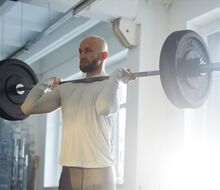
Expressive Pressures - Push / Split Jerk
You can handle the most weight in this execution. It's a weightlifting exercise, so you'll need to get your body below the centerline. You'll use your legs to help you as you would with a push press, but add an extra bend in your knees to get under the weight. After you start by moving your legs, you'll stuff yourself under the axle and finish the exercise more or less like an overhead squat. You're done when you' re standing upright and the weights are overhead.
What to watch out for:
- At the beginning of the exercise, your elbows will be slightly in front of the axis.
- People with long arms may prefer a slightly wider grip.
- It can be easy to get into a bad position under the axle because you're concentrating on getting it over your head. Pushing your knees out will help.
When to incorporate the exercise: Push-ups are a good introduction to weightlifting exercises you can add in a repositioning and practice a complete overhead press. They can also be added to circuit training. Don't waste energy. If your goal is only to get the axle overhead, use expression push-ups.
Recommended
Nebbia Dámské sportovní legíny se síťkou INTENSE Mesh 838
HellGel 80g 5+1
GymSupps Balíček pro krásu
Nebbia Classic HERO sportovní podprsenka 579
- Source: instagram, boxlifemagazine.com,
- Audrey Carson
- Jaromir Uhlir
No posts have been made yet.








