





Squat and knee health - deep or on parallel? Find out in our new article!
 Author:
 "Hey bro, don't go down on those squats like that, you'll blow your knees out!"
I'm sure all of us have heard that instruction from the local fitness guru, haven't we?
One recurring theme in strength training is whether you should go squatting deep to your maximum range of motion, or the furthest parallel. Other topics include whether to choose the powerlifter squat, the weightlifter squat, how to position your feet, whether it's dangerous to heel tuck...blablabla.
The only thing we can say for sure on these topics is that the correct squat position is always determined by OUR ONLY ANATOMIC STRUCTURE! This means that there is no one correct squat variation for all exercisers. It depends on how long our lower limbs are compared to our torso, whether we are anterior or posterior dominant (front X back dominance), how mobile our ankles and hips are, what our goal is, etc.
It would be very difficult to cover all of this in one article, so we will divide the squat articles into several topics and disciplines.
The first of these will be WHAT SQUAT IS GOOD FOR KNEE HEALTH.
In most coaching schools, fitness classes and other educational institutions you will learn that you should never go below parallel in the squat. In other words, your butt should not go below the level of your knees.
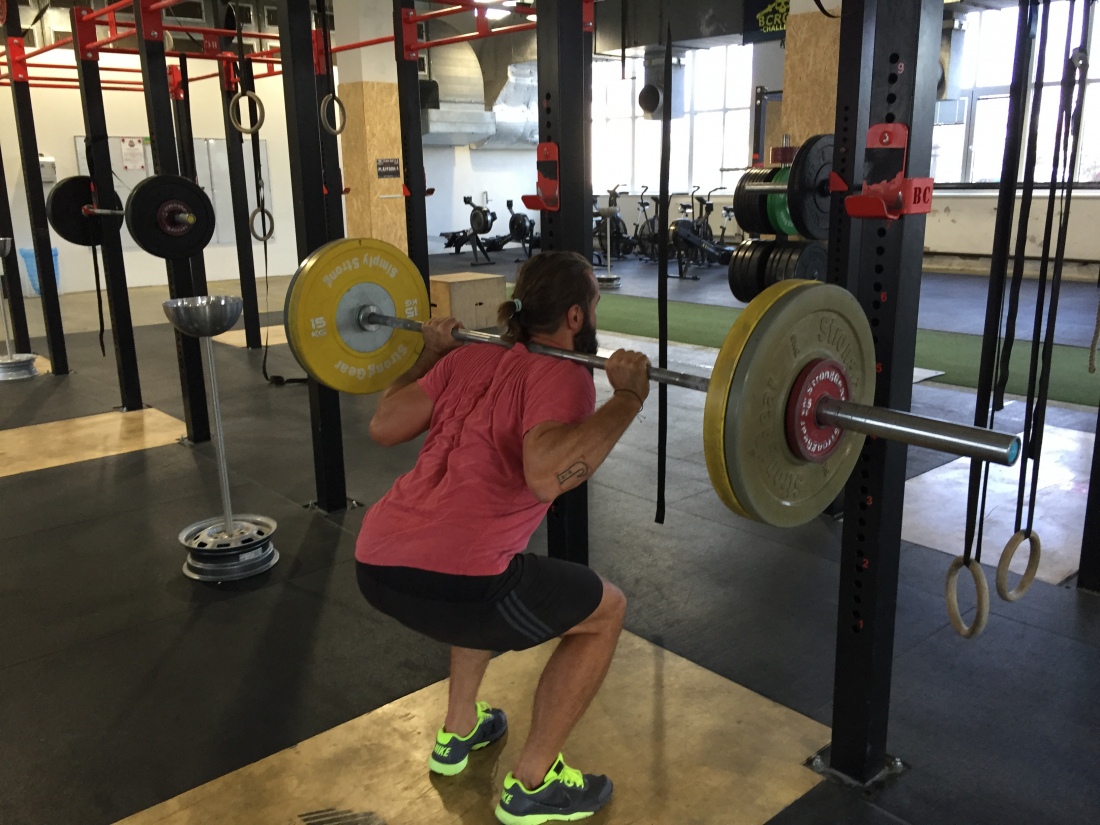
picture: squat to parallel, knees do not go in front of toes
Right off the bat, I'll tell you that I disagree. I'm even clearly and exclusively against it. In the next installment of this article, I'll try to explain why this is the case.
On the other hand, I am not saying that I am exclusively right, I am merely sharing my opinions and experiences.
Anatomical structure of the knee
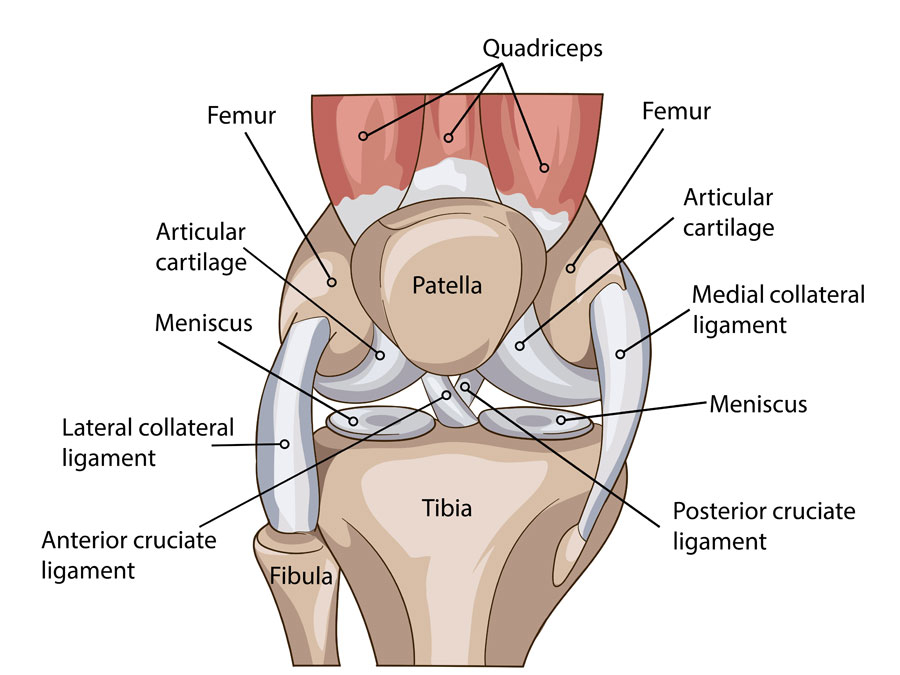
Image: anatomical structure of the knee, source: www.profadrianwilson.co.uk
ACL ( AnteriorCruciate Ligament)
- prevents the femur (thigh bone) from moving backwards onto the tibia (shin bone) and vice versa
- it is most superficial and therefore most susceptible to injury
- maximum tension occurs during internal rotation and flexion of 15'-30'
PCL (Posterior Cruciate Ligament) - posterior cruciate ligament
- prevents the femur (thigh bone) from moving forward onto the tibia (shin bone) and vice versa
- maximum tension during full extension (stretching)
MCL (Medial Collateral Ligament) - internal collateral ligament
- protects against inward knee sprain
LCL (Lateral Collateral Ligament) - the external collateral ligament
- protects against outward sprains of the knee
Menisci - inner and outer
- shock absorbing (femur to tibia) and spares the knee joint
- the inner meniscus is larger and fused to the MCL, so it is damaged more often
Forces acting
There are two distinct types of forces acting on the knee during the squat, which Dr. Aaron Horschig explains perfectly.
The first is "Shear Forces". I don't like to translate these terms from English, but I would loosely translate it as a forward-backward motion. Actually, it is a measurement of how much two bones, the femur and tibia, want to move one after the other in an oppositional direction. these forces can be dangerous to the knee ligaments - the ACL and PCL.
The second type of force is "Compressive Forces", the forces exerted in the knee by impact from the top and bottom (imagine hitting the ground after a jump). The menisci have to absorb the impact between the femur and tibia, the second compressive force acts between the back of the patella and the femur.
As we go deeper in the squat, the compressive forces increase while the anteroposterior forces decrease.
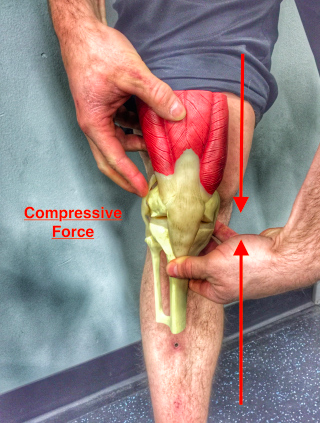
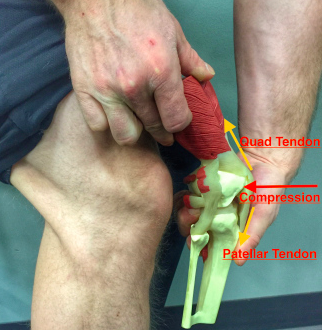
Images: forces applied. Source: www.squatuniversity.com
Historical roots
You're probably wondering where this statement came from to begin with.
In the early 1960s ( 1961 to be precise) a study by Dr. Karl K. Klein from the University of Texas (University of Texas) that purportedly demonstrated increased ACL (anterior cruciate ligament) and PCL (posterior cruciate ligament) laxity in weightlifters who frequently performed deep squats. He measured all of this with a device he created himself. The result of the study was the assertion that all squats should only be performed on the parallel bars.
Not only did this influence a significant portion of the sporting population, but even the medical community.Based on this study, the AMA (American Medical Association) came right back in 1962 with the claim that all deep movements, meaning within the range of motion of the knee, could potentially lead to knee injuries. The culmination of all this was a ban on physical education teachers teaching squats in the full range of motion.
What's great about research and studies is that if one study comes out that proves something, another one immediately comes out that tries to prove otherwise.
And that's exactly what happened... All of the studies done since then have NOT shown the same, or even a similar effect that K.Klein proclaimed, i.e. a correlation of deep squatting and higher injury risk!
The best opinion came shortly thereafter (May 1964) from Dr. John Pulskamp, who sought to refute Klein's study with counterclaims and the recommendation that deep squats should not be neglected. Unfortunately, the impact of Klein's study could no longer be significantly mitigated.
Modern studies
Now let's look at more modern studies for those who want to keep everything "science based".
Let's take the problem both logically and anatomically. It has been shown (give credit to Brad Schoenfeld's excellent summary study) that the forces acting on the ACL and PCL decrease as the knee flexion angle increases! Translated - the deeper we go with the squat, the less forces are applied to the knee ligaments.
The ACL gets the most work in the first 15-30 degrees of knee flexion, at 60 degrees the pressure decreases dramatically and then almost disappears as the angle increases.
The forces on the PCL are highest between 30 and 90 degrees of knee flexion and minimal below 120 degrees.
A classic example is the demonstration on squatting children. Are they squatting in a half squat? No, the only natural movement is one with full range, it is the degeneration of the human race that forces us to change established and natural movement patterns.
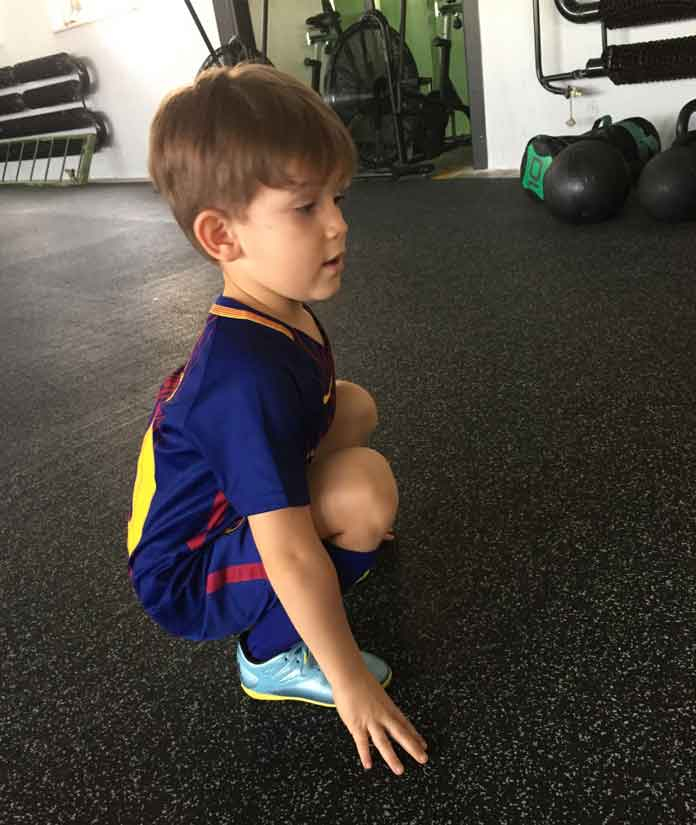
Picture: an example of a perfect squat performed by a child
Theoretically, the greatest stress could occur on the menisci and cartilage at an angle greater than 130 degrees for deep squats, yet there are no scientifically based studies proving this negative effect.
I say the studies are great, absolutely. The problem is that they are often misinterpreted, misinterpreted, and corruption and lobbying often play a role as well. Another problem I see is that the studies often fall short of real experience and practice. Take for example Cluster training, a type of training for increasing maximal strength. A study showing a positive effect on increasing strength came out in 2008. Great, except that for example, one of my mentors, Pierre Roy (you can read about meeting him HERE) has been incorporating this training since 1976 and the coach of hundreds of Olympic athletes, Charles Poliquin, has adopted and used the concept since 1982. Roy even mentions that weightlifters have been using the concept since 1948! What do you think, would they have had these results if they waited for a scientifically backed study to come out? You know the answer.
Sometimes we just need to take our wits about us and think rationally, even if it may go against our personal beliefs.
Practic e
In this section, we'll go over what I think is the most important part, the practical part!
In my experience, there is one simple statement, "The best squat is the one your body is ready for!"
It has been my experience with clients that approximately 50% of people are ready for the deep squat. With the other half, we need to start with basic progressions, strengthen the knee stabilizers, the plantarflexors, and only get the muscles ready for the deep squat. Some people have such a mobility problem that they absolutely cannot imagine doing a squat in full range of motion. In such a case, it is necessary to work on the mobility of the ankles, hips, on stretching the hamstrings and gluteals. Fascial release will do wonders for this. Others may counter that some people experience pelvic retroversion in the bottom position, the so-called "butt wink". This deserves a separate article where we will discuss the issue in more depth, here I will just suggest that it is not a problem.
People returning to sport after a knee injury (anterior cruciate ligament rupture, meniscus arthroscopy, etc) are a completely different chapter. Contrary to the common assertion that squats should not be performed after a knee injury, sometimes even banned from sports altogether, I regularly and successfully incorporate deep squats into my Knee Rehab Protocols in the more advanced stages. Of course, everyone has to progressively model to get there, but trust me, it is possible!
Video: client Denisa Stark during the fourth phase of the ACL Rehab Protocol, where we work on achieving full range of motion. After surgery, Dencha was told she would never be able to do a squat again, let alone with weight bearing, and not to think about returning to sports. Two weeks ago, she successfully completed her last college credit, the 1500 meter run, and can continue to study and return to taekwondo. Source: www.dominikkodras.cz
Incidentally, I have written an extensive separate article about knee injuries, primarily cruciate ligament injuries, problems associated with conventional treatment, rehabilitation procedures and the duration of returning to sport, which you can read on my blog HERE.
Probably the largest group of athletes who perform deep squats on a daily basis are weightlifters.
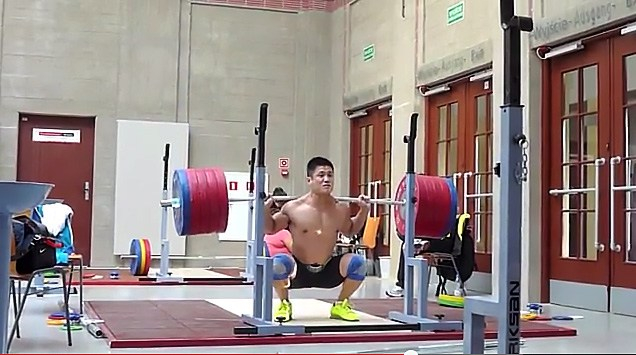
Image: weightlifter Lu Xiaojun during a series of deep squats. Source www.mobilityforweightlifting.com
Drill, drill, drill. Weightlifters lift dozens of tons of weight into a full squat every week, yet knee ligament injuries are a rarity for them, that says something too.
Can knees get ahead of toes?
If someone tells me that in a squat (or a lunge, split squat, step-up) the knee can't go in front of the toe, I fall into a swoon and think of the worst swear words in the world. It's nonsense!
I find it unbelievable that anyone can still live this myth these days. This is due to the fact that I surround myself with people who share my opinion, I follow social networks of people and sites I like. If I peek out of this shell from time to time, I can't help but wonder.
Again, it's important to mention that there is no literature or studies to support the claim that the knee should not go ahead of the toe. While Andy Fry's 2003 study did show more pressure to the knee when the knee went ahead of the toe, there was also a downside, and that was that the pressure increased in the hip joints and lower back as a result of a lot of forward bending.
So the problem arises when we try to compensate for the squat with restriction by more hip flexion when the pressure shifts to the hips and lower back. And because the lumbar spine is more prone to injury than other joint connections, we can conclude that it is safer to perform a deep squat with the knees moving in front of the toes rather than trying to keep the knees behind or level at all costs.
Recommended

Czech Virus Vitamín C

Nebbia Boxy crop košile s kapsami URBAN MUSE 598

Nebbia Crop top mikina MUSCLE MOMMY 619

Czech Virus ZMA MAX
I always find the best way to confirm this myth in my lectures or seminars is to ask the audience whether they think knees can go in front of the toe or not. 90% of the audience will answer that they absolutely may not (and that includes physical therapy students and fitness trainers....).
One of the things associated with the deep squat is that the knees get in front of the toes, the calves.Try doing a full squat without getting your knees in front of your toes. It's impossible, it's impossible!
Truth is, I get this question quite often and I'm tired of answering it. On the other hand, I know that there is so much misinformation out there that it's hardly surprising.
The biomechanics of the squat are clear - it is important to keep the balance exactly in the middle of the foot, if this is not the case, imbalance occurs, the weight is pushing into the toes or vice versa into the heels and we are not able to do a proper squat. If we want to maintain the correct distribution of force, the knees must come more and more forward in front of the toe as the angle increases.
And as we said above, it's not dangerous, on the contrary!
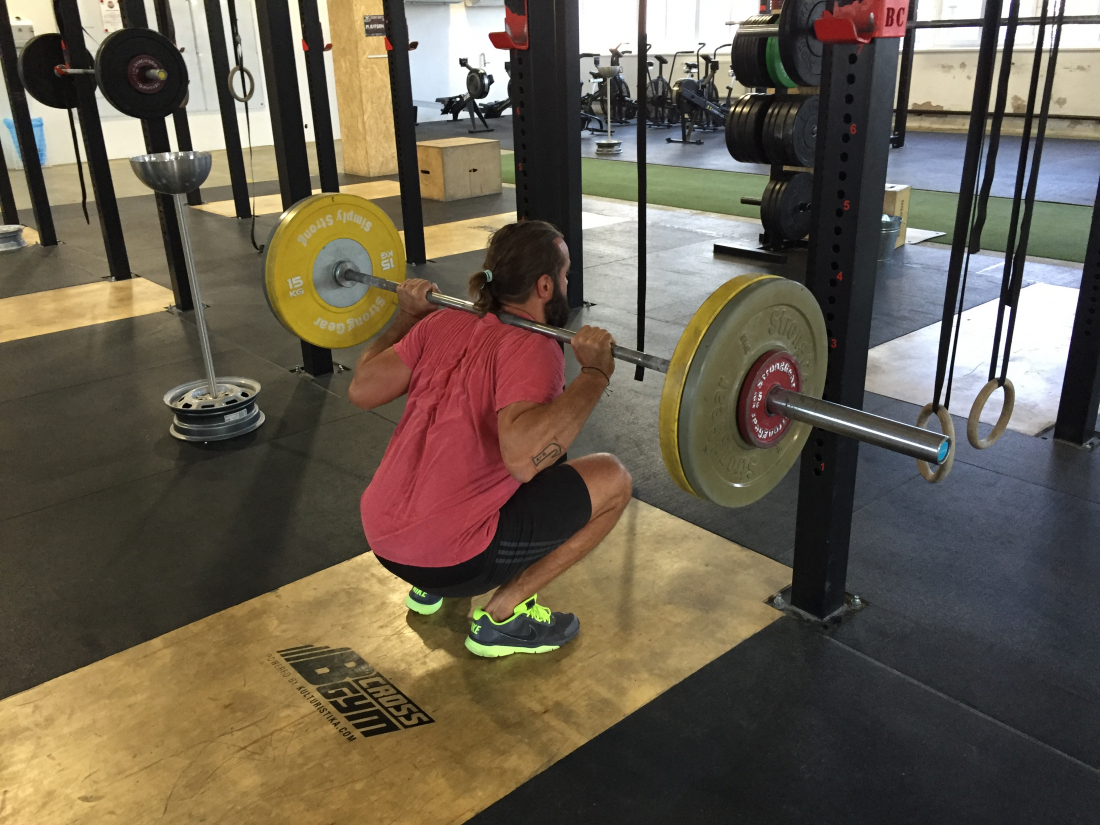
Image: ATG squat, knees going in front of toes
Other squat variations
I'd like to point out that there is no best squat variation, only the best one at any given time.
Whether we choose the front squat, the back squat, 1/4 or 1/2 squats (touchdowns), the squat with heels on the ground, or perhaps the Cyclist Squat (squat on an elevated mat) and the chain squat depends purely on our goal, current physical capabilities, condition, and ANATOMIC STRUCTURE.
Some will be comfortable with a wider stance, others will have to squat with their feet closer together, some will be able to do a full squat with perfect technique without any problems, others will benefit from squats with supported heels, some will find it impossible to break the butt-wink, while others will not be able to do it even if they wanted to.
In case someone has a shorter torso compared to the length of his lower limbs, he will need to work more on the squat, on the contrary, the deadlift will not be such a problem for him. Conversely, a person with a longer torso compared to the length of their lower limbs is predisposed to squat more and better, but will need to work that much harder on the deadlift.
Even unconventional and less used variations have their place in training plans, and it would be a shame to focus on just one variation with the assumption that it is the best.
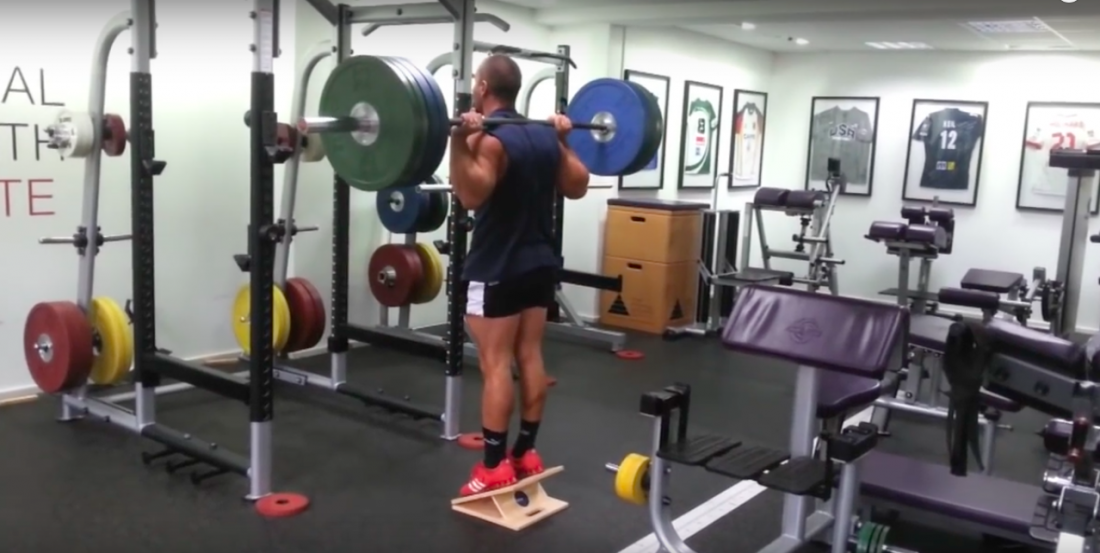
Image: a non-traditional squat variation, the Quad Squat on a platform. Source: www.ypsi.de
Conclusio n
From studies and experience, it is clear that a far better option for knee health is to perform squats in full range of motion and in a natural movement pattern, i.e. with the knees in front of the toe. But it would be the devil if there were no exceptions! If someone doesn't have enough mobility (ankles, knees, hips, shoulders), has weakened musculature (hamstrings, VMO, glutes, lower back), they need to work up to squats through gradual progressions. However, this should not take more than 2-3 months.
Good luck squatting!
Sources:
1. Klein K. e deep squat exercise as utilized in weight training for athletes and its ects on the ligaments of the knee.JAPMR. 15(1):6 - 11.1961.
2. http://www.lookgreatnaked.com/articles/the_biomechanics_of_squat_depth.pdf
3. Fry AC, Smith JC, Schilling BK. (2003). Effect of knee position on hip and knee torques during the barbell squat. J Strength Cond Res. 17(4):629-33.
No posts have been made yet.








