





How to challenge the "Over Head Squat"? Try to improve your thoracic spine mobility first!
 Author:
 This time we'll be looking at mobility in the overhead axis position. The lack of it could be limiting you in the market, overhead squat, and other exercises.
I'll share with you a few of my favorite exercises that address this issue.
- Mobilization (joint and soft tissue)
- Stretching
- Lower body chain activation
Article Outline:
Joint mobilisation
The first thing to address is the limitations in the thoracic spine. Rolling on a foam roller or stretching will not help here. If you feel stiffness in your mid-back in the back position with your back against the wall with your arms raised, this should help.
My favorite tool is the "peanut". It can be bought expensively, or you can wrap tape around two tennis shoes or lacrosse balls.
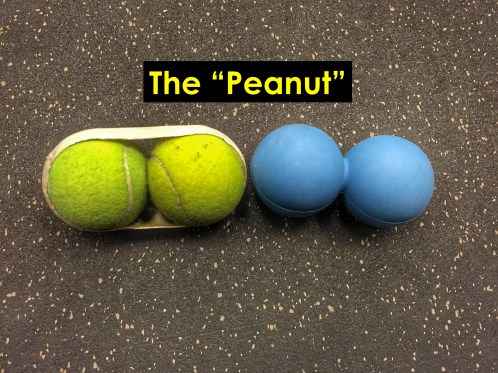
To mobilise the thoracic spine , lie on your back with your arms crossed in front of you. This will pull your shoulder blades out and to the side, creating space for the peanut to be placed. The balls should be on either side of your spine.

With your hands on your chest, perform a small push-up. The shoulders rise just a little. Hold the position for a few seconds and lay back down. Make sure there is no extension of the lower back. The movement starts from the thoracic spine.
The peanut serves as the center of rotation in this exercise. When a stiff joint is acted upon in this way, it can help with mobility.
Practice 2-3 sets of 15 repetitions with the peanut on any area of the middle back that feels stiff to you.
The exercise should not hurt intensely. If it does occur, I recommend seeking professional help from a physical therapist or chiropractor.
Soft tissue mobilisation
Joint restrictions are behind us. Next up is soft tissue stiffness. We can help with a foam roller or lacrosse ball. Athletes withlimited lat and pectoral musclemobility need to practice this daily.
The lats should be worked in a sideways position, with one arm raised above the head. Roll on the large muscle at the back of thearmpit. That's where the latissimus muscle is located.
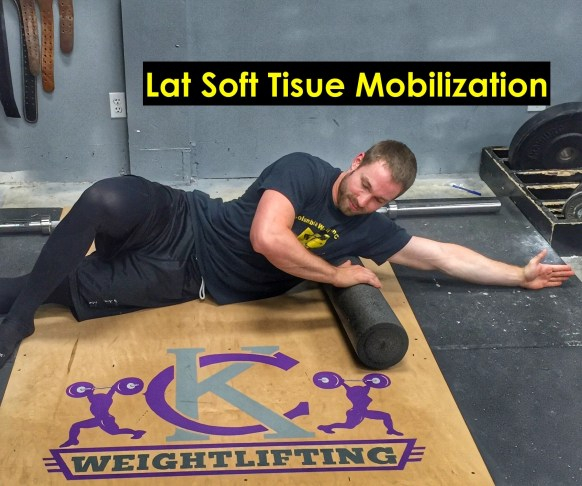
Roll over this muscle until you find a stiff area. Pause at the stiff spot for a few seconds and focus on it. Do not roll too fast, but rather rhythmically.
For the pectoral muscles , find a wall. Hold a lacrosse or tennis ball between your chest and the wall. Roll the ball over the muscle until you find a stiff area. Move slowly and take a moment to focus on the stiff areas.

You can add efficiency by starting to upswing after finding a stiff area to scroll for a while.
Stretching
The next step is stretching. I'm going to introduce you to my three favorite overhead axial mobility exercises.
- Stretching in prayer position
- Corner stretch
- Foam roller stretch
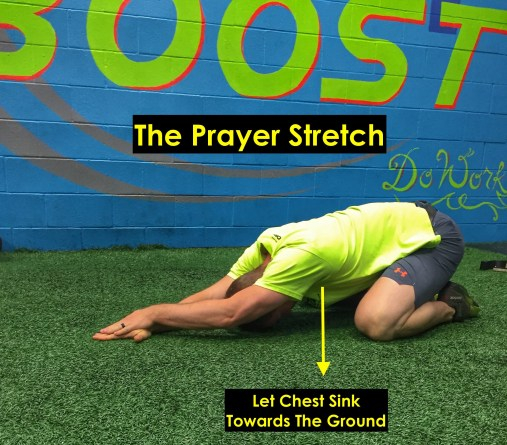
Stretching in prayer position is called child's pose in yoga. Start on your knees, sit on your feet and keep your hands in front of you (one on top of the other). Then lower your chest to the floor. With your hands still reaching above your head, exhale slowly. Try pushing your chest towards the floor. If you have stiff lats, this should stretch them out nicely. I recommend holding the position for 30 seconds.

I use corner stretches and foam roller stretches with my clients for limitations in the pectoral muscles.
Find a corner of the room and keep your arms at the sides of your body in the L position. Make sure there is no extension of the lower back. You should feel a good stretch in your chest. Studies show that this exercise has one of the greatest effects on the length of the small pectoral muscle (2).

Don't push too hard. The torque could damage your shoulders. You want to feel the stretch in your chest, not your shoulders. I recommend holding the position for 10-30 seconds.
Stretching with a foam roller is less intense and less torque is applied to the shoulders.
Start on your back, with the roller lengthwise under your back, between your shoulder blades. Take a PVC pipe or broom handle and place your hands as far behind your head as possible. You should feel a slight stretch in your chest. The goal is to relax the upper body and hold the slight stretch for a longer period of time (30 seconds - 1 minute).
Do not take a wasp or other heavy object in your hands here. This could put your shoulders in danger. If you feel tingling in your arms or hands, do not stretch too aggressively.
Activating the lower body chain
After the upper body exercises, you need to make sure your body can adapt to your newfound mobility. It's easy to forget the muscles that hold good posture. However, these are also important for overhead axial mobility. After the mobility exercises, you need to incorporate some endurance exercises.
In this short video, physiotherapist Mike Reinold explains a simple procedure to improve thoracic spine endurance.
If you've had problems with lats or pectoral flexibility, we need to focus on activating the scapular stabilizers (the muscles of the back shoulders and lower trapezius). I recommend the ER press exercise. It is excellent for stability and feeling good in the overhead axial position.
Conclusion
Now it's time for a newtest, in which you should show better results than in the initial one. And of course, there should also be improvement in the overhead axis exercises themselves.
Of course, the exercises presented in this article are not a miracle cure for improved mobility. They will not cure you in one workout. However, if you observe small improvements in your mobility with the overhead axis, you are on the right track.
Sources:
YouTube, Instagram, https://squatuniversity.com/
Translated by: Jaromír Uhlíř
Recommended

Beauty Booster 100cps 1+1

Carnigel 60g 5+1
Nebbia Sportovní volné tepláky GYM TIME 281
Nebbia Tričko s krátkým rukávem LEGENDARY 712
No posts have been made yet.








