





Get better with "active recovery"
 Author:
 When you walk into my gym in Baltimore, you'll find that my athletes never stop moving. It doesn't matter if they're bodybuilders, lifters, wrestlers, recovering from an injury, or just working out for fitness. They're all always moving.
If no one explains it to you, it will probably seem strange. Maybe you'll call it a "roundabout" and I'll have to punch you in the face. You might think it's a superset, which will technically be correct - it's usually a couple of exercises - but it will probably be something you've never seen before.
After a while, you'll find that the intensity of each exercise in the pair is completely different. The first exercise is hard and the second wants almost no effort. In fact, during the second exercise, the athlete is usually out of breath.
We call this active recovery. We help ourselves with the second exercise to recover from the first so we can work that much harder in the next set. Sometimes we use the second exercise to pursue a different goal, such as mid-body stability, neck strength, or rehabilitation from an injury.
This is why my clients never stop and why they get better results than the average exerciser in the same amount of time.
Like many trainers, I have found that I can only achieve limited results with my paying clients in the limited time I have with them. No one can lift nonstop for 50 or 60 minutes. If they are struggling in sets, it takes them more time to rest in between than the actual work.
I figure the only way to accomplish more is to use that rest productively, but not destroy them. It's called active recovery and you can incorporate it into your training. You get more work done in the same amount of time and you don't compromise the core of your training.
You can plan active recovery a dozen ways. All of them will be applicable if you stick to these three simple rules:
1. You have to have a damn good reason why you're doing this between sets. It can't be chosen at random.
2. It must not tire you out or limit your performance in the main exercise.
3. It must not stretch out the break or the entire workout, and it must not interfere with the goals you want to achieve with your main workout.
So let's look at some of those examples of active recovery.
For bodybuilders: antagonist exercises
In these exercises, you lightly contract the opposite muscles to the ones you were loading with the main exercise. So you'll do push-ups after heavy pull-ups, or light pull-ups after a heavy bench press.
Quoted from Serious Strength Training by Tudor Bompa and Lorenzo Carnacchia: "Such physical activity can improve recovery during the primary movement... Muscles relax more and energy stores recover more easily."
Your brain tries to limit the work done by the exhausted muscle. You're sending it the opposite signal.
I'll show you how to incorporate active recovery into a traditional bodybuilding three-day split.
Day 1: chest and triceps
| Primary exercise | Exercise for active recovery |
| 1) Bench press | Recline pull |
| 2) Incline bench press | Face pull |
| 3) Arm raises | Rear delts |
| 4) Triceps pulldown | Biceps deadlift |
Day 2: legs
| Primary exercise | Exercise for active recovery |
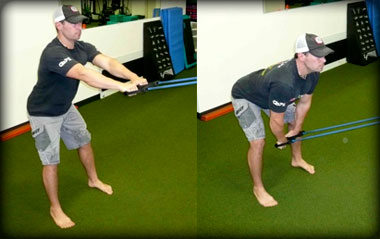
| 1) Squat or deadlift | Reverse pull-through with pulley or rubber band |
| 2) Overhead kick/bend | Burying/pre-trenching |
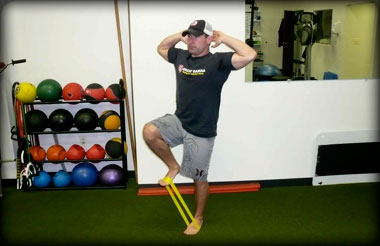
| 3) Calf raises | Dorsiflexion march with rubber |
Reverse pull-through: the name implies that it is the opposite of a pull-through. You are facing the pulley or your band grip and working the muscles of the front of your body. With your arms outstretched, pull the handle down, between your legs. Bend at the hips, not the back; you want your spine in the optimal position. If you like the exercise, try loading up more sometime and exercising your mid-body.
Dorsiflexion march: use a band with minimal resistance. Straighten up, march in place and keep your foot pulled as close to your leg as possible (as if you want to walk on your heels). Put your hands behind your head and keep your body straight to increase the load on your middle.
Day 3: back and biceps
| Primary exercise | Exercise for active recovery |
| 1) Overhead pulley bend or contraction | Shoulder press |
| 2) Lunge in front of the body or on the machine | Click |
| 3) Bicep Lift | Triceps extension |
For lifters: four-part squat
Even the smartest lifters can usually get by with a few minutes of mobility work during warm-up. That's fine as long as mobility doesn't limit your technique. Even the best, however, can get a little stiff. And for those who have mobility issues from the beginning of the workout, it will probably get a little worse as the workout progresses.
I learned this technique from Gray Cook and use it with a lot of my strength athletes. It's great in between a series of weightlifting exercises, as well as triceps ones.
Start with a wide stance as seen in the picture. Begin the movement by bending over and catching your toes.
Then get your hips as low as you can and go into a squat. Keep your back straight. You also need to engage your butt and push your knees out, as seen in the picture.
The third step is to raise your arms above your head so they are flush with your torso.
Finally, stand up.
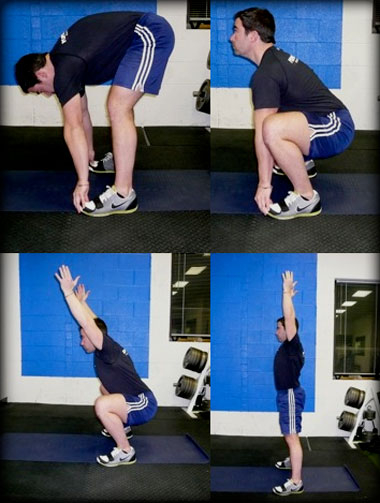
When you repeat the exercise, make sure you do each of the four steps independently of the others.
This is not the only way to use dynamic mobility as active recovery. You can also work on mobility when you train unrelated movements - train lower body mobility in bench press training and upper body mobility when you squat or deadlift.
For strength athletes, wrestlers: neck training
Technically, the neck is part of your mid-body. This means that neck training is useful for everyone. For wrestlers, MMA fighters and American football players, neck strength and stability are essential. But almost no one trains their neck anyway.
I described some nice neck exercises in my article How to Build a Strong Neck. Use them as active recovery and give your training a new dimension.
Neck stability exercises can serve double duty. Take the head-off-the-bench hold exercise I show in the article. It's simple: do one-arm push-ups on a straight bench or Swiss ball, but keep your head unsupported.
You can do those push-ups as an active recovery to the deadlift, and without your head supported, your neck will benefit as well. Do 8 to 12 reps in each set.
For everyone: mid-body and stability
Pick any three trainers and there's a decent chance you'll get three different opinions on mid-body training. Some say it's best to put it at the beginning of your workout before you get tired of the heavy exercises. Another says it doesn't belong before heavy exercises so that it doesn't tire out the muscles we need. The last one puts the midsection quietly into a separate workout.
I personally like to train the middle of the body as active recovery. I don't do it only when the main exercise is demanding on spinal stability. It's mostly squats, deadlifts and overhead presses.
But that still leaves us with three quarters of all the exercises we do. My clients get the best results with short and not too intense mid-body workouts.
Here are my two favorites. You probably haven't seen them yet.
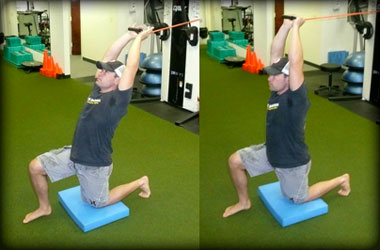
Kneeling posterior reach: use a band or pulley (Band is in the photo). Kneel with your back to brace. Hold the band with both hands over your head and start from your arched back. (If your lower back hurts, you may be too arched.)
Now you have a few options. You can hold it statically for 15 to 30 seconds or you can straighten your torso to the position shown in the second picture.
Or you can start from the second position, if the first one is very uncomfortable, and do isometric holds or short movements where you pull forward a little.
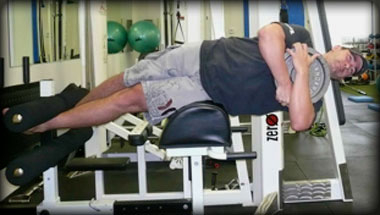
Lateral hold: in the picture you can see that I'm holding the position and I'm sideways on the GHR bench. You can also use a Roman bench or two parallel straight benches, where you'll be lying on one and sideways on the other. You can hold the position with your own weight or add weights as in the picture.
Hold the position on both sides for the same amount of time.
One last thing about mid-body training: I don't like to use rotational movements as active recovery. They are too complex movements and deserve more attention. Use them as primary exercises.
For all athletes: reflex and reaction training
I don't like the term "sport-specific training." If you're an MMA fighter, your specific training is sparring. A baseball player hits, throws, and catches. I help you get stronger, bigger, and faster so you can then get the most out of what you train on the field, court, or mat.
I have no problem coaching specific skills. A wrestler can use shadowing as active recovery, or even modified sparring if they need to practice new positions before an upcoming match.
If a tennis or golf player comes to me, I might have them bring their racket or club, respectively. This is especially appropriate if his coach has recently modified something in his movement mechanics. This is a decent way to experience the new movement and not disrupt your normal practice routine.
You can also practice things that aren't sort of specific to any sport, but improve general athletic skills like reaction time. Probably my favorite is the card catch that's on the video. Todd Durkin taught it to me and I like to use it towards the end of practice when my athlete is tired.
For the injured: rehab .
A few months ago I had ACL surgery on my right leg. It was horrible. I lost a bunch of muscle from my legs, especially the right one.
Using rehab exercises like active recovery doubled the amount of work my legs got- three times a week with a therapist and three times a week my own workout. Within seven weeks, I was able to rebuild, run, train and show my charges even complicated movement patterns.
I'm not going to go on and on about it. Every injury is different. I just want to emphasize that low-intensity rehabilitation exercises are ideal as active recovery because they do not fatigue the injured muscles further.
Summar y
In my opinion, these are the key points to active recovery:
- You'll get more out of your core exercises if you lightly exercise the opposite muscles between sets.
- You can use mobility exercises between sets of weightlifting exercises. This will improve execution and range of motion.
- You can exercise your neck and mid-body, improving stability and strength, and not prolong your workout unnecessarily.
- If you are doing a sport, you can practice the basic movements - a combination of kicks or punches, swings, throws - and you won't tire yourself out unnecessarily.
- Athletes who train for speed and reaction time at the end of a workout when they're tired can also improve their performance outside the gym. If the decisive moment comes at the end of the event, whoever can deliver a better performance tired will win.
- If you are returning from an injury, rehabilitation exercises can help reduce the time needed to recover
- I certainly haven't exhausted all the possibilities of active recovery with this article. Between sets, you can train a variety of athletic skills - agility, flexibility, balance, hand-eye coordination. You can save time and prepare for the main exercise that will follow.
It's better to do active recovery on time, not on number of reps. (Consider neck training an exception.) If you're taking long breaks, try incorporating unilateral exercises. If you're doing short breaks, stick with bilateral exercises.
Most importantly, active recovery must not tire you out. Specifically, it must not fatigue the muscles you use in the primary exercise. So don't put push-ups in between sets of bench presses, don't put your midsection in between sets of squats or other stability-intensive exercises.
The other two rules are clear. Always have a good reason for choosing an exercise for active recovery, and don't exceed the length of your normal break.
Otherwise, you will be limited only by your own imagination. Use active recovery carefully and imaginatively and maybe your workouts will be more productive and you won't have to add a minute to your gym time.
Written by Nick Tuminnello, translated by Jaromir Uhlir, Images taken from T-Nation
No posts have been made yet.








