





Deal with shoulder pain once and for all! Ask coach #2
 Author:
 In the first part of the "Ask Coach" series of articles on various topics, we covered an article on how many reps in a workout is ideal to choose for different goals. If you missed the article, definitely come back to it.

After this article I got a lot of questions and requests for more interesting topics, often repeated question about shoulder problems, shoulder protraction (shoulder forward), pain in the front of the shoulders, inability to do bench press without pain and also inability to get the axis behind the neck (the so-called Behind the Neck position).
So we generalize the question:
"What should I do if I have unrelenting shoulder pain?"
Again, this is a strongly general question and we need to further specify it and break it down into sub-questions.
But let's start by talking about the anatomical structure of the shoulder joint and especially the EXTERNAL ROTATORS OF THE SHOULDER, which often play a key role in shoulder pain.
Muscles of the external rotators of the arm:
- m. deltoideus posterior (posterior part of the deltoid muscles)
- m. teres minor (small rounded muscle)
- m. supraspinatus (supraspinatus muscle)
- m. infraspinatus (subcostal muscle)
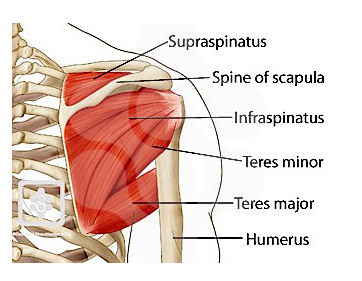
Possible causes of shoulder pain:
1. disproportion between the internal and external rotators of the arm
This is probably the most common problem for most gym-goers today.
Everyone wants big, strong pectoral muscles and powerful anterior delts. Few people think about long-term shoulder health and training longevity at that point, so they neglect training smaller muscles that aren't sexy on the surface either. Hand on heart, have you ever practiced structured training of the external rotators or seen someone specifically target them?
Anyone who sees themselves in this let them bang their head against the wall. When you recover from a mild concussion in a few days, come back to read this article.
The internal (internal) rotators of the arm are:
- m. subscapularis (subscapularis muscle)
- m. latissimus dorsi (broad back muscle)
- m. pectoralis major (large pectoral muscle)
- m. teres major (large rounded muscle)
- m. deltoideus anterior (anterior part of the deltoid muscle)
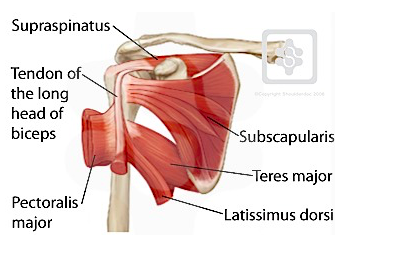
These muscles are involved in a large proportion of movements in everyday life, so they tend to shorten (1), while their antagonistic muscle group, the external rotators of the arm, tend to weaken. Prof. Kolář, one of the world's most famous physiotherapists, states in his works that these muscles are developmentally younger, thus the need to strengthen them (2).
Ergo: Focus on compensating for these disparities by including 2 external rotator cuff exercises at the beginning of each upper body workout, a minimum of 2 sets (I recommend 3) ranging from 10-20 reps at a controlled pace.
An example of such a specialization workout would look like the following in a prescription:
- A1 External Rotation - Standing - Arm Abducted to Side - Low Pulley, 3x12-15, 3010, 10s
External rotation with emphasis on the m. infraspinatus:
- A2 External Rotation - Side Lying - DB - One-Arm, 3x15-20, 2010, 10s
External rotation with emphasis on m. teres minor:
2. Too much emphasis on push exercises, as opposed to pull exercises
Here the cause is clearly visible. The constant prioritization of pressure exercises, primarily horizontal (bench press, incline press) with simultaneous neglect of such exercises cannot do any good in the long run. Therefore, shoulder pain seems to be the logical outcome of a poorly set training plan.
I can't even count how many people have told me that they almost can't bench press because of shoulder (or both shoulders) pain.
Yet the most elegant solution is to scrap all exercises that make your shoulder/shoulder sore for a while and focus on a "rehabilitation process" during which you focus on balancing the disparity of pulling and pushing exercises.
If you have been bench pressing for several years and have not neglected the pulling exercises, don't expect the situation to improve in 6,8,or 10 weeks. It took some time to develop the sore shoulder syndrome and it will take some time to get rid of it.
Ergo: Eliminate all horizontal pressing exercises (bench press with both axial and single arm in all inclines) for a minimum of 12 weeks and specialize in posterior chain pulling muscles. In point number 1 we gave a demonstration of training for external rotators, these will be an integral part of point 2 as well. Next, we need to strengthen the m. latissimus dorsi (Seated Cable Rows = pull-ups of the lower pulley while seated, Lat Pulldowns = pull-ups of the upper pulley, T-Rows = pull-ups of the T adapter while standing, etc.).
Recommended

Nutrend N1 Pre-Workout
Prom-in Vita Solution 2.0

Nebbia Boxy fit košile s kapsami STREET ICON 599
Czech Virus Testo Virus Part 1
An example of such a specialized deadlift workout using vertical press and delts training would look like the following in a prescription:
- A1 Overhead Press - Seated - DB - neutral grip, 4x10-12, 3110, 75s
- A2 Pull-Up - Pronated - mid grip, 4xmax, 3010, 75s
- B1 45' Lateral Raises - Seated - DB, 3x12-14, 2012, 60s
- B2 Lat Pulldown - Supinated - mid grip - paused, 3x12-14, 3012, 60s
- C1 T-Rows - Standing - semi-pronated grip, 3x12-15, 2011, 30s
- C2 External Rotation - Side Lying - DB - One-Arm, 3x15-20, 2010, 30s
3. Performing exercises in incomplete range of motion
Another recurring factor in the development of shoulder pain is performing exercises in an incomplete range of motion. The shoulder joint, like any other joint, is predisposed to a variety of motion, so overloading it with a constantly shortened range of motion is not beneficial, quite the opposite.
This leads to fascial adhesions, where muscle function deteriorates and the brain sends signals that something is wrong in the area. This can manifest itself as pain in that particular location.
Ergo:The simplest solution is to EXERCISE IN FULL RANGE OF MOTION!
And this includes all exercises such as bench presses, dips, overhead presses, one-arm push-ups and so on. Fascial stretching and relaxation also occurs during the exercise.
You can see the full range of motion for the overhead one-arm press below.
If you have a good physiotherapist, get advice on fascial stretching exercises or have the fascia relaxed with manual therapy.
4. Exercise with the same grip all the time / little variation in grip rotation
A common maladjustment - exercisers do not change grips during upper body exercises!
We have 3 basic grip types:
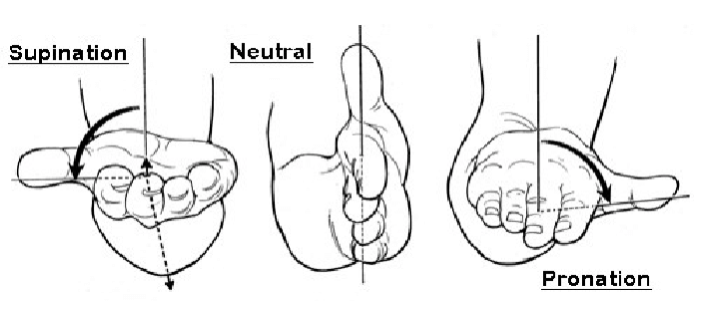
- Neutral position = thumb edge is in line with the elbow and shoulder joint
- Supination (underhand grip) = the hand is palm up
- Pronation (overhand grip) = hand palm down
Now, hand on heart and honestly answer for yourself, how much grip variation do you have in training?
90% of the time the same thing is repeated over and over again: pronation grip (overhand grip) dominates the vast majority of your push and pull exercises!
In this case, constant stress is created on the shoulder (and also elbow) joint, which in time must manifest itself in pain in these joint connections.
It is also necessary to take into account HOW WIDE YOU USE THE ARCH. Wide, medium, or narrow. But let's not complicate this and focus only on grip rotation, I just wanted to emphasize that varying and alternating the width of your grip also plays a big part in making sure you don't constantly overload your muscles and joints at one angle.
Ergo: To keep the principle that most readers will remember, I'll limit myself to a few simple rules.
- In case you choose a pronation grip for basic pressing exercises (bench press, incline press, military press...), choose a neutral or supination grip for pulling exercises in this training.
- On the other hand, assuming that you choose a supination grip, i.e. underhand or neutral grip, for the basic pulling exercises (chin-up = pull-up underhand, pulley pull-up underhand or neutral grip, pulley pull-ups to the waist with supination or neutral grip...), you can afford to use the pronation grip more in the push exercises.
Example of training with grip change for push and pull exercises:
- A1 Chin-Up - Supinated - close grip, 6x4-6, 3010, 120s
- A2 Bench Press - Pronated - mid grip, 6x4-6, 3010, 120s
As we can see in the prescription, for the first exercise (deadlift) we used the underhand grip, while for the second exercise (push) we chose the overhand grip. In such training, the correct solution is to choose the NEUTRAL GRIP for the supplementary exercises, but this is not a rule that always applies.
5. Weakened upper and lower scapular fixators
Other muscle groups that play a pivotal role in preventing shoulder injuries are weakened and underdeveloped upper and lower scapular fixators.
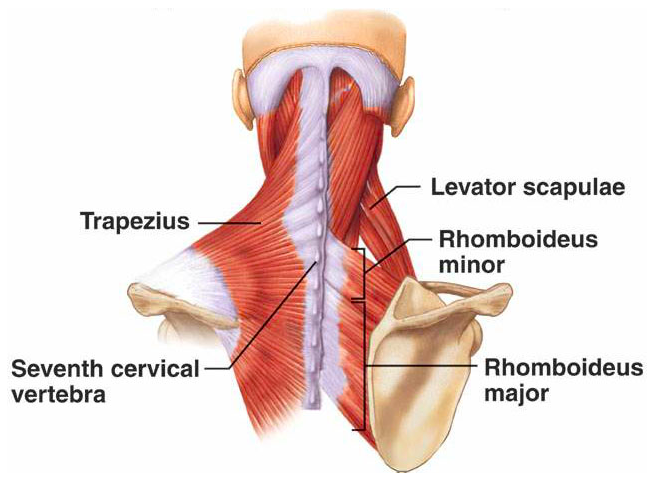
We want these postural muscles to function properly so they can perform their functions.
If we focus only on the interscapular (rhomboid) muscles, we will not solve the problem completely, because this would cause the shoulder blades to be pulled more together, but the way the muscle fibres of the rhomboid muscles are leading the shoulder blades to elevate, i.e. move upwards!
We need to compensate for this by also strengthening the lower scapular fixators, which pull and fix the scapulae where their collective name suggests, downwards.
Assuming that we are constantly overloading the internal rotators of the arm, primarily the m. pectoralis major, we must compensate for this by strengthening its antagonists as well. In this case, it will not be the interosseous muscles, as people sometimes mistakenly believe, but primarily the m. latissimus dorsi (broad back muscle). In addition, the scapulae should be fixed with m. serratus anterior (anterior sawtooth muscle) and m. trapezius - pars descendens (lower part of the trapezius muscle, sometimes called Trap 3).
Ergo: Exercise the interscapular and lower scapular fixator muscles! You can include them as an activation at the beginning of your workout, or as a finisher at the end of your workout. Because the muscle that gets the biggest training stimulus is the one that is targeted first in the workout, I recommend including the exercises at the beginning of the workout and at least in the first two to three phases of the training macrocycle.
Recommended exercise for the interscapular muscles: Powell Raise - Flat - DB
Recommended exercise for lower trapezius: Trap 3 Raise - Kneeling - Low-Pulley - Rope
You can include these two exercises as a superset at the beginning of your upper body workout.
6. Strength disproportion between long and short biceps head
One of the most underrated things when it comes to shoulder health!
Almost nowhere have I seen any mention that shoulder joint pain can be caused by just a disparity in strength between the long and short head of the biceps. Yet it makes a lot of sense.
A bit of anatomy: one of the functions that the biceps performs is to extend the shoulder joint, so it would be a mistake to skip biceps training on the grounds that it is an important part of shoulder joint function.
- Long head of the biceps = the tendon of the muscle starts at the scapula near the shoulder joint, then the muscle goes over the shoulder joint and extends to the radius.
- Short head of the biceps = at the shoulder blade, it branches off medially from the long head and joins the long head of the biceps about halfway along its length and also attaches to the radius.
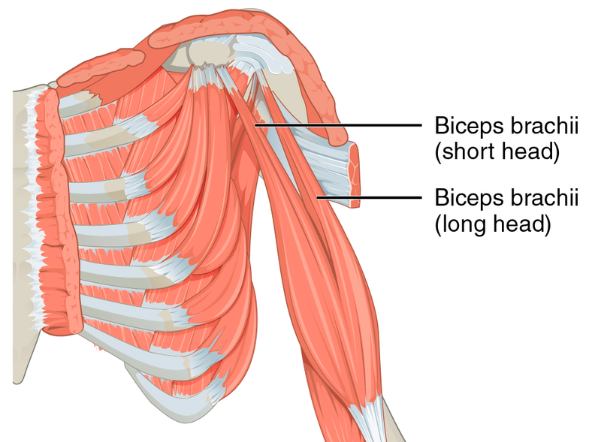
The long head of the biceps makes an aesthetic bump, while the short head gives the biceps the necessary density.
Ergo: The keyis to not overload one head more than the other in the long run and to reflect this in your training plan!
Exercises targeting the long head of the biceps: all exercises where the elbows are at body level or slightly behind the body. The best exercise is the 30'Incline DB Curls
Exercise targeting the short head of the biceps: all exercises where the elbows are in front of the body, for example Spider Curls.
Exercise for both heads: BB Biceps Curls (standing biceps axis lifts)
!! In case you don't know what exercises are involved, look them up on YouTube !
7. Find out where to find the Bicep Biceps in the video below.
If we go completely in depth and want to rule out all causes of shoulder pain, we must also take into account the nervous system and the innervation of the deltoid muscles.
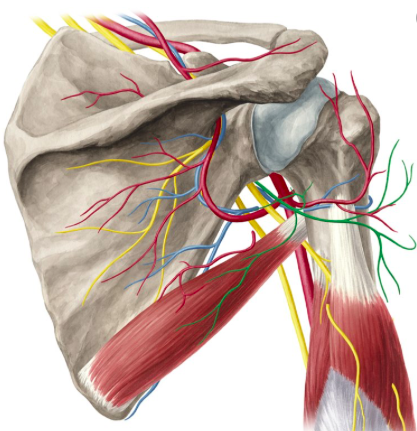 The delts are innervated by a nerve called the Axillary Nerve and it is often the case that it is the impaired innervation of the delts that can cause pain and impaired range of motion in the shoulder joint.
Releasing the nerve is beyond the scope of this article, but if you have someone who is familiar with the issue and will be able to advise you on how to release the nerve using exercises, or manually or using the Dry Needling technique, go for it!
I hope the article was beneficial to you and that you will try out the recommendations mentioned in your quest for healthy shoulders.
If you have questions you want answered, feel free to leave a comment just below this article. We'll be sure and happy to answer!
Support your performance with quality supplementation!
On our store you can choose from a lot of proteins, gainers, amino acids(bcaa, glutamine, ...), vitamins and minerals, creatines,fat burners and much more. So don't hesitate and step it up a notch!
Sources.
No posts have been made yet.








