





Build volume, increase your strength and work on your performance! - Part 1
 Author: Šárka Randáčková
 What's better than being big and strong? Being big, strong and powerful. In short, to be a man who can deliver top sporting performance and looks muscular.
However, there aren't many exercisers who fill all of these categories. Most people focus on size and strength, but outside of the gym, they are flabby turtles.
While maximal strength is important (it's the foundation of the other skills), it's still only one piece of the puzzle. For complete athletic development, you need to improve synergistically in strength exercises, power and speed. How to do this? You need to become a master of the strength and speed curve.
What is the strength and speed curve?
It's a basic description of the inverse proportionality between force and speed. It simply describes the fact that maximum force is generated at low speed (squat with 95% of the maximum), while maximum speed is achieved at low force (jump with self weight).
The eigencurve is made up of 5 zones:
- Maximum strength: 90-100% intensity.
- Strength-Speed: 80-90% intensity
- Peak power: intensity 30-80%
- Speed-strength: intensity 30-60%
- Maximum Speed: 0-30% intensity
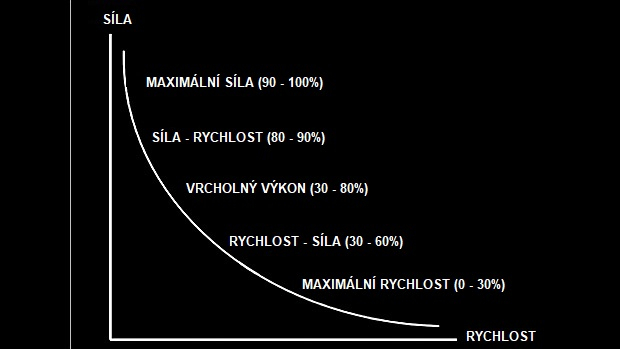
Coaches may not completely agree on the percentages, but it doesn't matter that much. Basically any exercise can be modified for either end of the curve.
The most important thing is to train along the entire curve. This is a one-way ticket to station progress.
Why train along the entire curve?
Each point on the curve requires a different level of physiological adaptation, thus training strength, volume, power and athletic skills. Here's an explanation.
None of the strength qualities are neglected.
Westside lifters train this way. They train each of the qualities of the strength hierarchy - maximal strength, dynamic strength, and repetition strength - under the same umbrella.
Maximal strength will always be the most important, but the other skills are conducive to it.
It develops an explosive force
Since peak performance is the offspring of strength and speed, it is logically necessary to train it through a combination of strength and speed training. Anything else will lead to suboptimal results.
It accelerates muscle growth
Both strength and speed exercises train fast-twitch type II muscle fibers, which have the greatest growth potential. In addition, such training will also force the slow fibers to behave like the fast fibers by increasing their size and strength potential.
The space between the two ends of the curve will be taken care of by other volume mechanisms such as muscle damage and metabolic load.
This improves overall performance
Improving strength, volume, and power will make an excellent athlete out of anyone. When the entire curve shifts to the right, it means the athlete is improving in all trainable skills. No element of performance is neglected because of training something else.
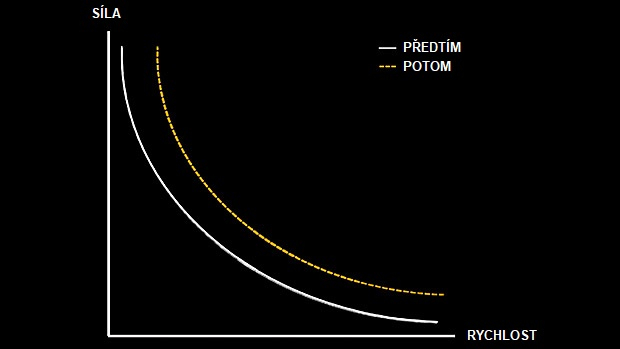
How to create perfect strength and speed training
1 - Start each workout with 1-2 exercises focused on maximal speed
This is about pure momentum and contracting as quickly as possible, so the load should be minimal. The best example is sprinting. Also, bungee jumps, jumps from a deep squat, plyometric push-ups, or throwing a light medicine ball can serve.
How to do it?
- Add 1-2 dynamic exercises before the main workout, for 2-4 sets and 3-5 reps.
- If you squat, incorporate some lunges.
- If you're doing some push-ups, do plyometric push-ups or medicine ball throws.
- If you want to make your workout shorter and more varied, pair strength and dynamic exercises.
Medicine ball throw
Lunge from deep squat to wide
2 - Practice 1-2 exercises for maximum strength
This is where you will approach maximum intensity. It's all about one thing, building strength. It doesn't matter if the reps last 3 or 30 seconds. You only need to get the axis from point A to point B.
Complex exercises are essential. For the upper body, it'll be bench press, overhead presses and dips. For the bottom, squats, deadlifts and variations.
Loaded variations such as single leg bench squats, Romanian deadlifts, positive bench and weighted push-ups can also be useful.
Recommended
Nebbia FIT Activewear šortky se skrytou kapsou 442
Czech Virus Vitamín C
Nebbia Legínové šortky s vysokým pasem 5” HAMMIES 615
How do you do that?
- Use 90-100% 1RM.
- You can also use intensification methods such as slow starts, pauses, isometric holds, choosing exercises with a lower load capacity such as the front squat.
- The key is to stick to a range of 1-5 reps and 3-5 sets.
3 - Practice 1-2 strength-speed or speed-strength exercises
These two zones usually use the same exercises. These will be complex exercises included right after the main pillars of the workout. The difference will be in the speed and load.
In the strength-speed variation, you'll want a heavy load and move it quickly. In the speed-strength variant, you'll be moving light weight fast. The weight will move as fast as possible.
How to do it?
- Strength-speed is practiced at 80-90% intensity for 4-8 reps.
- Speed-strength is practiced with 50-70% for 3-5 reps and rubber bands and chains are used.
4 - Add supplements
Spend two-thirds of your training time working somewhere between the ends of the curve. The purpose is to accumulate volume of work, improve weaknesses and recruit muscle.
Single-arm push-ups, weighted push-ups, pull-ups, Romanian deadlifts, and back work (thrusts, glute-ham raises), etc. fall into this category of repetition exercises.
How to do it?
- Use different loading schemes.
- From 6 to 15 reps and an intensity between 50-80%.
- If you have the time and inclination, pump through isolation exercises, machines, elastics, etc.
5 - Evaluate your starting position and adapt your training to it
Exercising along the entire curve is a must, but not everyone starts from the same position and shouldn't exercise the same way.
Fortunately, it's not an extreme science. To quote Eric Cressey:
If you're fast, train strength. If you're strong, train speed. If you're neither, stop making stuff up and just train.
Next time we'll show some examples of how to build your training around this principle.
Source : www.t-nation.com - Out-Lift the Big Guys, Out-Perform the Little Guys
By Charley Gould
Translated by: Jaromír Uhlíř
Author: Šárka Randáčková No posts have been made yet.








