





5 tips on the topic: How to take your handles one step further!
 Author:
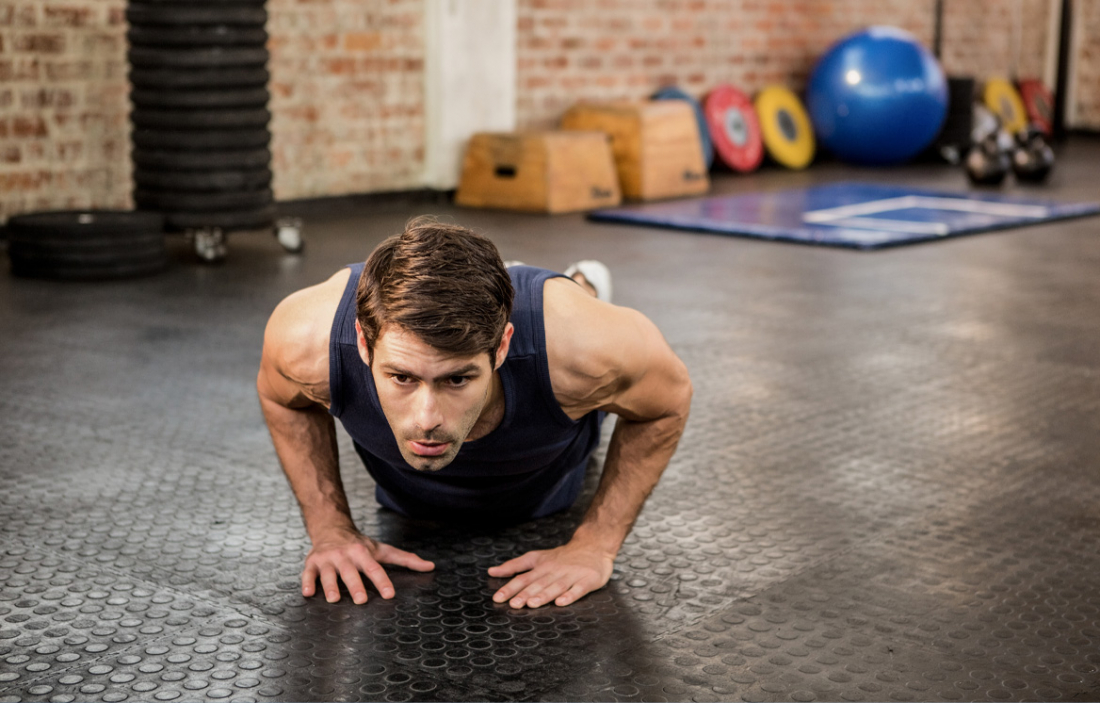
 If you can do classic push-ups with ease, it might be time to take on a new challenge! The next step can be as simple as moving your arms or legs.
Al Kavaldo, bodyweight training expert:
"As kids, my brother Danny and I spent a lot of time competing in push-ups. Ifone of us did thirty of them, the other had to do thirty-one. It didn't take long for thirty push-ups to become fifty. Then fifty became seventy. We were obsessed with getting to three digits.
What we didn't know then was that from a certain point on, just adding re ps wasn't the best way to improve. After a few years, when we both became fitness professionals, we realized that there was a more effective approach, which we now call progressive calisthenics."
Rather than endlessly adding reps of the same exercise, progressive calisthenics calls for more challenging versions of the same movement pattern if you can already master the previous ones. By changing the leverage, altering the ratio of weight per limb, or removing a fulcrum, you'll find a way to increase the load without adding external weight.
When it comes to building muscle mass and strength, resistance is resistance. As long as the muscles receive the proper stimulus to grow, they don't care if the resistance comes from an external object or their own body weight. Just as you have to increase weights to get stronger in strength training, you have to find a way to increase the intensity of your calisthenics training if you want to give your body the impetus to grow again.
The push-up is one of the easiest ways to see the principles of progressive calisthenics in action. While these changes may sometimes not be noticeable to the untrained eye, they have a big impact on the difficulty of the workout.
Let's take a look at five ways to modify push-ups using the principles of progressive calisthenics.
Move your hands closer together
This is a method that most push-up performers can often get to grips with very quickly. In a standard push-up, the arms are slightly wider than shoulder width. If you bring your arms closer together, the leverage point changes and the exercise becomes more challenging. Many people preach more load onthe triceps andanterior delts when performing this, but make no mistake, you will still get the most pump in the chest area.
Raise your legs
Raising your legs to an elevated position will transfer much more weight to your hands compared to traditional push-ups. This means more work for your chest, arms and shoulders. The higher you place your feet, the harder the exercise will be.

Change your grip
The traditional push-up requires keeping your hands flat on the floor throughout the entire range of motion. However, changing your grip to knuckles or fingers creates extra space between your body and the ground, allowing for a longer range of motion. This means that to get your chest all the way to the ground, you'll have to bend more at the elbows. By increasing your range of motion, you'll also achieve an increase in the intensity of your work on each repetition. Among other things, the fingertip version of the push-up also loads the muscles of the whole hand, fingers and forearms that are neglected in the standard push-up.
Of course, you don't have to do push-ups on just your fingers or fists to achieve a longer range of motion. You can use any piece of equipment - a kettlebell, for example, or apush-up adapter designed specifically for this work.

Bring your arms closer to your hips
In a classic push-up, your arms are in line with your shoulders, but by bringing them closer to your hips, you make the exercise harder without using any external equipment. Even though this is a subtle change, placing the arms lower will lessen their impact and add weight to the hands, making the exercise harder than it may seem. This variation will also provide a stretch to your wrists.

Remove the fulcrum of the upper or lower limbs
The most obvious variation to increase the load on push-ups is by removing a limb as a fulcrum. Obviously, a one-arm push-up like this is somewhere else in terms of difficulty than a conventional one.
Although many people may not be ready for the one-arm push-up right away, you can experiment with lifting one leg after you are confident with the classic push-up. By raising your leg, you increase the need formid-body stabilization to maintain alignment, which makes the push-up more challenging. When you're ready, lifting your arm and leg is the final variation.

Conclusion
You can also combine methods from this list to create your own variations. There is always an additional challenge for those willing to pursue it.
Recommended

Nebbia Deni x NEBBIA Fitness tracktop na zip 314
Nebbia Fitness legíny s kapsou DISCIPLINE 708

Nebbia Oversized tričko RESET 491
Nebbia Sportovní tepláky MUSCLE MOMMY 623
No posts have been made yet.








