





Old School Legacy #2 - Mike Mentzer - A new series of articles about the stars of the golden era of bodybuilding, including proven training routines.
 Author:
 In the first part of this series of articles mapping the most important personalities in bodybuilding history you could read about Vince Gironda (link HERE).
Now it's time to remember another pioneer in the field of training, nutrition, and the overall view of the human body. The Old School Legacy is back and you have something to look forward to, today I've put together a review of a man who has undoubtedly greatly influenced events in an industry full of hard work, sacrifice, sweat and tears with his views and practices. This is one of the most respected figures in the bodybuilding industry. MIKE MENTZER (1951-2001).
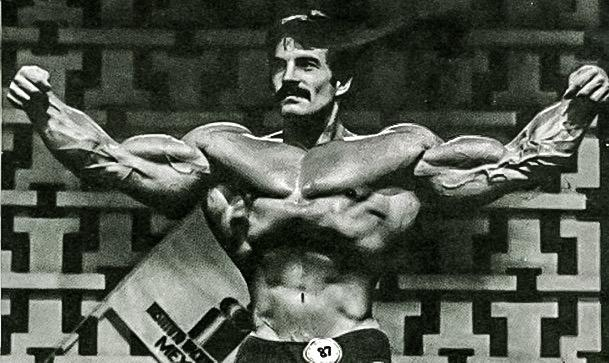 Source: www.reddit.com
In his competitive beginnings, Mike trained the old-fashioned way - long workouts, lots of sets and reps. That changed when he suffered his worst competition defeat in a contest won by Casey Viator (note: AAU Mr. America 1971, 10th place). And it was his encounter with Viator that influenced the course of bodybuilding history, as he mentioned to him how his workouts only lasted about half an hour, during which he would lift much heavier weights to failure. Mike was shocked by this revelation. Casey passed on to him the contact details of his trainer Arthur Jones - the inventor of High Intense Weight training. Meeting Jones was absolutely pivotal to Mentzer's continued involvement in the bodybuilding field. Mike subsequently came up with the Heavy Duty workout years later, which you'll read about in more detail below.
Mike was also significant because of his view that philosophy and bodybuilding are one and the same. That's why his books are packed not only with information from the world of bodybuilding, but also a lot of philosophical ideas. His statement says it all:
"Man is an indivisible entity and an integrated unit of mind and body."
In the field of nutrition, he kept to simple principles and refuted the contemporary notion of how much a man must eat to keep his bulk and strength up. How simple and how timely his views were, we shall discuss in the next section.
As it happens in the world of bodybuilding, this progressive man and innovator had his demons. Mike used amphetamines to improve productivity, suffered from anxiety and spent his days in bed. After some time, hospital visits and help from close friends, he returned and began training Dorian Yates and writing for Iron Man magazine. Therefore, he will be remembered not only for his achievements in bodybuilding, whether for his victories or his training methods, but also for his life story.
Let us now take a look at the contribution of this passionate, dedicated and knowledgeable man in the bodybuilding industry.
LEGACY - Legacy
1. Food and supplementation
Mike understood that each individual has their own individual needs, but inside we all work the same. He did not represent the majority opinion regarding the amount of protein needed for muscle growth. Still a hot topic, don't you think? When you meet today's enthusiastic exerciser on every street corner, you hear that huge number of protein that you MUST suck in no matter what!!!However, Mike knew that protein in muscle is only 22% and the other 70% is water. This didn't lead him to drink hectoliters of water every day in an effort to accelerate muscle growth. He was of the opinion that intake should be covered 50 - 60% by carbohydrates.
To understand, let's review his theory regarding muscle growth. If we want to gain 10 pounds (about 4.5 kg) of lean muscle per year, we need to consume 6000 calories above our basal metabolic rate (BMR). Not in a week, not in a month, but in a year! A pound of muscle contains 600 calories and we are thinking 10 pounds per year. Simple math tells us that we need to take in an extra 16 calories each day - and only a quarter of that is protein (the aforementioned 22% in muscle). This is a good one to keep in mind, as it's a counter-current statement and probably won't come up in conversation at the gym.
Mike stuck to 4 nutrient sources:
- GRAINS - 4 or more servings per day
- FRUIT and VEGETABLES - 4 or more servings per day
- HIGH FOOD sources - meat, fish, eggs; 2 or more servings per day (he considered 1kg of meat as a serving)
- MILK and MILK products - 2 servings per day

As you may have noticed, Mike was not an advocate of low-carb eating, although he did not deny that it works. However, in his opinion it is better to lose weight by cutting back on all 3 of the main macronutrients. Mike argued that as long as the diet is balanced, he doesn't mind the occasional inclusion of processed foods. Before the 1979 Mr. Olympia competition, which he won in the heavyweight division and finished second overall, he consumed ice cream almost every day. He didn't worry about it.
2. Training
HEAVY DUTY TRAINING
Before we show specific training protocols for different levels of advancement, let's look at Mike Mentzer's 13 rules of strength training, which he described in one of his HIT (High Intensity Training) training videos, the video is still available to watch on YouTube:
- After reaching a position where the muscle is in contraction (shortened), wait a moment before returning back to the position where the muscle is lengthening.
- If a small pause in this position is not possible, it is an indicator of too much weight being used.
- We must remember that during the negative phase (slowing down the weight) we must slow down the weight in a controlled manner until we reach full contraction of the muscle.
- If we want to get the maximum training effect, muscle involvement must be at its maximum!
- Fast and uncontrolled repetitions reduce muscle involvement.
- The concentric (positive) phase, when we lift the weight, should last 2-3 seconds, while the negative phase (slowing the weight down) should last 4 seconds.
- Progressive overload is the key - add weight!
- He recommends that we should start with a weight that we can only do 8 reps with, provided strict technique is maintained.
- Work with this weight until exhaustion, this will make you stronger.
- If you are able to do 12 reps, raise the weight by 10% and continue training to achieve progressive overload.
- If you have more experience with the workout, add forced reps (forced reps) to total muscle exhaustion. You will need a sparring partner here.
- We measure exhaustion by whether or not we are able to lift the weight in strict form without the help of someone else. Some people make the mistake of thinking that exhaustion occurs only when we are unable to lift the weight in any way. In this case, however, this is not true. Exhaustion is already at the moment when we are unable to maintain strict execution from full contraction to full extension (stretch) with a certain weight.
- Also work on smaller muscle groups to support the strength for the main exercises.
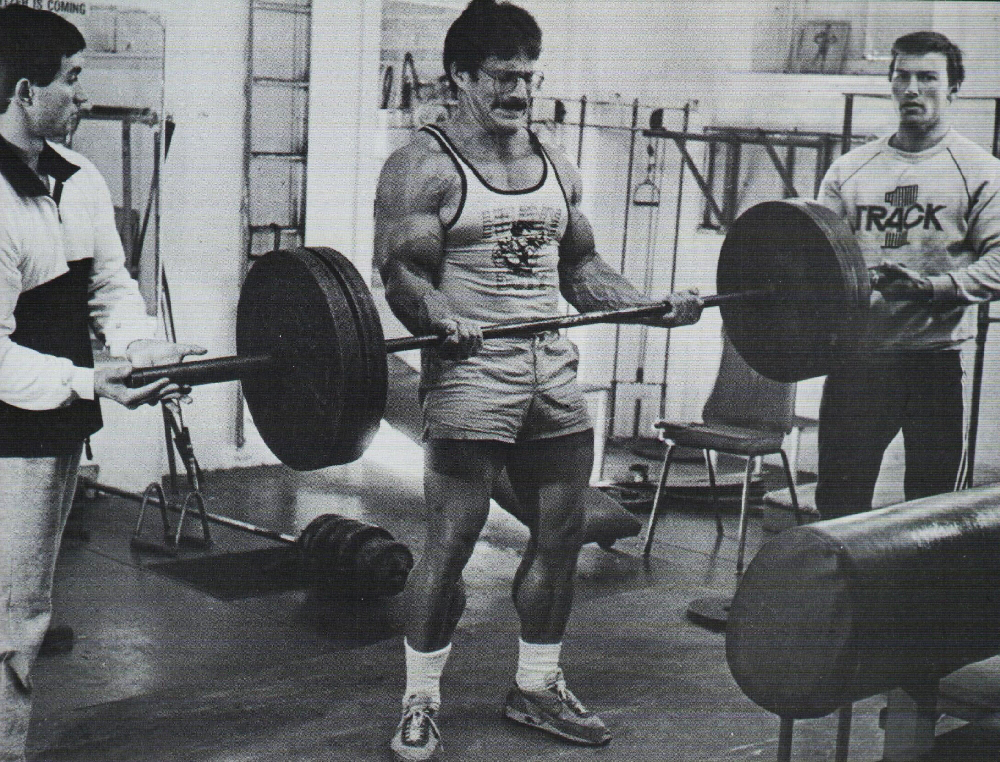
Source: www.allaboutpowerlifting.com
Mike Mentzer realized that in order to increase muscle strength and volume, you need to continually increase training stress. If he stopped increasing the training intensity, he would begin to stagnate and further growth would be impossible.
Warm-Up:
Just a few words about warming up before training. Mike didn't use anything miraculous as a pre-workout warm-up, he simply went to the exercise he was supposed to do and did a few warm-up sets. Most of the time it was 3 sets, with the first set being with light weight only to get blood to the muscles, the second repetition being with medium weight, and the last third repetition being with heavy weight to get the central nervous system (CNS) used to the heavier weights that were to come in the workout. Here again he used a slow negative phase, a pause in the stretch position and a slow positive phase. As an example of a warm-up, consider the Incline Bench Press:
1st Set: 20kg x 1 repetition.
2nd Series: 50kg x 1 repetition
3. 80kg x 1 repetition
After experience as a personal trainer of beginners and professionals he divided the training load into 4 categories:
BEGINNERS
If a person who has no experience with strength training starts training, it is enough stimulus for the body and the muscle mass goes up rapidly. Just gradually add weight and shorten the rest time between sets. If the progression stops, you need to move to the next level of intensity.
INTERMEDIATE
Greater training intensity is provided here by including pre-exhaustion (pre-exhaustion) sets. For example, a series of Leg Extensions (pre-kicks) to exhaustion followed by a series of Leg Presses (or squats) again to failure. A controlled negative phase can be added to this. Mike soon reached this level in his training and started thinking about how to stimulate the body more for muscle gain.
ADVANCED
At this level, Mike found himself so strong and his willingness to work at maximum effort so high that each repetition was overwhelmingly intense. Lactic acid and oxygen debt build-up occurred almost immediately. In this case he could not continue, not because of muscle failure, but because of cardiovascular failure. Therefore, he began to look for a way that he could lift even more and at the same time slow down the formation of lactic acid and the onset of oxygen debt in the muscles.
With that, he came up with his renowned Rest Pause workout. The procedure was as follows. Mike used a weight he could only handle 1 rep with, then incorporated a 10 second pause. During that time, the waste products flushed out of his muscles and in turn, oxygen flooded in so he could continue with the next repetition. The second repetition was again followed by a 10 second pause. He then either lowered the weight by 20% or used his training partner to push the weight. This time it was the turn of the 15 second pause and the last, fourth, repetition.
1 Mike Mentzer Set:
= 1st Max Rep + 10 Second Rest + 2nd Max Rep + 10 Second Rest + 1 More All Out Rep or Reduce Weight By 20% And Do The Rep + 15 Second Rest + Final Rep
Example Breast Workout:
| Exercise | Series | Number of Reps |
| Peck Deck | 1 | 4 (rest pause) |
| Incline Bench Press | 1 | 4 (rest pause) |
| Dips | 1 | 5 (negative reps only) |
EXTREMELY ADVANCED
The last, hardest, intensity level according to Mentzer is Infitonic training. It's all about extending the positive and negative phase as long as possible. His partner pushes him down during the negative phase and Mike tries to slow the movement down as much as possible.
The absolute hardest method of execution within Heavy Duty training is Omni-Contraction training - focusing on all 3 contractions a muscle can go through:
Weight Lifting - Positive Phase.
Lowering the weight - negative phase.
Holding the weight - static phase.
If you want to train this way, be prepared for each repetition to cost you maximum effort and you'll need a lot (really a lot!) of willpower. Perform the static phase in three different positions during the negative phase. First at the top in a light contraction (like a squat - legs slightly bent), then halfway through (in what some consider a full squat position) and the last stop in the bottom position (like a Kangaroo Squat). He lasted for 3 seconds in each position! That's 9 seconds of just the static phase! Add to that the slowest possible negative and positive phase. This is all with weight for 1 repetition! It's no wonder then that although his training was very short in time, it was so grueling that Mike at his peak included 4-7 rest days between workouts.
I hope you enjoyed the article!
If you have a suggestion for who else to target in Old School Legacy, let us know in the comments!
No posts have been made yet.








