





Is it possible to increase testosterone levels naturally? Find out if yes or no in this article.
 Author: Šárka Randáčková
 Essential variables for increasing testosterone levels are quality sleep, physical activity and weight watchers.
Some supplements can also help with maintaining healthy levels, but most of them, even when marketed as testosterone boosters, don't work! Some camouflage it by telling you they increase your libido.
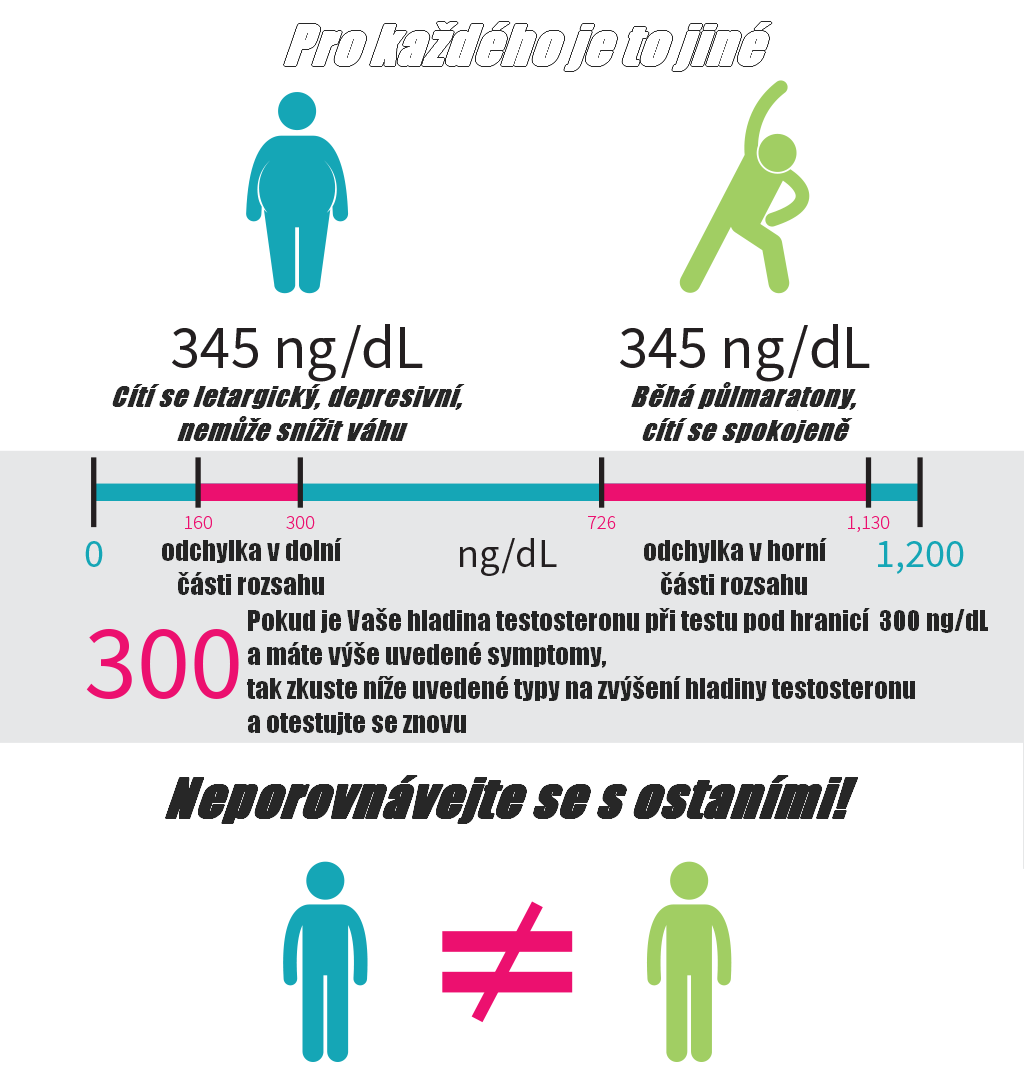
Testosterone is the male, androgenic, sex hormone. However, women need it too. Low testosterone levels in men are associated with low libido and poor health, such as metabolic syndrome. In both men and women, low testosterone is associated with depression.
In middle-aged and older men, testosterone levels decline by 0.4 to 1.6% per year. However, below-average levels are not rare even in men in their thirties.
Fortunately, quality sleep, physical activity, weight control, magnesium, zinc and vitamin D canhelp.
Lifestyle
Optimal testosterone levels are not achieved by vitamin and mineral intake alone. You also need quality sleep, exercise and maintain a healthy weight.
1. Sleep
Lack of it causes many health problems. It reduces testosterone production and promotes fat production (fat itself can reduce testosterone production).
If you are suffering from poor quality sleep, you can support it with various supplements that we offer in our shop and we also recommend reading some articles that we have already published regarding sleep.
2. Physical activity
Weight training increases testosterone levels for 15-30 minutes after exercise. And it is beneficial in the long term as well, as it improves body composition and reduces insulin resistance.
However, overtraining is counterproductive. Long endurance training lowers testosterone levels. You also need adequate recovery time for physical activity.
3. Weight control
Weight gain and associated chronic conditions such as cardiovascular problems and type 2 diabetes are strongly linked to a decline in testosterone levels, especially in middle-aged and older men.
If you get fat, your testosterone production decreases. Fortunately, it can rise again when you lose weight.
Image.
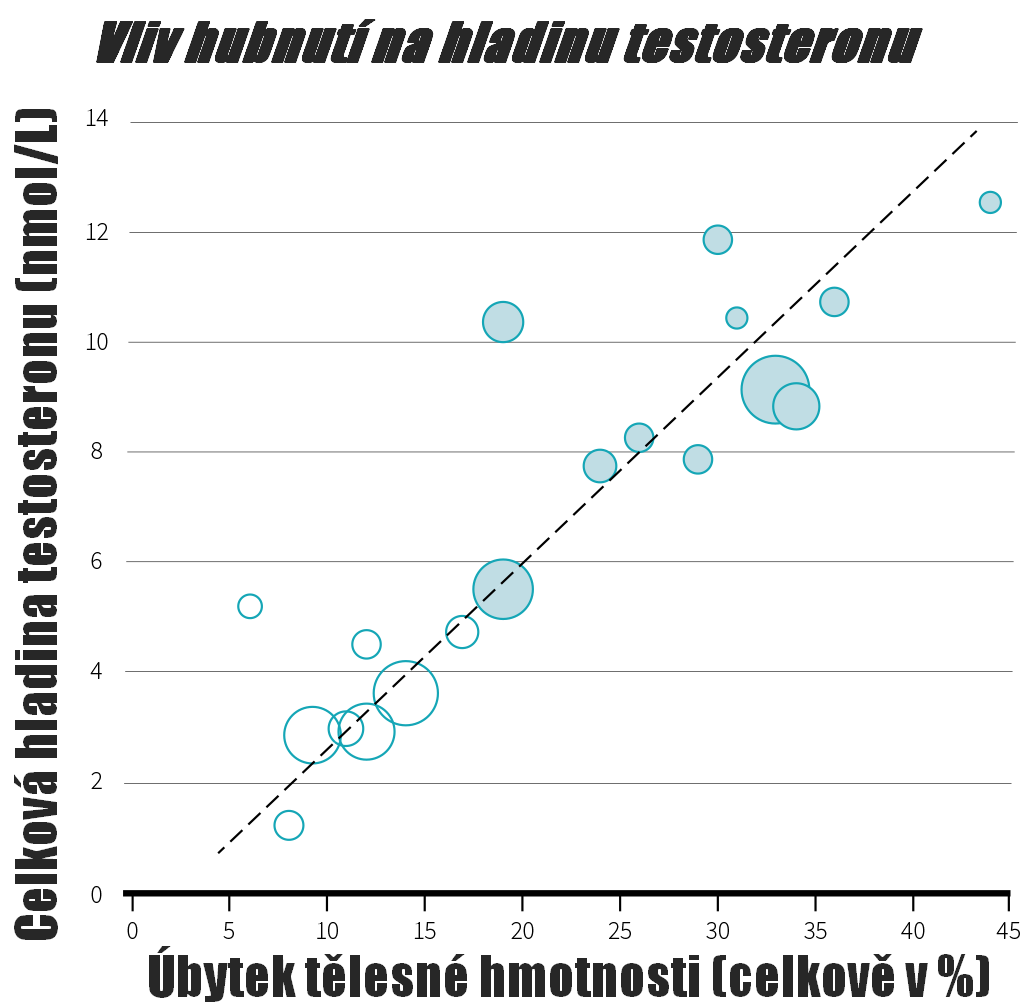
Studies on obese people are consistent. The more weight they lose, the more their testosterone production recovers. Clinical tests confirm this. And they don't have to lose weight dramatically. 5% Weight reduction increased testosterone levels by 2 nmol/L (58 ng/dL).
Supplements
Few have been shown to benefit testosterone levels. Evidence supports vitamin D and zinc, as well as magnesium. However, you should be aware of two things:
- Supplements containing vitamins or minerals will probably only help you if you are deficient in them.
- Correcting a deficiency will probably only increase your testosterone levels when they are low.
1. Vitamin D
Vitamin D helps with the regulation of testosterone levels. You should ideally get all the vitamin D you need from sun exposure. However, if you live far from the equator, are dark, or simply spend most of your time indoors, supplements can come in handy.
Blood levels of vitamin D by dietary institution
Status | Endocrine Society | Institute of medicine | Vitamin D Council |
Severe deficiency | < 20 | < 12 | < 30 |
Deficiency | 20 to < 30 | 12 to < 20 | 30 to < 40 |
Sufficient | 30 to 100 | 20 to 50 | 40 to 100 |
Adverse effect | > 100 to 150 | > 50 to 60 | > 100 to 150 |
Risk | > 150 | > 60 | > 150 |
In the U.S. and Canada, the recommended daily allowance (RDA) for vitamin D is between 400 and 800 IU (international unit). Some cr itize this amount as too low. In addition, it can only be obtained from a few sources, which makes supplements a big hit.
The recommended amount of vitamin D
Age* | Men and women** |
0-12 months | 400 IU (10 mcg) |
1-70 years | 600 IU (15 mcg) |
> 70 years | 800 IU (20 mcg) |
* Adequate intake
** Including pregnant and lactating women
If you would like to try one of the vitamin D supplements, check out our extensive range of these vitamins in the shop, where you can choose, for example, according to our customer reviews.
2. Zinc
Zinc deficiency can hinder testosterone production. Zinc, like magnesium, is lost through sweating, which is why athletes are most prone to deficiency. Most zinc is found in animal foods, but some is also found in cereals and nuts.
Recommended amount of zinc
Age* | Men | Women |
0-6 months | 2 mg | |
7 months-3 years | 3 mg | |
4-8 years | 5 mg | |
9-13 years | 8 mg | |
14-18 years | 11 mg | 9 mg |
* Adequate intake
Getting high above the DDD can be harmful. In the short term, a high dose may cause nausea and vomiting. Long term, however, it can lead to copper deficiency.
If you'd like to try some zinc and don't know which one, check out our extensive selection in the shop, where you can choose based on customer reviews, for example.
3. Magnesium
For men with low testosterone levels, increased magnesium intake can reduce magnesium production even further.
Magnesium deficiency is more common in the older generation, but it is not unknown for young athletes either, as it is lost through sweating. Getting on a DDD should be easy: magnesium-rich foods are numerous and can be adapted to any diet.
The recommended amount of magnesium
Age* | Men | Women |
0-6 months | 30 mg | |
7-12 months | 75 mg | |
1-3 years | 80 mg | |
4-8 years | 130 mg | |
9-13 years | 240 mg | |
* Adequate intake
If you want to take magnesium as a supplement, remember that it can easily be harmful. Because of this, the FDA has created a maximum magnesium supplementation limit for adults, at 350 mg. Also, avoid magnesium oxide. It is poorly absorbed (15% in mice) and only 4% in humans. In addition , it can cause indigestion and diarrhea.
If you would like to try some magnesium and don't know which one, take a look at our extensive range in the shop, where you can choose, for example, according to our customer reviews.
Supplements with an unnecessarily good reputation
Guaranteed testosterone level kickers are countless. Most of them do not work. Some at least increase libido, and that's why you might believe them.
Maca, for example, increases libido but has no effect on testosterone levels.
One of the most popular supplements is DAA. In two studies using 2.66 g and 3.12 g per day, respectively, it increased testosterone levels. However, the other two studies found no effect at 3 g per day. And one study even found a decrease in testosterone levels at 6 g per day.
Conclusion
The things described in this article will work best for men with reduced testosterone levels. But they can also help men with normal levels to maintain them.
Supplements can help, but there is no substitute for a healthy lifestyle. Make sure you get enough quality sleep, exercise and watch your weight.
Get enough vitamin D, zinc and magnesium from your diet. If diet is not enough, take supplements.
If none of the above works, it may be time to seek medical help.
Author of article: Michael Hull, Translated by: Jaromír Uhlíř, Source: link
Author: Šárka Randáčková No posts have been made yet.








