





How much protein do you really need?
 Author: Šárka Randáčková
 The first protein powders
Protein powders have been used by exercisers since the 1950s. They were first produced by Mr. Irving Johnson from Chicago, who later moved to Beverly Hills and changed his name to Rheo H. Blair.
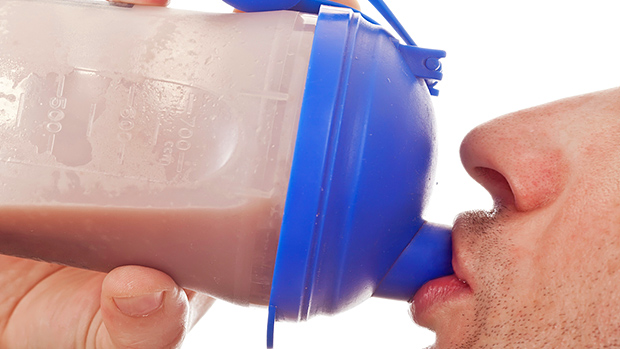
Rheo was soon able to literally bathe himself, both in protein powder and money. The girls could always tell when their roommate was at Rheo's because a cloud of protein powder would roll out of her panties when she took them off.
I may be making this up, but it sounds pretty likely. Anyway, big names from the practitioner and business community joined in. Bob Hoffman started making protein powder, and so did Joe Weider and Peary Rader.
Hoffman's product was the one that rose to the top. It was called Hi-Proteen and was made from soybeans, a source, by the way, that no modern exerciser would touch with a two-foot pole.
The origins of protein recommendations
Hoffman and his associates were businessmen completely without scruples, and they wrote articles endlessly about the demands of protein intake. They told people that they should eat six high-protein meals a day and supplement them with protein powder.
They advised skinny guys to drink four litres of milk a day with enough protein powder that you could fill a guy's foot buckets with it, let it dry, throw it in the river, and never hear from him again.
No eager exerciser was allowed to be without a bottle of protein drink for even a minute, or his muscles would begin to contract immediately. And just to be on the safe side, they were to carry pockets full of Hoffman's protein pills and swallow them throughout the day.
There were basically no specific recommendations, but the universal advice aside from the amount of protein intake was simply "a lot". Interestingly, although many years have passed since then, we are not that much closer to answering this eternal question.
The recommendations are endless. Some supposedly college-educated dietitians even assume that even for bodybuilders, there is no need to ingest anything beyond the basic recommendation of the nutrition agencies (0.8 grams of protein per day per kilo of body weight).
The age of uncertainty may be over. A Canadian scientist at McMaster University recently published a summary of studies on how much protein exercising athletes need, and claims to have found a definitive answer.
What he did
Scientist Robert Morton was not satisfied with the results of previous studies on the topic of daily protein needs. There was no consensus because the criteria for acceptance into the test groups varied widely. The subjects were of different ages, they were not performing equally, they were not taking in the same amount of protein, they were not taking it from the same sources and in the same doses.
Some studies looked at only experienced exercisers, old people, supplements that didn't contain protein only, only one source of protein, short workouts, people on diets, sometimes there were women, sometimes not, in short, completely different criteria.
But Morton wanted to see what role protein intake plays in people who exercise. He searched 49 studies on 1863 men and women and compared the results.

What he found
The studies looked at men and women exercising between 6 and 52 weeks. Some took supplements, while others got protein only from food. Protein doses ranged from 5 to 44 grams per meal.
Morton discovered a clear link between total protein intake and net muscle mass. Protein supplementation also significantly increased single rep maxes and muscle fiber diameter.
This is not surprising information. However, the statistics showed that anything above 1.62 g per kilo of weight had no effect on increasing training performance or muscle volume.
"Conflicting messages are being sent to the public, and incorrect practices are occurring," Morton said in a press release. "My summary of the studies puts an end to this debate... Protein intake is essential for muscle health, and the recommended amount of 0.8 g per kilo of weight is too low."
What this means for you
If you exercise, you need more protein than what's recommended. A lot more. But according to Morton's summary, anything above 1.62g per kilo of bodyweight will be unnecessary and probably won't yield any extra growth. Converted to a daily allowance, the 1.62 g will look something like this:
- 110 g per day for a 70 kg exerciser
- 147 g per day for a 90 kg exerciser
- 166 g per day for a 100 kg exerciser
Those amounts are not as high as recommended by Hoffman and his friends, but it is probably more than you are currently taking in. Anyway, it will be basically impossible to get to that number without protein supplements.
The ceiling of 1.62 grams per kilo of weight is very specific. There may be those among us who could benefit from an even higher intake. Not everyone fits into such a neat protein box.
Source: www.t-nation.com
Author: TC Luoma
Translated by Jaromír Uhlíř
Author: Šárka Randáčková No posts have been made yet.








