





Gain muscle without fat? That's possible too!
 Author:
 [Text: Pavel Samek, consultant for the development of Prom-In nutritional supplements]
Many of us would like to get an impressive physique despite the fact that we don't have competitive ambitions. We also don't want to look like swollen bubbles for most of the year, but radiate health and good shape.
In the long time I have spent working with many athletes in the fitness and bodybuilding industry, I have come to the conclusion that the classic system of bulking and sculpting brings more negatives than positives. I believe that gradually building muscle volume is more beneficial than the classic bulk system. Of course, we have to take into account the individual somatotype, training regimen, overall lifestyle, etc. when preparing a diet for an athlete. I would try to dispel some nutritional myths and evaluate the action of some interesting nutritional supplements.

For an athlete who is involved in strength sports, I do not consider the use of alternative nutritional styles such as split diets, blood group nutrition, Atkinson diet, etc. In my opinion, an athlete needs a quality balanced diet that will cover his increased need for essential nutrients. The balanced diet of an athlete obviously includes nutritional supplements and functional foods.
I don't like the word diet because it evokes a sense of restriction in people, but eating a healthy diet should be completely natural. Conversely, the diet of the majority of the population seems unnatural and restricted to me. Therefore, we will first look at the intake of essential nutrients.
Protei n
Proteins are the most important building blocks of our bodies. Adequate protein intake is absolutely crucial for a strength athlete. The question remains as to what can be considered a sufficient protein intake. The opinions of individual authors vary quite a bit. I myself lean more towards a higher intake. I would consider the optimal intake for a non-sporting population to be about 1.8 g per kilogram of body weight. For strength athletes, however, I would suggest a dose of 2.5 - 3.5 g per kilogram of weight and in certain specific cases, such as final preparation for competition, even a slightly higher dose. Of course, it depends on the age, metabolism and even gender of the exerciser. What also matters a lot is the total volume and intensity of the training.
I must point out that we are talking about a performance athlete who trains at extreme intensity, at least 4 times a week!!! His need for protein is increased! It is advisable to reduce protein intake by about 1.5 g per kg of weight on days off, while increasing carbohydrate intake proportionally. This sudden drop in protein intake will trigger internal reactions that will put the body in a state that naturally protects the existing protein balance from further reduction. When you return to your original protein intake the next day, you will streamline muscle gain as the body continues to produce the enzymes and hormones that prevent the protein breakdown triggered the day before.
We prefer the intake of complex types of protein, that is, those that contain all the essential amino acids. These proteins have a high so-called biological value. Of course, protein intake cannot be solved only by their intake from natural foods. This is where supplements such as protein concentrates and amino acid preparations come in.
Beware, with increased protein intake I have encountered in almost all athletes increased activity of aminotrasferases ALT, AST, which from blood analysis could be misinterpreted as liver damage. After consulting with several leading hepatologists, it was explained to me that this is a normal response of the body to strength training and an increase in metabolism. I know that suggesting such a high protein intake for an athlete not taking any substances of a doping nature is somewhat bold.
However, by observing the nutritional habits of many strength athletes and from my own experience, I am convinced that for these individuals such an intake is appropriate, effective and therefore rational in the case of strength sports. I have not been able to find any studies that suggest that high protein intake, unless accompanied by excessive saturated fat consumption, can be detrimental to an athlete's health. On the contrary, practical experience speaks in favour of consuming a higher protein intake.
Carbohydrate s
In the whirlwind of today's low-carbohydrate diet revolution, it might seem that carbohydrates are a bad thing. But from an athlete's point of view, this is definitely not the case. Carbohydrates can be divided into two basic groups: complex carbohydrates and simple sugars. Complex carbohydrates are found in whole grains, vegetables, rice, potatoes, etc. Simple carbohydrates are found in sweets, fruit drinks and dairy products.
I recommend that athletes focus on natural starchy carbohydrates such as potatoes, whole grain rice, whole grain pasta, oatmeal, etc.
At the same time, it is advisable to add vegetables to the range of carbohydrate sources, as they contain a lot of fibre and can effectively regulate blood sugar levels. Conversely, I recommend avoiding simple carbohydrates such as sweets, sugary drinks, but also fruit juices and dairy products with a high lactose content. I also don't recommend overdoing fruit consumption - sure, fruit is an excellent source of vitamins, minerals and fibre, but I consider starches to be a better source of carbohydrates to replenish muscle glycogen reserves than simple carbohydrates.
Carbohydrate intake must be adjusted to metabolism, so I do not consider it advisable to radically restrict their intake. It is preferable to divide their intake into several smaller doses, similar to protein intake, and thus try to maintain a constant blood sugar level. Carbohydrates are our body's primary source of energy and this should always be kept in mind when creating a diet.
Fat s
Although I am not an advocate of high fat intake in the diet, I do believe that a certain amount of fat in the diet is necessary. Fats provide a medium for the dissolution of vitamins A, D, E, and K and are a source of essential fatty acids. Without fats, important hormones could not be produced and function in the body.
As far as fat intake is concerned, I think that for an athlete , it is sufficient to consume the fats hidden in those foods that serve as a source of protein and carbohydrates, i.e. the so-called hidden fats.
It is also advisable to supplement the diet with cold-pressed oils (olive, linseed, sunflower), which are a rich source of unsaturated fatty acids. It is also advisable to consume marine fish with a higher fat content (salmon, mackerel), which are a source of omega-3 fatty acids.
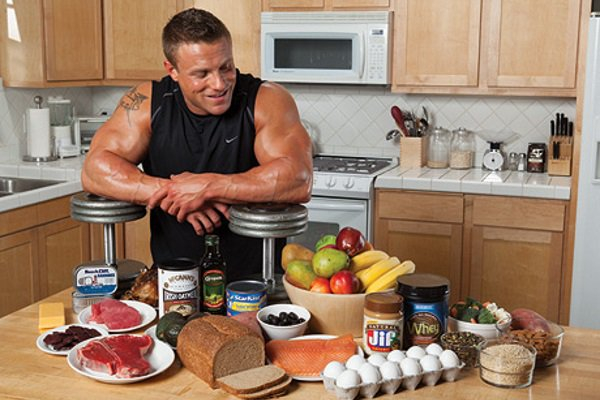
Dietary nutrient ratio
To some extent , we can control what gets converted into fat and muscle in our bodies. During the digestive process, different food components are predetermined to be stored as fat or to help build muscle mass. This is largely influenced by the hormonal system.
Two of the important hormones involved in muscle growth are insulin and glucagon, and both are produced in the pancreas. They regulate carbohydrate and fat metabolism. If blood sugar levels rise - usually after eating carbohydrates - insulin is secreted. This carries glucose into the cells, where it is broken down as energy or stored as glycogen. But if carbohydrates are excreted into the bloodstream too quickly, excessive insulin production occurs. There is a risk that some of the carbohydrate will not be converted to glycogen and stored, but will be stored as fat. We try to avoid this by limiting the consumption of simple carbohydrates.
Recommended
Regel 80g 5+1

Nebbia Tvarující bezešvý crop top FLOW SEAMLESS 499

Intense Šortky GOLD Nebbia print 828
The key to success is eating the right types of carbohydrates in small doses throughout the day, ensuring only small fluctuations in insulin levels and maximum energy levels. Glucagon has the opposite effect to insulin. It is secreted when blood sugar levels are low. Glucagon then activates the conversion of glycogen to glucose in the liver, which is a normal response to low blood sugar. This triggers fat burning because it does not get energy from carbohydrates, which are preferred as an energy source.
The ratios of the two hormones determine whether you are gaining fat or burning it. Therefore, by determining the right portions of protein and carbohydrates, you can regulate fat storage better than just reducing calorie intake. You can even break down fat at significantly higher calorie intakes. And even build muscle mass. And that's our goal.
As far as the ratio of nutrients in your diet, I suggest keeping the ratio of protein to carbs between 1:1 and 1:2. It very much depends on the individual metabolic rate. However, you must not go to extremes, i.e. reduce carbohydrate intake to very low levels in an attempt to break down more fat, etc. It is not possible to build muscle mass from the assumption of extremely low carbohydrate intake. The body would not have enough insulin necessary to carry amino acids.
The rate of digestion is also a very important factor. This is ensured by ensuring that each of your daily meals contains the right combination of protein, starches, fibre and fats. This combination will slow down digestion and prevent carbohydrates from being excreted into the bloodstream too quickly, thus avoiding excessive insulin production.
Diet is the cornerstone of success. The correct ratio of nutrients is absolutely crucial. Using a practical example, I will try to explain the timing of nutrient intake throughout the day.
Sample diet
It is advisable to divide food intake into approximately 5 - 7 portions. Contrary to common practice, I suggest that the nutrient intake at each of the daily meals should be approximately the same. In the evening only, focus on fibrous carbohydrates with a low glycaemic index. Now for a practical breakdown of what to eat at what time of day.
Breakfast: breakfast should contain complex carbohydrates, oatmeal or a good quality muesli mix, wholemeal rye bread or even rice are excellent. It is advisable to supplement breakfast with fruit, because in the morning the body replenishes glycogen reserves and therefore does not risk gaining fat.
Protein comes from natural sources such as egg whites or very high quality turkey ham.
Together with breakfast it is advisable to take some supplement such as a multivitamin, fish oil or other supplements such as coenzyme Q10, vit. E, etc.
Before training. I suggest focusing only on anti-catabolic supplements such as BCAAs and glutamine, which should be used before training at a distance of about 30 min.
Post-workout. 30 min after the end of the workout we take whey isolate or even better whey hydrolysate, which we supplement with micellar casein, maltodextrins and glutamine, so that the resulting cocktail contains protein and carbohydrates in a 1:1 ratio.
Lunch: Lunch follows approximately 1.5 - 2 h after the end of the workout. Lunch should be based on high quality protein sources with lower fat content. I would consider turkey or chicken breast or fish to be good choices, in which case I would prefer lower fat species (cod). Supplement the protein with a source of good quality carbohydrates - rice, potatoes, whole grain pasta, etc. To ensure that our blood sugar levels don't fluctuate too much, a portion of steamed vegetables will provide particularly beneficial fibre.
Snack: I suggest that snacks should be similar in volume to lunch, which is somewhat unusual. However, it has been my practical experience that dividing the daily caloric intake into six volume-like meals produces excellent results. I suggest using, for example, a very high quality turkey ham, accompanied by wholemeal rye bread, which has a very favourable glycaemic index (blood sugar levels do not fluctuate). This should be supplemented with vegetables, which can be in the form of a vegetable salad.
Dinner: For dinner, I suggest using a relatively fattier type of meat as a source of protein. Salmon is excellent, but you can also use lean beef. As a carbohydrate source I would recommend a source with a very low glycemic index, e.g. a vegetable salad with red lentils and olive or, better still, flaxseed oil as a dressing.
Suitable supplements are fish oil and a second dose of a multivitamin.
Bedtime meal: some kind of slow-absorbing protein is advisablebefore going to bed. Today we can find preparations on the market designed specifically for this purpose, usually referred to as Night protein. These are mostly milk casein based preparations, another slowly absorbed protein is soy protein, which stimulates thyroid function and is excellent for cancer prevention. If we do not want to use these alternative sources, we can preferably use a good quality low-fat cottage cheese (abroad it is called low fat cottage cheese) supplemented with organic yoghurt.
This is just one possible suggestion of what a strength athlete's diet might look like. Still, I think these recommendations can help most strength athletes to ensure optimal muscle mass gain and fat reserve reduction.
Supplements
Although I consider the basis of a diet to be quality food, the use of some supplements is advisable and when used properly can greatly aid performance growth. A prerequisite for their successful use is a perfectly balanced basic diet.
Protein supplements - basically we don't even have to consider them as supplements, but rather as an integral part of the diet or if you want a functional food. I have already outlined their use in the sample diet.
Multivitamin supplements with minerals - they are a must for athletes, they serve to maintain immunity, to increase the level of recovery after training and to support the overall metabolism. The emphasis is on the essential antioxidant vitamins, i.e. vitamins C and E, plus B-complex vitamins that aid nutrient metabolism.
Glutamine - is the most abundant amino acid in the human body. When there is insufficient glutamine in the muscle fibers, further muscle growth is not possible. Other functions of glutamine include boosting the immune system, improving recovery, increasing growth hormone production, and better glycogen synthesis in the liver. The appropriate time to use it is before and after training and it can also be taken before bedtime.
BCAAs - When you train hard, you want to build muscle mass and break down fat at the same time, you can unfortunately get into a stage of catabolism, which means that your body would start breaking down its own muscle tissue as a source of energy. BCAAs are able to stop this process. I suggest taking BCAAs primarily before and after your workout, using them in the morning on an empty stomach is also advisable.
Among the supplements we can find many other very interesting substances and their description would take several dozen pages. Specific supplements such as creatine, arginine, ZMA, tribulus terrestris, or various herbal extracts I would suggest to take rather in cycles and with respect to their specific functions. Susceptibility to these products is highly individual.
Supplementary nutrition is constantly evolving and the market is always bombarding us with new and "miraculous" products, but many of them have a "yuppie" life. Only a few of them are eventually proven to be really effective, yet it is not good to condemn supplements. They can help us a lot.
Nutrition is the foundation of both athletic success and a fulfilling life. The sad fact is that many people are more concerned about what fuel they put in their car than what fuel they put in their body. You can increase athletic performance without the use of banned drugs, all you need is discipline and a skilled approach.
References used:
Fořt Petr. Nutrition not only for bodybuilding and fitness. World of Bodybuilding: 1996
Fořt Petr. Nutrition mainly for bodybuilding and fitness. World of Bodybuilding: 1998
Fořt Petr. What you don't know about nutrition and sport. World of Bodybuilding: 2001
Antonio José. Effects of training and supplementation on body composition. Physical fitness: 1999
Taylor Peter. Amino acids in weight control. Berger nutrition: 2000
Parrillo John. A guide to amino acid supplementation. Bodybuilding World: 2003
Nelson Montana. Soy - a completely finished source of protein? Bodybuilding World: 2002
Parrillo John. Diet wins over genetics. Bodybuilding World: 2003
Glass Charles. Post-workout supplementation and glutamine. Bodybuilding World: 2003
Mindell Earl: The vitamin bible: Ikar: 1996
No posts have been made yet.








