





BCAAs and their dosage: the key to effective training and recovery
 Author:
 What am I writing again about nothing that is already known and that repeating the same thing is boring and will not bring anything new? Do you think you know BCAAs well, have you tried them and they worked for you or have you felt no change? What new insight can I bring to this issue? Certainly one thing that is a critical factor in taking BCAAs that may cause you to feel that what hasn't worked for you so far will work. It all comes down to dosage.
Once you've made your choice (with the help of expert or less expert articles and/or purely based on what you have in your gauge) of what to take, you still need to know how much BCAAs, when to take BCAAs and how often to take BCAAs. There are many examples when a "dude" buys a protein powder and in order to make it last as long as possible he takes only 10 grams a day and instead of two weeks the powder lasts two months, then he goes to the gym and tells all his friends that such and such product is completely useless, it doesn't work at all and what do I know when he took it for two months and nothing happened.
The difference between the recommended dosage of BCAAs on the packaging and the dosage according to top trainers is most obvious with branched-chain amino acids (BCAAs ). It is possible that you yourself have asked how the recommended 2-3 grams of BCAAs can help you, when you can simply replace them with 10 grams of some whey protein, which is ten times cheaper than the aforementioned dose in BCAA capsules anyway?
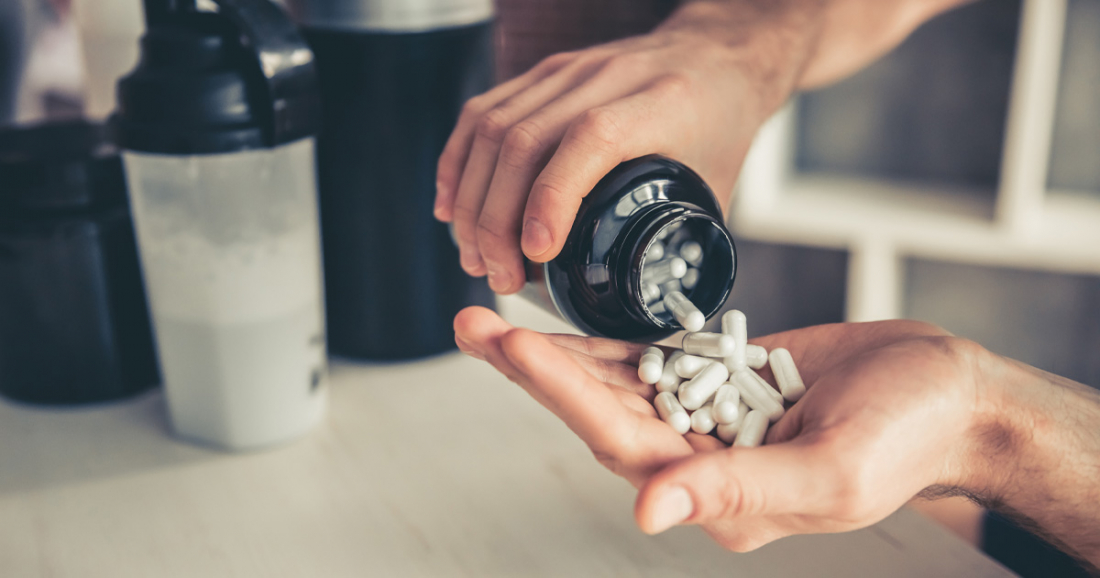
What are BCAAs and what are they famous for?
The branched chain amino acid group consists of three amino acids - leucine, isoleucine and valine. In addition to being part of the aforementioned BCAAs, these amino acids are also essential. We must therefore take them in the diet because the body cannot create them on its own. BCAAs are best known for the fact that they can be used by working muscles as energy sources during prolonged exercise. The carbon chains of BCAAs, which come mainly from skeletal muscle, serve as an energy source. The other nitrogenous parts form the amino acid alanine, which is then transported to the liver and transformed into glucose, which travels back to the muscle as the aforementioned energy source. Energy used in this way saves muscle glycogen.
An example is a study in which test subjects cycled for 60 minutes at 70% of maximum oxygen intake and then cycled for 20 minutes at maximum. Muscle glycogen concentration showed a much smaller decrease (10%) in the group taking a solution with 90mg of BCAAs per kg of weight every 15 minutes compared to the control group (35% decrease) without this intake.
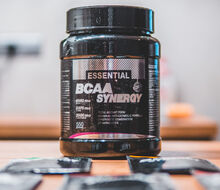
Also important, if not more important, is the question of the anabolic effect of BCAAs. BCAAs administered during training increase growth hormone and insulin levels at the same time, leading to an increased anti-catabolic and anabolic effect. What's even more interesting, one study found that administering BCAAs just before a workout prevented a drop in testosterone levels after the workout was over, and conversely led to even more of an increase.
One last noteworthy effect when administering BCAAs (different from other, "normal" amino acids) is the reduction in perceived exertion, making exercise seem lighter than training without BCAA application. This fact is supported by the fact that a reduced concentration of BCAAs in the blood leads to an increased concentration of serotonin in brain cells and an increase in the manifestations of fatigue.
Recommended
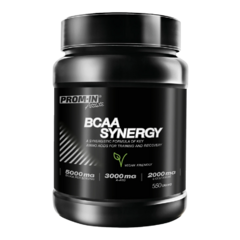
Prom-in BCAA Synergy
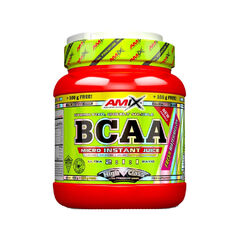
Amix BCAA Micro Instant Juice
So much for some of the important functions of BCAAs. Let's now clarify how much, when and in what form of amino acid to administer for the best possible results.
As I mentioned before, in my opinion, and not only in my opinion, it makes no sense to give a small amount of BCAAs and even more so, spread out over the day. A few extra grams of protein can easily replace this function.
Let's start with the question, "When?"
It seems both best and most beneficial to take BCAAs during training. In addition, outside of training, BCAAs are abundant in the food and supplements we eat. This should give us one part.
But the more important question seems to be, "How much?"
Let's repeat what I've already said and what not only I, but most of the world's leading coaches think. The amounts recommended on supplement labels, around 2-5g per day, are very small and by themselves will not cause any visible effect. This low dosage is mainly determined by the commercial policy of the company, because if they stated a higher dosage, few people would buy their product, but also by the doctors approving the sale of these supplements.
Top trainers, among them Charles Poliquin in the first place, and nutritional experts recommend giving approx. 0.4 g of BCAAs per 1 kg of body weight. For a 90 kg exerciser this would mean around 36 grams of BCAAs during a workout. I can imagine your reactions - "36 grams?, that's almost 40 grams, where the hell am I going to get that much?" and so on.
True, true. You can't even get that much amino acids out of all the capsules of some BCAA doses. And if you do, you've got enough for two, maybe even three workouts at most and you can go to the store again for another pack.
As Charles Poliquin recommends, for the less affluent, a good option is to give at least 0.22 grams per 1 kg of weight, otherwise there's no point, and possibly save the BCAA administration for the days you train the parts you want to improve.
Basically, BCAAs can be given in three forms - BCAA capsules, BCAA powder and BCAA solution, but here I know that one bottle would definitely not be enough.
When taking capsules, divide them into several doses (say 10 for example) of a few capsules each and wash them down at regular intervals during your workout. With some products, you'll have to ingest well over 50 capsules and that's saying something. It's easier to give BCAAs in powdered form mixed with a drink.
After reading this article, taking BCAAs has definitely reached other dimensions for you. If you take BCAAs on their own, then in the manner mentioned above. If you're up to it, give it a try. It can't hurt you.
No posts have been made yet.








