




Charles Glass Reveals a Trick for Wider Shoulders! Lots of People Make This Mistake When Working Out!
 Author:
Do you want massive, round, and really broad shoulders? You might not need to add more kilograms to the barbell—all you need to do is change one small detail in your technique! Legendary coach Charles Glass, nicknamed the “Godfather of Bodybuilding,” explained why many people unnecessarily overload their trapezius muscles during one-arm rows instead of focusing more on their deltoids. His advice is surprisingly simple, and you can try it out right away during your next workout!
Are you working your trapezius muscles instead of your shoulders? Charles Glass pointed out a common mistake!
Charles Glass is one of the most respected trainers in the history of professional bodybuilding. Throughout his long career, he has worked with such names as Dexter Jackson, Dennis James, and Shawn Rhoden. He’s best known for his extraordinary emphasis on biomechanics, proper exercise form, and his ability to adapt seemingly simple movements to better suit a specific athlete’s goals. And it’s precisely one such detail that he focused on in his latest Instagram video!
This time, he focused on one-arm chin-ups, also known as the dumbbell upright row.
This exercise is a favorite for developing the shoulders and upper back. However, according to Glass, many gym-goers perform it in a way that shifts the focus—and part of the load—from the middle deltoids to the trapezius muscles.
And the reason?
Instead of letting their elbows lead the movement, they focus primarily on lifting the dumbbells themselves!
According to the experienced trainer, this can unnecessarily limit the targeted work on the shoulders.
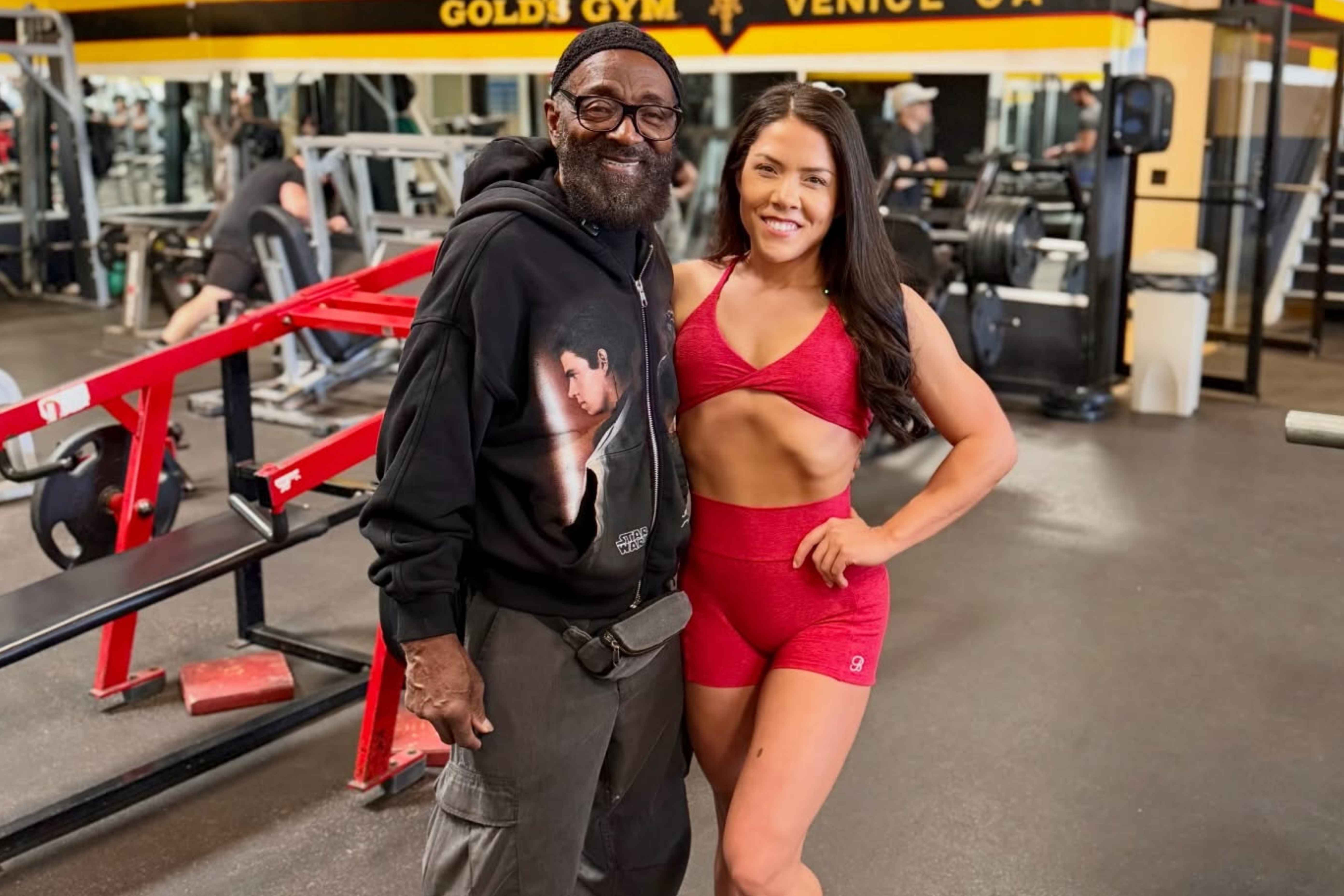
Don’t lift the dumbbells with your hands! The movement must be led by your elbows
During his demonstration, Glass explained that the key difference lies primarily in the direction of the arms’ movement. In the classic form, many people pull the dumbbells straight up, keeping them close to their bodies. In doing so, they often raise their shoulders excessively toward their ears or try to lift the weights as high as possible.
Glass, however, recommends a completely different approach.
“Lead the movement with your elbows, not your hands. Your elbows must point outward,” he explained during the demonstration.
In practice, this means that when lifting dumbbells, you shouldn’t just try to bring the weights up to your chin. Instead, you lead your elbows diagonally upward and outward, which allows you to better target the middle portion of the deltoid muscles. According to Glass, it’s important for the dumbbells to follow the natural path of your arms as you lift, rather than having your elbows travel only close to your body.
And it’s precisely this detail that can change the way you feel your shoulders working during a set!
Glass also points out that if you start pulling the movement too close to your body and excessively raising your shoulders, the trapezius muscles may take over most of the work. Of course, this doesn’t mean that the trapezius muscles aren’t engaged at all when the exercise is performed correctly. The main goal is to distribute the load more evenly and focus on the target muscle group.
No swinging! Glass revealed another important detail
Another common mistake Glass pointed out is using dumbbells that are too heavy. If you choose a weight you can’t control, you’ll start compensating by moving your torso, swinging, or engaging other muscle groups during the lift.
The result can be a technically flawed repetition that defeats the main purpose of the exercise.
Glass therefore recommends avoiding any unnecessary swinging and performing each repetition in a controlled manner.
His tip for starting each repetition is also interesting. According to him, the dumbbells should rest on the upper part of your thighs in the bottom position. From there, you’ll initiate a new movement, focusing primarily on guiding your elbows outward and upward. This helps minimize the use of momentum and keep each repetition as controlled as possible.
So it’s not about how many kilograms you can lift, but whether you can effectively target the desired muscles!

Does science also support Glass’s technique?
Interestingly, scientists have also studied the importance of grip width during chin-ups.
A study published in 2013 in the Journal of Strength and Conditioning Research examined muscle activity during barbell rows using three different grip widths.
The researchers found that a wider grip led to greater activity in certain parts of the deltoid muscles.
The results thus suggest that the way the arms are positioned can indeed influence the engagement of individual muscle groups.
However, it is important to note that the study also recorded higher trapezius activity with a wider grip. It therefore did not confirm that it is possible to completely exclude the trapezius from the movement. Furthermore, the researchers examined a barbell variation, not specifically the Glass technique with dumbbells. Nevertheless, this is an interesting finding that underscores the importance of proper form and tailoring the exercise to a specific training goal.
Watch Your Shoulders! One-Arm Rows May Not Be Right for Everyone
Although single-arm rows can be a very useful exercise, they aren’t automatically suitable for everyone. If the elbows are raised too high—especially in combination with significant internal rotation of the arms—the shoulder joints may be subjected to unfavorable mechanical stress.
Therefore, it’s not necessary to bring the dumbbells all the way to your chin at any cost.
It’s better to choose a range of motion that you can perform in a controlled manner and without pain. As a general guideline, you can raise your elbows to approximately shoulder height at most, or lower depending on your own range of motion. If chin-ups don’t work for you over the long term, a similarly targeted alternative could be, for example, classic lateral raises with dumbbells or on a machine.
The most important thing is that you’re able to sufficiently challenge the target muscles without unnecessarily straining your joints.
Want broader shoulders? Sometimes all it takes is changing a single detail!
Throughout his career, Charles Glass has helped shape the physiques of some of the world’s most successful professional bodybuilders. His latest advice, however, shows that useful training insights don’t have to be complicated. Sometimes all it takes is adjusting the position of your elbows, slowing down the movement, and stopping focusing on the weight you’re using at all costs.
After all, proper technique, sufficient muscle tension, and long-term progress form the foundation of effective strength training.
So if you feel that when doing chin-ups, you’re primarily engaging your trapezius muscles and barely feel your shoulders, it might be worth trying Glass’s variation. Choose lighter dumbbells, lead the movement with your elbows pointing outward, and focus on each repetition. You might find that for a better shoulder workout, you don’t need any extra weight plates at all—just a little better technique!
Do you want to build massive shoulders and get the most out of every workout? As the legendary Charles Glass reminds us, the foundation of real progress isn’t just lifting heavy weights, but above all proper technique, systematic training, and quality nutrition! To add creatine to your supplement regimen, try GymSupps Creatine HCL in convenient capsules. If you want to replenish amino acids during your workout, you can also reach for GymSupps BCAA 4:1:1 Instant. And since adequate protein intake is essential for building and maintaining muscle mass, don’t forget to include high-quality foods like GymSupps Yellowfin Tuna Fillets. Train smart, focus on every rep, and get in the best shape of your life!
Recommended

GymSupps BCAA 4:1:1 Instant
GymSupps Creatine HCL
No posts have been made yet.