





"Every workout is as hard as you make it" - strength coach Jakub Brousil
 Author:
 In our magazine you will find an article in which we briefly outline what Strong First is, what their philosophy is and what equipment they train with. Today we would like to introduce you to Jakub Brousil, who is one of a handful who managed to complete one of the courses organized by Strong First.
Hi Jakub, could you briefly introduce yourself?
Hi. My name is Jacob and my nickname is "Jake". I live in the beautiful city of Písek and I have my family here. My hobbies are motorcycle riding, nutrition and mostly sports. I've been playing sports since I was a kid, when I used to play ball with my boys on the playground. Later on, at about 14 years old, I got hooked on the gym and strength training with weights, machines and axes.
After threeyears, thanks to my brother who took me along to Thai boxing training, and I loved it, I was actively training until I was 26. Today I take boxing as a complementary sport.
You are one of the few people in the country who managed to successfully complete the course organized by the "Strong First" school, am I right?
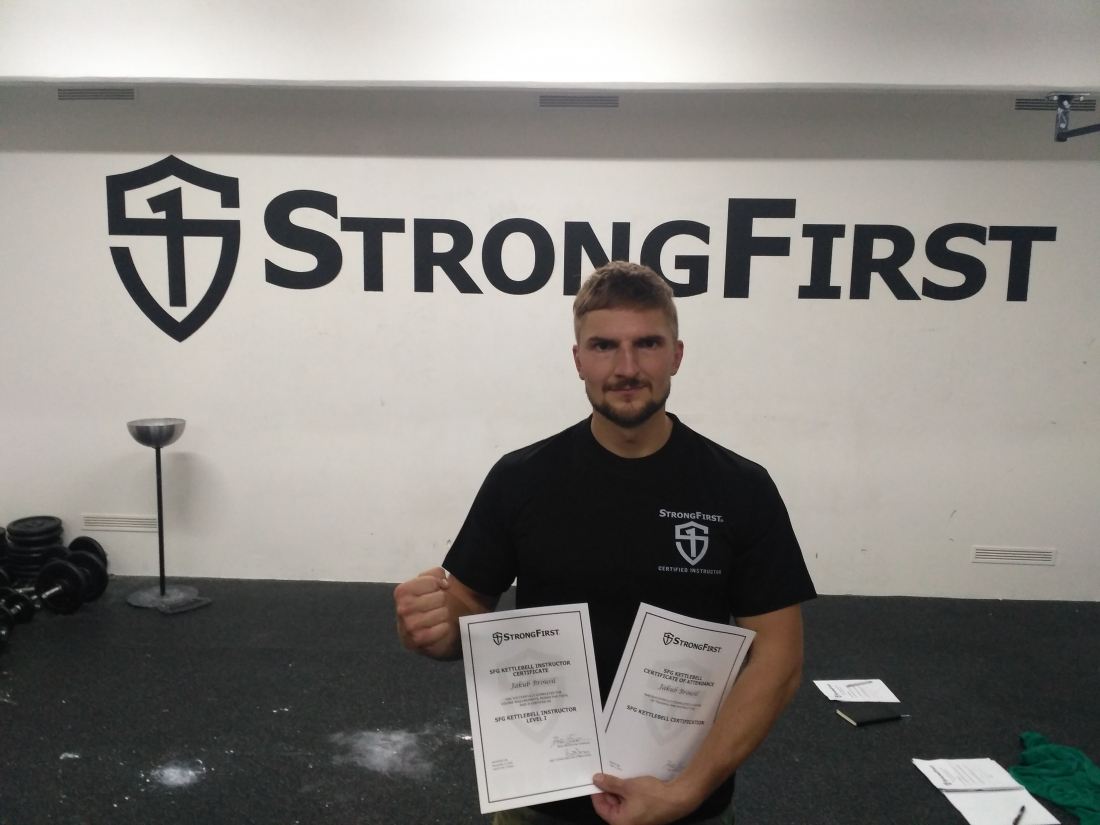
You're right. During the last year I managed to make my efforts to prove something. It wasn't easy, but I succeeded and now I have my SFG I trainer certification.
Could you give us an outline of what this "Strong First" is? After all, when you mention "Strong First" in front of people I guess not many know what it is?
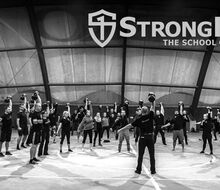
"Strong First is a school of movement, strength and conditioning. It teaches men and women how to get stronger quickly, safely, and even while working out or playing sports. It is a globally recognized organization that focuses on building strength using several tools - kettlebells, big dumbbells and working with your own body weight. The founder is Pavel Tsatsouline and the instructors are national champions, coaches of champions, special forces members, elite martial arts practitioners and other strength sports professionals.
Do you remember when you first learned about SF?
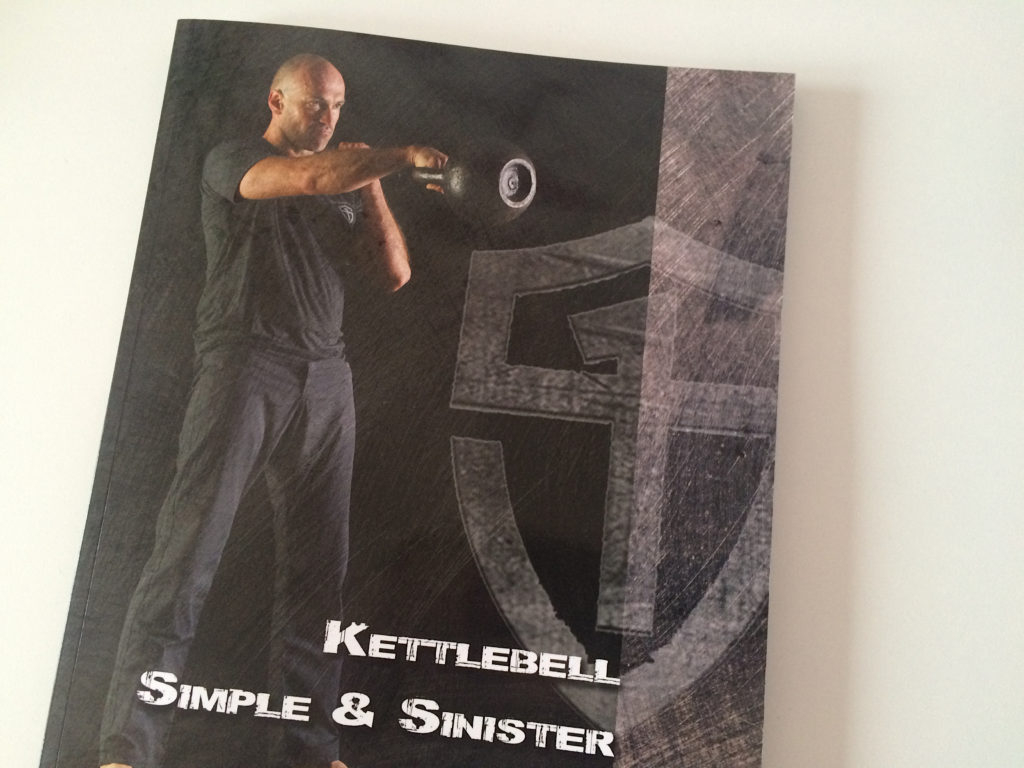
I remember it exactly. On June 2, 2018, a sporting event was held at the PVA EXPO Letňany in Prague, and I went to see it. The exhibition included, among other things, the opportunity to participate in one competition of holding in the trapeze. Whoever can hold on for longer than I think 3 minutes gets a book. It was a piece of cake and the book was on its way home. It's called "Simple & Sinister" by Pavel Tsatsoulin.
When I got home, I flipped through the book and put it away. Six months later, I picked it up again and started reading. I liked the simplicity of the writing and the ideas on how to approach sports and life in general. That was the impetus for me to start getting more interested in the SF school both online and later at a trial class at KB5 Gym.
SF offers different certifications, how do they differ from each other? And how many people in our country have any certification?
SF offers certifications for bodyweight work labeled SFB, for kettlebell work labeled SFL, and two certifications for kettlebell work labeled SFG I and SFG II. Each certification has its given exercises, repetition counts as well as technique execution. For more information regarding the exercises, visit strongfirst.com.
Likewise, you can search for certified trainers near you. There are only 21 registered people with a valid certification, whether with their own body, an axle or a kettlebell in the country so far.
Why did you choose SFG I and what does this exam entail?
Nowadays there are tons of experts in weight training with both your own body weight and a large barbell. When it comes to kettlebells, there are only a handful who know how to work with this tool and what benefits it even has. For me, it was the obvious choice after reading the aforementioned book "Sipl & Sinister". The test involves mastering 100% strict technique of 6 exercises (swing, get-up, clean, press, squat and snatch) with a given weight according to body weight and gender.
The final test also includes 100 repetitions of snatches in 5 minutes, which is not easy at all, and I think most people have a hard time with it.
How demanding and prestigious is it to meet some certification from SF?
I think the number of people who have passed any given certification speaks volumes about the difficulty. It's not easy and it's not for everyone. This is not some weekend course for coaches culminating in a written test to pass a coaching certification. It is a practical demonstration of mastering all the exercises already mentioned, to show that you can work with clients, and do it all sensibly and most importantly safely. In addition, trainers must retake the exam every two years for all parts.
It's called recertification (renewing your trainer certification again). This is the only way to achieve a high standard of coaches who must continually educate and maintain themselves.
Can SF certification be compared to any other certification? A coaching course and the like?
I wouldn't dare compare it to any other certification. This was my first experience. However, a colleague who has already done a regular coaching course, he himself told me that it is not comparable. He hardly had to prepare for the previous course. He was "taught" everything in a weekend. The certifications from SF are on a completely different, level than most other courses or certifications. Preparation is dependent on your level of physical readiness. You have to prepare for a course from SF in advance, whether it takes you six months, a year, or even longer.
Just the fact that trainers travel from all over the world to each certification to impart their knowledge and review the progress of the re-testing speaks volumes about the prestige.
How long did you prepare for the exam, where did you take it and how much does such an exam cost financially?
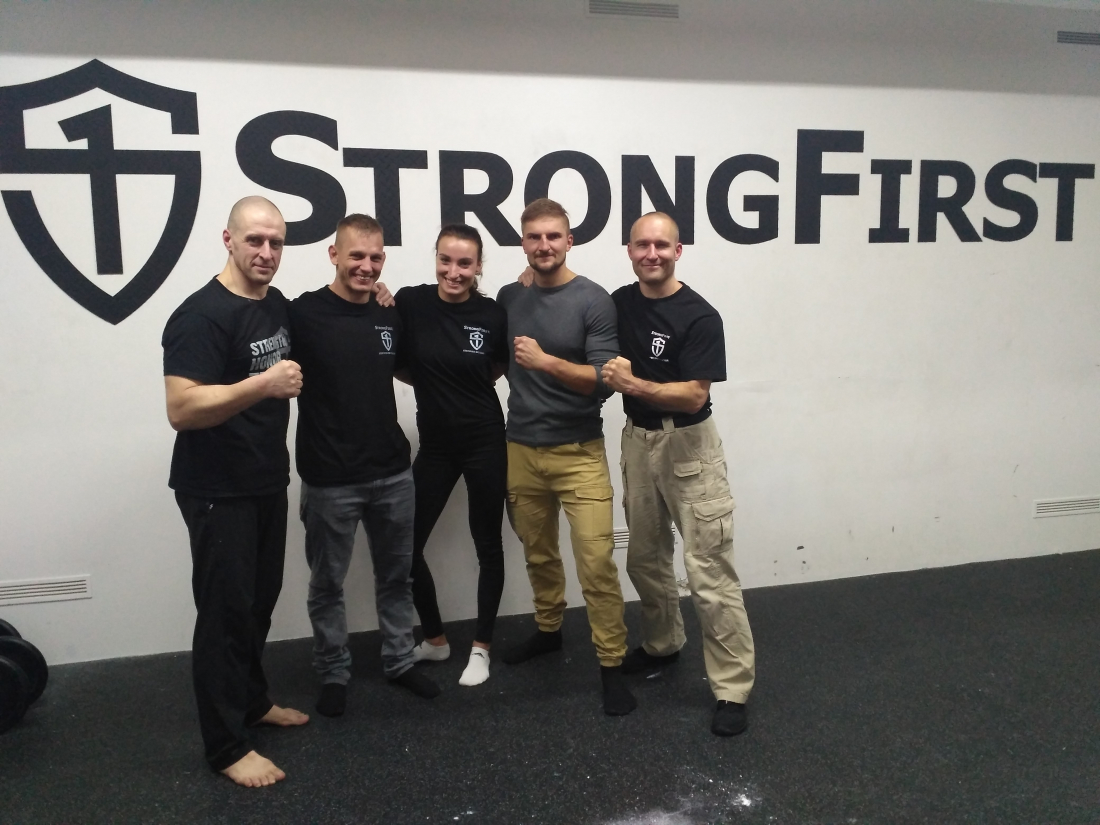
My preparation was, so to speak, from the first day in the gym. During those few years of constant training I have developed a pretty good (at least I hope) movement foundation. I started dedicating myself to kettlebells to the max about ¾ of a year before certification. During this time, I was only fine-tuning the details of the technique of all the exercises and preparing physically for the snatch test. The certification was held November 1-3, 2019. The certification test was held at the KB5 Gym in Prague 3. As for the financial side, you can check out the SF website for details.
What do you think are the main benefits of kettlebell training?
The main benefits I see are that you don't need ten different weights to get stronger, you don't need 20 different weight machines. All you need is a kettlebell, some space, shorts and a t-shirt. You can use a kettlebell to exercise your whole body, develop more strength, momentum and mobility. It is suitable for both main training and as a supplementary exercise. Are you going on holiday and are unhappy that you don't pack the whole gym with you? With kettlebells this is no problem. One small weight with you and you're good to go...
Do you work out only with kettlebells or do you use other equipment? Axle, one-armed, etc...
I train 70% with kettlebells only. But I like multiple sports and try to be a comprehensive athlete and not focus on just one movement activity. That's why I will occasionally use both the axle, one-arms (minimally), and my own weight. I am also involved in TFA firefighting competition which I got back to thanks to my brother Michal. Last year he won all the competitions and became World Champion. It's my engine that keeps driving me forward J
Are you planning to move on, or is the SFG I certification enough for you?
I'm definitely planning to do that and go for SFG II. I don't have a deadline yet, but nothing is over.
Training with "bello" is both strength and conditioning demanding, right?
Any workout is as challenging as you make it. For beginners, I would recommend training at 50-80% of your capacity. Focus on technique first and foremost, and then start adding weights and speed of exercise execution gradually.
Do you think working out on machines in the gym is comparable to working out with a "bello"?
What I see as a negative thing about machines in the gym is that they usually don't allow a path of movement according to the physiological needs of a given exerciser. For example, imagine a machine for pre-kicking. What you engage on such a machine is only the anterior thigh muscle. The other muscles are not engaged and this creates imbalances in the different muscle groups. In a Bell exercise, you engage more than 90% of the muscle groups in each exercise, which means even strengthening. You will also improve your mobility, stretching and overall posture.
Recommended
Nebbia Legíny na cvičení ROUGH GIRL 616

Eurovo Service Tekuté vaječné bílky

Nebbia Boxy fit košile s kapsami STREET ICON 599
If someone was interested in preparing for SFG I, what would you advise them?
My advice would be: First of all, find an experienced SFG certified trainer who will save you a lot of time trying exercises by trial and error, help you set up a training plan, teach you the exercises and their correct and safe execution. He will show you how to get maximum results in minimum time.
If someone wants to work out with you or use your knowledge, where can they meet you? Do you work in a gym?
I currently train at PowerGym in Písek under the Gymplem. However, I often go to České Budějovice for work. You can find my contact details on strongfirst.cz, strongfirst.com and KB5.cz. My brother and I also have our own Facebook page MJBro (MikeJake Brothers), instagram, as well as videos from training and life on YouTube.
Okay Jakub, thank you very much for the interview, have a nice day and good luck!
I also thank you for your interest and it was a pleasure to talk to you. Have a great time and train smart.
Source.
No posts have been made yet.








