Is frequency of eating an important factor for fat burning or muscle growth?
 Author:
 When you are starting a healthy diet, in addition to what your daily intake should be, you will also want to know how many meals per day you should actually spread it over. Most of the recommendations you'll get will probably sound the same - "you need to eat 5-6 times a day to keep your metabolism running well." Does it matter how many meals we eat our daily intake in? Does meal frequency affect muscle mass or weight loss?
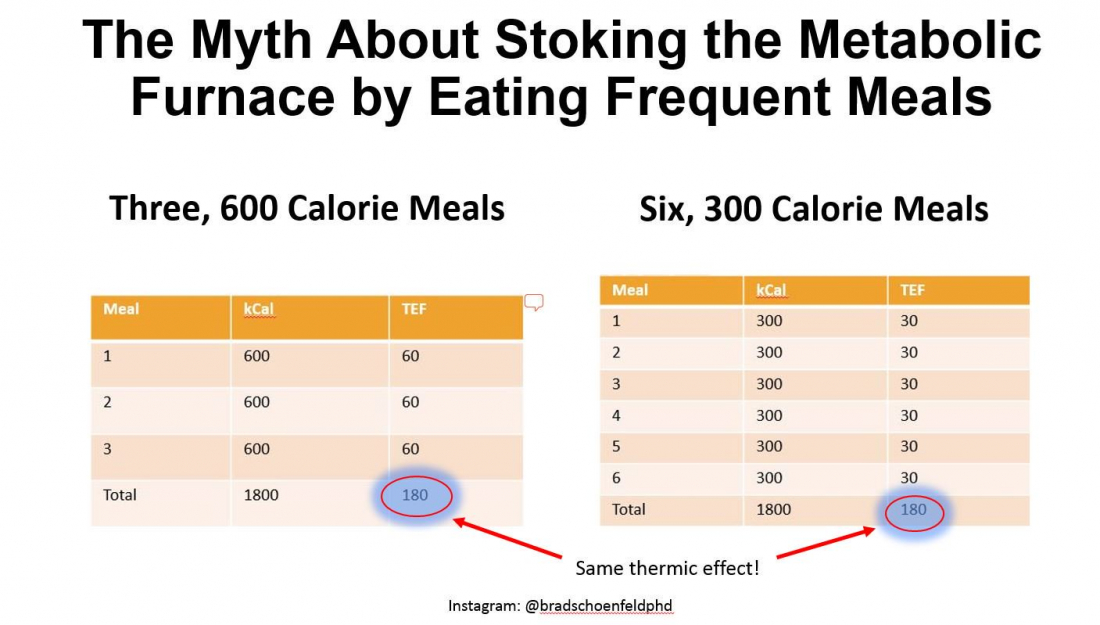
You've certainly heard the recommendation to eat 5-6 times a day. And there's a pretty clear argument for it - eating smaller meals multiple times a day will give you a higher metabolic rate because you practically always have to digest something. But is it really true? Is there any scientific basis for such a claim? It is a fact that digestion increases metabolism slightly. We refer to this phenomenon as the thermic effect of food because every time we eat, our metabolic rate increases slightly due to the digestion of food and the absorption of nutrients. However, it is the total amount of food ingested that determines the amount of energy expended in digestion, not how many meals the intake was spread over, so the claim that high-frequency betting increases metabolic rate cannot be considered to be ceiling valid.
Let's take an example. Consider a woman who has her intake set at 1800 Kcal and the thermal effect (TEF) is let's say 10%. If she eats a 600Kcal meal 3 times a day, the thermic effect will be exactly the same as if she eats 300Kcal 6 times a day. (See figure) Frequency of eating is a frequent subject of studies, but none has yet conclusively confirmed a significant relationship between frequency and metabolic rate, or even between frequency and fat burning.
The main reason for the high frequency approach to fitness is the volume of athletes. This is because top (actually amateur) volume athletes have to consume large amounts of food, and therefore it is easier to spread this intake over six or more meals per day. The idea of more and smaller meals per day has caught on with other nutritionists, and so this theory has begun to find its way into weight loss and healthy eating concepts.
High-frequency eating (supposedly) means a higher metabolic rate and better burning. However, in contrast, there is such a thing as IIFYM, which in turn supports the theory that you only need one or two large meals in which you eat your entire intake. So how is it, does it matter or not? As is good practice in nutrition, you can find thousands of studies that have looked at meal frequency. Whether you eat a low or high frequency diet has no bearing on the state of your metabolism, i.e. how much fat you have. So it seems that if you've heard a statement like "the number of meals a day doesn't matter, eat the way that works for you" recently, it's probably true. In essence, this is indeed true, yet high-frequency eating offers several benefits over low-frequency eating. For example, high-frequency eating positively affects cholesterol levels and has a positive effect on the psyche. It is also claimed that higher frequency offers a feeling of greater satiety - but this statement cannot be considered valid for everyone, some people simply find fewer larger meals more filling.
Another very common argument for eating high frequency is that high frequency eating makes our blood sugar levels more balanced. Eating large meals should lead to more fluctuations in sugar levels than if you spread your intake over multiple servings. But even when it comes to this claim, there are no absolutely clear scientific conclusions to back it up. It may even be quite the opposite. It turns out that people who consume large meals with less frequency have lower blood glucose levels on average. There may be fluctuations, but overall blood sugar levels are lower in people eating low frequency meals. Further, studies show that eating the largest meal of the day in the morning or at the beginning of the day, i.e., breakfast, lowers average daily blood sugar levels.

In addition, it is possible that some people find high-frequency eating completely overwhelming, as they are constantly focused on when they can eat. You could say that in this case, the only solution is actually to cut back on frequency and increase portion sizes. A lot depends on the total daily intake. If your intake is low and you divide it into six portions, then you're left with a really small calorie margin for each portion and therefore not enough food, which is a common problem, especially in the female population. Tiny portions don't fill you up and you're constantly thinking about when the next meal is coming or you tend to overeat. In this case, less frequency really seems to be the ideal solution. Don't divide your daily caloric intake into too many portions unless it is high enough to fill you up. On the contrary, choose meals of maybe four that will keep you eating enough to keep you from being hungry for longer periods of time.
And this brings us to a very debatable question...
TO EAT BREAKFAST OR NOT TO EAT BREAKFAST?
You've probably heard statements like "breakfast is essential" or "those who don't eat breakfast won't lose weight". It is breakfast that is described as the key meal of the day, which starts your metabolism and helps you to lose weight. Indeed, research suggests that people who don't eat breakfast are more likely to be obese than those who do. Yet this is not a causal nexus. Indeed, no result shows that breakfast promotes weight loss, only that breakfast is associated with a lower risk of obesity.

Breakfast is associated with a healthy lifestyle and successful weight loss, but there is really no evidence to suggest that breakfast jump-starts metabolism and is therefore the basis for fat reduction. However, breakfast does have some benefits that your body will appreciate. One of them is the aforementioned regulation of blood sugar levels. A lot of people have a problem with breakfast - they simply aren't hungry or craving it in the morning - it's okay, if you can control your intake for the rest of the day, then breakfast isn't necessary. Breakfast should definitely not be skipped by diabetics.
Nothing is black or white.. and even skipping meals can have its benefits.
One of the main modern approaches to dieting is called intermittent fasting, IFYM, or just IF, which is based on the principle of a "meal window" in which you eat all your intake and fast for the rest of the day. You might think that fasting is bad for the body because it is associated with muscle loss. However, if your intake during the eating window is ENOUGH, this statement is not true.
Studies on short-term fasting show that metabolic rate can actually increase initially, only decreasing after prolonged fasting. In addition, human and animal studies show that intermittent fasting has various health benefits, including improved insulin sensitivity, lower glucose levels, lower insulin levels, and more. There's even evidence that even a 40-hour fast does not lead to muscle loss (unless it's too frequent and followed by adequate intake), so it's safe to say that eating every 2-3 hours is not necessary to maximize muscle growth.
Meal frequency and effect on weight loss
Let's break down in a little more detail whether meal frequency plays a role when trying to lose weight. If you read our articles carefully, you'll know that creating a CALORIC DEFICIT is key to successful weight loss . There we go again, a caloric deficit is key here as well. It's not how many meals you eat in a day that matters, it's the TOTAL CALORIES you take in. So as long as you have the right amount of calories you should ideally be taking in each day, then it doesn't matter if you eat them in one, three, five or eight meals, as we've explained in the previous paragraphs.

How many meals you divide your daily intake into is a completely individual matter. Some people are really comfortable with fewer meals multiple times a day, while others are fine with two large meals. Many people, for example, do not have the space to eat 6 times a day. But that doesn't mean they can't lose weight! The frequency of meals really isn't the key point that is responsible for reducing body fat and therefore overall body composition. Again, the key is setting an optimal caloric deficit. Another important thing to consider when choosing a frequency is your subjective feeling. Some people find it bothersome to eat every 2-3 hours, or it simply doesn't suit them, on the other hand some people find it difficult after only two big meals. Adjust the frequency to suit your body, and your daily routine, job and activities.
Frequency and muscle mass
The concept of high frequency eating can be well observed in professional bodybuilding, for example. A higher frequency of meals, or the protein intake in that meal, is a suitable strategy for muscle growth. And this is not just some mumbo-jumbo, but the results of many studies show it. So we can say that if your goal is to gain muscle mass, a really high frequency diet of 4-5 meals with protein is a much better choice than just 1-2 servings of protein per day.

However, there are of course studies that support that even when it comes to gaining muscle mass, meal frequency is not the key element to focus on (see above and the note about the 40 hour fasting study). Therefore, it is not absolutely necessary to stick to two to three hour intervals for eating.
What to say in conclusion?
As usual, even when it comes to meal frequency, there is no universally valid conclusion that can be applied to everyone. Higher frequency doesn't speed up your metabolism, you don't burn more calories, and if you're uncomfortable with it or don't have the time to do so, there's no need to eat 6 times a day or follow strictly defined intervals between meals. Eat when you are hungry. Make sure your diet is healthy, varied and, once again, remember that it is more important to have a total intake than how many portions you consume.
The important thing is to find a frequency that suits you personally. The number of at least four meals a day is said to be optimal , but it's more important to create a sustainable, long-term, regular regimen. This is what contributes to long-term results in transforming your physique, but also to a better psyche. Whether your eating regime is designed to be 3.5 or 7 meals is really a purely subjective factor. Adapt your eating style based on your specific goals, capabilities, requirements and of course respect the principle of how the body works so that the chosen method does not bring you unnecessary stress and is effective enough.
Resources:
https://www.karger.com/Article/Abstract/95354
https://onlinelibrary.wiley.com/doi/pdf/10.1002/oby.20296
https://www.karger.com/Article/Abstract/95354
https://jissn.biomedcentral.com/track/pdf/10.1186/1550-2783-8-4
https://jissn.biomedcentral.com/articles/10.1186/s12970-018-0215-1
https://www.ncbi.nlm.nih.gov/pubmed/26024494
https://www.ncbi.nlm.nih.gov/pubmed/9155494¨
No posts have been made yet.