





Focus on the glycaemic index. Is it necessary to monitor this number when trying to lose weight, or is it another untelling indicator around which unnecessary "halo" is made?
 Author:
 Glycemic index... A long phrase that commands respect. At one time, it was a big phenomenon (maybe still is?) to check this index during reduction diets, because it is supposedly very important for successful reduction to eat only foods that have a low GI. It sounds logical but later we will find out that monitoring the glycemic index has several shortcomings. It has been leapfrogged (unfortunately) by carbohydrates per se in the scarecrow rankings, followed by gluten, but the glycemic index will be right behind.
WHAT IS THE GLYCEMIC INDEX ANYWAY?
So let's talk about what the glycemic index actually is. The Glycemic Index (GI) was created sometime in the 1980s and its original target users were diabetics. The GI is actually a measure of how quickly blood glucose levels rise after consuming carbohydrates. Blood sugar levels are important to the body, especially in terms of the production of ATP (adenosine tri-phosphate), which as you know is the body's source of energy.
A GI value of 100 is assigned to the glucose reaction. Subsequently, scientists measured and compared individual foods and assigned numbers on a scale. They chose a reference food - let's say white bread - and assigned it a value of 100. If the blood glucose response after eating the test food was, for example, 50% of the reference food, the test sample was given a GI value of 50. The same was true if the food had a GI greater than 100. So 130% = GI 130. So you could basically say that the lower the number a food has, the less blood sugar response it causes when eaten.
So logically, simple sugars have the highest GI, whereas complex carbohydrates should have the lowest. But... There are many factors, such as the amount of fiber, fat, acid, sucrose content, or technical processing in a food that can increase or decrease its glycemic index. The glycemic index is simply a number that indicates the rate at which the carbohydrates in the ingested food are converted into glucose in the digestive tract and enter the bloodstream. Nowhere is it taken into account whether the food is nutritionally rich or, say, a doughnut.
The first problem with the glycemic index is that the glycemic index is a number that indicates the rate at which carbohydrates are converted to glucose and enter the bloodstream only if the food is consumed ONCE and ALONE. But let's face it, would you eat rice alone, pasta alone, or a bagel alone? Rarely. We always have some protein and fat with the carb side dish, which reduces the glycemic response, i.e. the GI of the carb side dish. For example, if you top a slice of rye bread with cheese and some vegetables, there is a significant reduction in glycemic response. Of course, there can also be an increase, for example if we eat riper fruit.
Another factor that influences GI can be your physical condition. Some studies conclude that if the individual being studied is fairly aerobically trained, then there may be less of a glycemic response than individuals who do little or no exercise. Interesting, isn't it? Heat treatment also plays an important role. For example, overcooked pasta has a higher glycemic index than pasta cooked "al dente". The longer and more sparingly cooked, the higher the GI.
How is the glycemic scale divided?
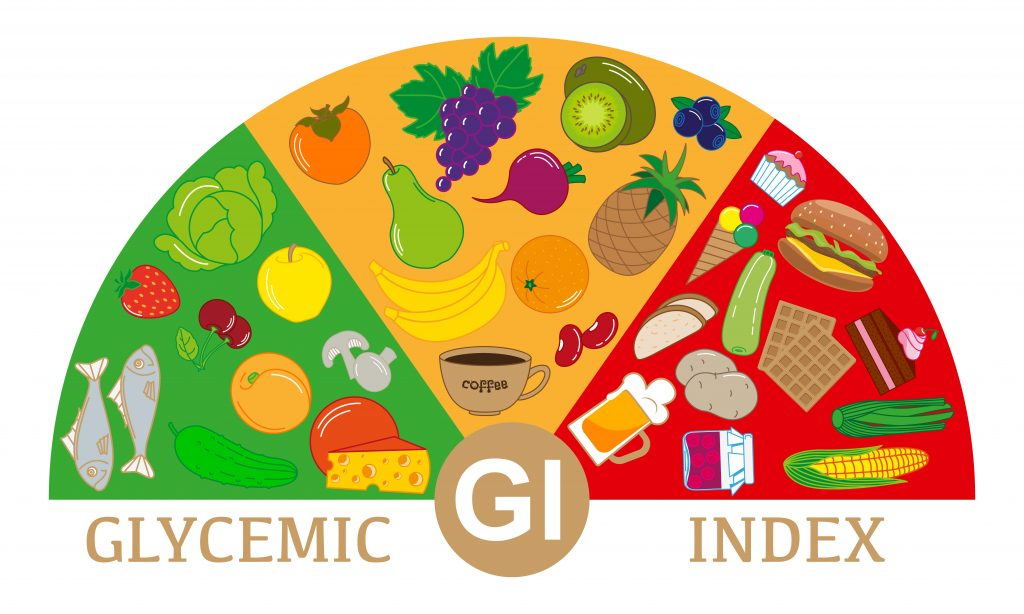
The glycemic scale is divided into three parts.

1) Low GI foods - i.e. GI 55 and below
- Foods in this group are slow to digest, they don't spike blood sugar levels too much. These foods have the greatest satiating effect.
- These include vegetables, some fruits such as strawberries, nuts and legumes for example
2) Foods with a medium GI value - i.e. values of 56-69
- Foods in this group break down slightly faster than the first group and it is advisable to supplement their consumption with some protein to reduce blood sugar spikes.
- This group includes pasta, most fruits, rice, oatmeal, wholemeal bread
3) Foods with high GI values - i.e. values of 70 or more.
- This group of foods will usually cause a rapid spike in blood sugar, followed by an early drop back down. Thus, we can say that hunger comes very soon after eating ONLY high GI foods.
- In this group we find confectionery, bagels, baked potatoes, wafers.
Watching the glycemic index is not enough.
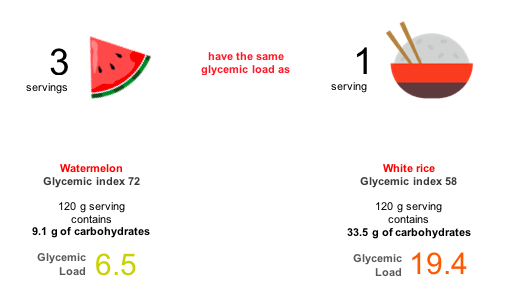
Glycemic index is by no means a decisive factor and very often the so-called GLYCEMIC LOAD (GL) is forgotten. What does this indicator tell us? While the glycaemic index is only a theoretical value, the glycaemic load already tells usquite concretely about the absolute values of the increase in glycaemia after eatingand also about the expected stimulation of the beta cells of the pancreatic islets of Langerhans to release insulin into the bloodstream. For example, watermelon has a GI of 72 and therefore falls into the category of high GI foods i.e. actually "not-quite-appropriate-foods". But watermelon has only about 8g of carbohydrate per 100g and its GL is very low. The final GL value is influenced not only by the nature of the food but also by its processing, the presence of fibre, starch and the type of cooking.
Another important piece of information is that if we take two foods with the same GI, they may not have the same glycemic load because we eat different amounts of each food. To illustrate, take a pair of peppers and garlic - both of these foods have a GI of 10, but you will never eat as much garlic as peppers in a single serving (if you do, hats off and my condolences to your neighborhood :D). Of course, the total amount of food consumed has a big impact on the final glycemic load. In fact, as part of the glycemic load, we look at the amount of carbohydrates in the food in addition to the rate of blood sugar reaction. Thus, one serving of two different foods with the same or similar GI may not represent the same glycaemic load at all.

We can calculate the glycaemic load quite simply using the formula below.
GI = GI × g carbohydrate / 100
For an example calculation, let's take the aforementioned watermelon to show that being a high GI food does not make it a diet demon. 100 g of watermelon with a total carbohydrate content of 8 g has a resulting GN = 5.76 (GI = 72 × 8 g S / 100). And from the scale below, you can see that this is actually perfectly fine.
In discussing this issue, we come to another concept that must not be overlooked, and that is the SYTITUDE INDEX.
From the scale, it would seem that foods with a lower GI are associated with a higher satiety index, i.e. they keep us full for longer. Not quite. For example, foods like rice, boiled potatoes, and bread, which have a high GI, but are also foods with a HIGH satiety index, so tracking only the GI may not be such a good strategy. After all, it's not a rule that if a food has a high GI, it can't be satiating. In fact, potatoes, for example, are one of the foods with the highest satiety index ever, despite having a high GI. And given the low caloric value of potatoes, you can consume quite a large amount and I doubt you'll feel hungry after a serving of potatoes.
The importance of monitoring your glycemic index and trying to lose or maintain weight.
Based on what most people know about the glycemic index there is an idea that it is best to eat foods that are low GI. This idea has arisen from a misunderstanding or general ignorance of the basic concepts of the subject. That is, glycemic index, glycemic load, insulin, and energy balance. We have already explained two of these concepts.
Insulin is a hormone that regulates blood sugar levels - aha, you see where the wind is blowing from, right. It is secreted by the pancreas after a meal and its main role is to transport glucose to the necessary tissues. Insulin is the bogeyman for its negative effect for fat loss. Insulin levels in the blood should be reasonably balanced, with evidence that insulin levels rise (and then fall again, of course) after carbohydrate consumption. Therefore, the theory has arisen that for successful reduction, the oscillation of insulin levels needs to be reduced as much as possible.
But this theory has significant flaws. Insulin secretion is not only caused by carbohydrate-containing foods, but even by protein itself. For example, beef reacts quite strongly to insulin. Therefore, it is clear that insulin alone cannot be the only indicator responsible for fat stores. Moreover, in healthy individuals, insulin does not remain elevated, the problem is diabetics who are insulin deficient and so it is very important for them to control the GI of the food they eat. However, as we have repeated many times, the basis for reduction is to create a calorie deficit.

It is important to remember that the glycemic index is by no means an accurate indicator of how much insulin secretion will occur after consuming a given food. In fact, other macronutrients and micronutrients that we are currently consuming play a large role, so it is indeed true that rather than monitoring the glycemic index of a food, it is much more important to monitor the overall glycemic load of the food consumed.
Even actually the GI of a given food is actually a fairly useless number because EVERY ONE OF US REACTES DIFFERENTLY. Yes, even this number, or reaction, can be considered individual. The Glycemic Index is not a fixed number, but its values fluctuate from individual to individual by as much as a few percent! Therefore, it is not a good practice to use only a table with the distribution of foods according to their glycemic index when composing a diet. As already mentioned, it also depends on the overall composition of the body. Individuals with a higher percentage of muscle mass may take much less account of how food (or GI) affects blood sugar levels.
Let's recap.
In today's article, we explained terms like glycemic index, glycemic load, satiety index, and in simple terms, how insulin works. The fundamental question we were looking to answer was whether it is important to track the glycemic index at all. It makes sense to look at the glycemic index, especially for diabetics who simply must. If you are one of the healthy and active individuals, then there is no reason to pay too much attention to it.

Of course, the diet should consist of mostly unprocessed or minimally processed foods from the category of "healthy food" such as fish, meat, dairy products, cereals, fruits, vegetables, nuts. Conversely, it should contain as little fast food, fried and fatty foods or sweets as possible. The glycemic index is a number that indicates the ORIENTAL rate of reaction after consuming a carbohydrate-containing food ON ITSELF and ON TIME, a case that doesn't happen much in real life.
So if you are focusing on whether you are ingesting mostly low GI foods, then you can drop this concern entirely. In the context of reduction, it is much more important to monitor caloric intake and the ratio of each macronutrient, or to create a negative energy balance so that caloric intake is less than caloric expenditure.
Sources:
https://www.ncbi.nlm.nih.gov/pubmed/17823436
https://www.ncbi.nlm.nih.gov/pubmed/14522732
https://www.ncbi.nlm.nih.gov/pubmed/18167171
http://spectrum.diabetesjournals.org/content/17/3/183
https://www.ncbi.nlm.nih.gov/pubmed/16835599
https://www.ncbi.nlm.nih.gov/pubmed/8604670
https://academic.oup.com/ajcn/article/74/1/96/4739643
No posts have been made yet.








