





Carbohydrate waves - everything you need to know
 Author:
 In the last article, we discussed the general principles of weight loss. In today's article we will focus on one of the methods of weight reduction or body sculpting if you want. That method is the so-called carbohydrate waves. There are many articles on the internet on this topic and many of you have heard of waves, some of you may have even tried them.
As the name implies, it will be a diet where something will happen based on working with carbohydrates or sugars in the food you eat. Let's take another look at what carbohydrates are this time in a little more detail for the sake of argument. I don't want to get into some extensive chemical formulas and detailed descriptions of how carbohydrates work in the body.
For our purpose, the basic division into simple and complex carbohydrates will suffice. The difference between the two is primarily the rate of their absorption into the body. Simple sugars are an immediate source of energy for the body, but if there are too many of them, they are also quickly stored as fat. So these will not be the right carbohydrates for our purpose. This kind of sugar is contained in all the sweets and treats that many of us find it hard to deny ourselves J .
Complex carbohydrates work a little differently. They break down gradually in the body and create a short-term energy supply in the form of glycogen, which is stored in the muscles and liver. Rice, pasta, potatoes these are going to be our main commodities going into the carbohydrate surge.
The principle of this diet is to cycle carbohydrate intake with the goal of reducing subcutaneous fat with minimal loss of muscle mass. In layman's terms ... we take in a different amount each day, thus not giving the body a chance to set itself on some sort of constant regimen. Thus, there is a constant confusion of metabolism. The time period over which we form what is called one wave is one week.
The amount of carbohydrate is given in grams per day, i.e. from waking up to going to sleep. For example, 1 quick-cook bag contains 120g of raw rice = roughly 100g of carbohydrates. It is not necessary to calculate this to the nearest 1g. I would see a tolerance somewhere around +/- 20g of carbs per day. There are handy tables of nutritional values of foods on the internet for these conversions.
The content of these values is always calculated on a raw basis.
You may take this for granted and not need to point it out, but I've really seen too many times where people weigh their food after it's been cooked. Logically, this is nonsense, as I will never cook rice so that it contains the same amount of water, therefore weighing the same. Respectively, I can't always prepare any food the same way, so if I want the most accurate readings, I have to work with raw food weights.
Now let's look at a sample drawing of a one-week wave:
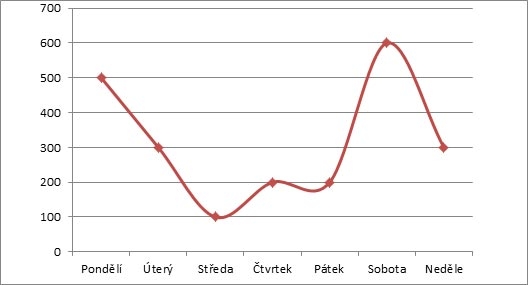
Now, I'm sure a lot of you have thoughts running through your head like "why 500g of carbs on Monday?", "why isn't the wave just going up or down?", etc.
The simple answer: again, it's an individual thing. Again, a lot of factors play a role here such as weight, height, male or female, metabolism, training style, certain habits of those who have already tried a certain way. It's hard to say which way is the best. It is necessary to try and try. Personally, I've tried a number of ways and the one that has worked best for me is the one where there are really bigger jumps from day to day.
If someone takes in 100g of carbs one day, 150g the next day and 200g the third day, the body really doesn't notice it much.
Also, someone might think that if they just stick to a low carb diet, they'll lose fat faster. Wrong!!! This would put us in a state where the body starts to conserve its energy and the weight loss stops.
When determining the wave distribution, it is advisable to base it on how we have put together our training split. In our example, 600g falls on a Saturday, which is already a solid portion of food, so on a day like that it's best to have a day off from training. The muscles will fill up nicely with glycogen from the carbohydrate intake and the body will get some rest at the same time.
Recommended


Amix ThermoCore 2.0


So far, the talk has been all about carbohydrates and their cycling. Of course, this doesn't mean that we don't take in any protein. We'd lose all the hard-built muscle. Generally we follow the rule of thumb that we take in 2g of protein per 1kg of our weight. As a brief reminder, protein sources are: lean meat, dairy products, protein supplements.
Even protein will need to be cycled a bit. On a day when we are around 400-500g carbs, we can stay at that 2g per 1kg with protein. On low carb days we add a little more and vice versa. Dieting is not starvation!
Example of a 500g carb day
1. Breakfast
- 6 pieces of racio bread, 5 eggs (only 1 yolk)
- 49g carbs; 26g protein
2. Snack in the morning I.
- 120g rice
- 98g carbs; 8g protein
3. Morningsnack II.
- 6 pcs racio bread, 250g low-fat cottage cheese
- 58g carbs; 37g protein
4. Lunch
- 250g chicken breast, 120g rice
- 99g carbs; 56g protein
5. Afternoonsnack I.
- 6pcs racio bread, 50g protein supl.
- 51g carbs; 44g protein
6. Afternoonsnack II.
- 120g rice
- 98g carbohydrate; 8g protein
7. Dinner I.
- 250g chicken breast, 5 pieces of racio bread
- 41g carbs; 51g protein
8. Dinner II.
- 50g protein supplement
- 3g carbs; 39g protein
TOTAL = 497g carbs, 268g protein
There is quite a lot of protein, but this is also due to the inclusion of protein from grains (rice) which do not have the full amino acid spectrum. These cannot be taken as complete proteins.
The carbohydrate diet is a several-week affair. It depends on how much we want to carve out and how fast our metabolism is. Optimal weight loss is around 1.5kg per week. Also, we can't count on the fact that if we set up a wave system at the beginning that it will work indefinitely. There will come a time when the weight loss may come close to stopping. Then maybe 100g of carbs can be taken off each day. Where we already have 100g/day, then only 50g can be taken off and after a week we can check the weight again to see whether or not it has had an effect. In the same way, so can the training be adjusted. Add cardio, add training units, etc. The options are countless and everyone has to know their body, what it responds best to.
No posts have been made yet.








