





Volume programme
 Author:
 One of the good things to appreciate about the existence of the internet is the access to literally thousands of workout programs, complete with photos, videos and of course routine descriptions.
While this fact can be great for "information junkies" craving all the "how and why" of strength training, ultimately all this disparate information can lead to true "over-information" that results in an inability to analyze and follow.
Maybe you don't need to draw information in this way. Building muscle, reducing fat stores or increasing strength is actually a pretty simple process, especially if you see the same things around you today and every day. In fact, most good trainers with good information can introduce you to the basics in less time than it would take you to read articles on your favorite site.
Information is fine, provided it helps you reach your goals. If your goal is to build muscle, I can help you see through all the confusing and conflicting opinions in this article.
All the essentials, no frills. Sound good?

Training to build muscle mass
I'm going to walk you through a precisely targeted program that we use every day to gain muscle mass.
That means descriptions of sets, rep ranges, length of breaks, workout splits, and base volume for a program aimed at muscle hypertrophy. All the best we can find for making rapid progress.
Volume phase goals
- Gain muscle mass
- Acceleration of metabolism. Muscle mass requires energy. It's simple, the more muscle you have, the more calories you burn during the day. Furthermore, muscle is metabolically active tissue, the physical place where fat is burned.
- Improving the weak areas of your body. This helps bodybuilders achieve muscle symmetry, which then allows them to excel in competition.
- Helping athletes in contact sports such as American football or rugby, gain volume for greater endurance on the field.
- Build tendon strength and muscle fiber density, for more intense training in the following strength phase.
Average duration of a typical volume phase
- Phase lasts an average of 4-8 weeks, depending on goals and level of training
- The typical pattern is three weeks of heavy training with one week of volume reduction.
- The training routine is repeated 4-6 times and then changed
- Occasionally, after three of the same workouts, only some exercises are changed, while others remain the same. This promotes motivation while subtly changing the way you stimulate your muscles, which is another effective way to spice up your training routine without drastically changing your entire program, specially during periods when your current training program is working well.
Training frequency
- Anything from 3 to 5 workouts per week, depending on your training and capabilities
- Each muscle group is exercised twice a week (if possible)
Repetition range
- The rep range is from 8 to 15.
- Occasionally use higher repetitions, around 20-25 reps or up to 50 reps to increase training volume.
- In the later stages of a volume program for advanced bodybuilders, start using intensification techniques to increase training volume, such as crash sets, rest breaks and forced reps
Number of sets per exercise
- Generally use 3-4 sets per exercise
- Usually increase training volume each week; for example, in this way: week 1 - 3 sets of 8 reps, week 2 - 3 sets of 10 reps, week 3 - 3 sets of 12 reps, week 4 - 3 sets of 14-15 reps
- Other form: week 1 - 3 sets of 8-10 reps, week 2 - 3 sets of 12-15 reps, week 3 - 4 sets of 8-10 reps, week 4 - 4 sets of 12-15 reps
- Also use the pyramid at this stage. For example, week 1 - 8,10,12,14 reps, week 2 - 14,12,10, 8 reps, in the next two weeks repeat the pattern of weeks 1 and 2 with heavier weights.
- You can also use wave weights. For example, week 1 - 10,15,10,15 reps, week 2 - 12,8,12,8 reps, in the next two weeks repeat the pattern of weeks 1 and 2 again with heavier weights.
Total number of sets per batch, workout and week
- Use 12-20 sets per batch per week
- Can be done in one workout, or spread the load over multiple days of the week
- Muscle groups that need to be improved are trained multiple times per week
Repetition rate
In volume training, use a slower tempo to perform negative reps. Lengthen the dumbbell return phase and add an isometric phase as well. As for the concentric phase, perform it as fast as usual.
Breaks
- Shorten the breaks in order to stimulate the hormonal response
- The average break will be 30-60 seconds
- If you use a repetition count above 15, extend the break to 90 seconds
Intensity and volume
- If you are just starting out with the program or are a beginner, always leave a margin for 1-2 reps.
- Keep the intensity from medium to high
- Advanced bodybuilders will use weight for reps to failure, sometimes even more advanced techniques. Occasionally, "old" bodybuilding techniques can be used - perform the maximum reps you can handle and then two more to enhance the hormonal response.
- The hormonal response is dependent on the tension achieved
- Training volume should be as high as possible due to the creation of changes at the cellular level. Volume is increased rapidly during the first three weeks, once neurological changes are established, the exercise style needs to be changed.
- Once a new exercise is involved, high progress is made in the first few weeks due to neuromotor adaptation
- This initial "learning" phase is followed by progress based on morphological changes. Muscle fibres grow.
Training approach
In the volume phase, we use mostly traditional "old" school methods with a large barbell and one-arm dumbbells, supplemented by machines. Isolation exercises may be added. Although free weights are preferred, machines that allow for constant tension throughout the movement can also be used. In the volume phase, we use mostly single sets, not supersets, etc. Supersets are only used when muscle antagonists are involved. If you use unilateral training (training for each half separately in a series), always use simple series.
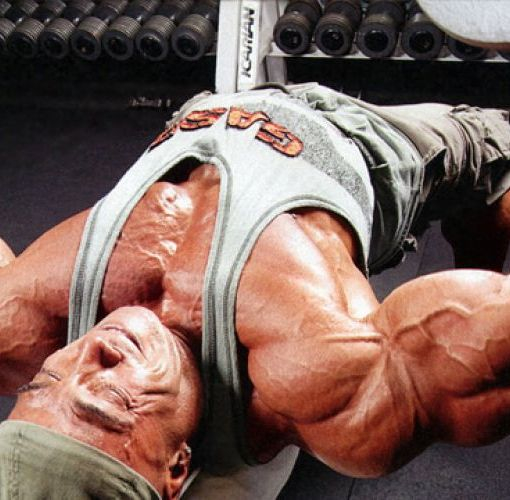
Here are examples of three, four and five day volume workouts. Always keep in mind that volume training is not designed to increase strength. Volume training is only made up to gain muscle mass.
Three-day volume training
Day 1 - Deadlifts
A) Shrugs, 4 x 8-12
B1) Wide pulldowns, 3 x 8-15
B2) Shoulder Shrugs, 3 x 8-15
C) Single arm rowing , 3 x 8-12
D) Rowing machine to waist or higher, 3 x 8-12
E1) Forearm press, 3 x 10-15
E2) Biceps lifts, 3 x 10-15
Day 2
A) Squat, 4 x 10-15
B) Front squat, 3 x 8-12
C) Lunges (each side), 3 x 10-12
D1) Lunges, 3 x 8-12
D2) Front squat, 3 x 8-12
E1) Hyperextensions, 3 x 12-15
E2) Calves, 3 x 12-15
Day 3 - push-ups
A) Bench press with one arm, 4 x 8-12
B) Overhead press, 3 x 8-12
C) Overhead press, 4 x 8-12
D) Push-ups close (hands on ball), 3 x 12-15
E1) Arm raises, 3 x 12-15
E2) Triceps pulley, 3 x 12-15
The five-day volume workout is the same as the three-day volume workout, only the days of the three-day workout are repeated.
Four-day volume training
Day 1 - push/pull
A) Wide pulldown, 4 x 8-12
B) Big dumbbell pull-ups to waist, 4 x 8-12
C) Seated waist pull-ups - narrow, 3 x 8-12
D) Lying push with one arm, 3 x 8-12
E) Seated push-up, 3 x 10-15
F1) Biceps, 3 x 8-12
F2) Forearm press, 3 x 10-15
Day 2 - Legs/Hips
A) Squat, 4 x 10-15
B) Front squat, 3 x 8-12
C) Lunges, 3 x10-12
D1) Lunges, 3 x 8-12
D2) Front squat, 3 x 8-12
E) Calves, 3 x 12-15
Day 3 - push/pull
A) One-arm press, 3x 8-12
B) Overhead press 3x 8-12
C) Single-arm seated press, 3x 10-15
D) Pull pulleys to waist wide, 3x 8-12
E) Pulley pulls close, 4x 8-12
F1) Triceps pulley, 3x 8-12
F2) Sit-ups, 3x 10-15
Day 4- lower back/legs
A) Deadlift, 4x 8-10
B) Bulgarian Squats, 3 x 8-12
C) GHR, 3 x10-12
D1) Hyperextensions, 3 x 12-15
D2) Calves, 3 x 12-15
Training tips and advice
For more practice-oriented training, e.g. in the case of non-bodybuilding athletes, perform some exercises at a lower than recommended intensity.
Include abdominal and corset exercises at the end of all training days.
Caloric intake is essential for success in this phase of training. It is essential to watch your protein, carbohydrate and fat intake. By sufficiently intaking these essential substances you will achieve the potential for building muscle mass and speed up recovery between workouts.
The volume phase involves the use of whey protein, BCAA and creatine.
Summary
Have you ever heard the saying, look out of the hole? We just did the same thing. I gave you the "who", "what", "why", "when", "where" and "how" to build muscle. Now you have all the tools to succeed.
Your only concern is to go to the gym and put the methods into practice.
No posts have been made yet.








